Master linear algebra through the lens of artificial intelligence. Learn vectors, matrices, dot products, eigenvalues, and tensors by seeing exactly how they power neural networks, transformers, embeddings, and other AI systems.
Linear algebra is the mathematical foundation that makes modern AI work, yet most learners encounter it without any connection to the systems they actually want to build. This free intermediate course bridges that gap by teaching vectors, matrices, dot products, eigenvalues, and tensors through the lens of real AI applications. Each concept is grounded in what it actually does inside neural networks, transformers, and embedding models, so the math stops feeling abstract and starts feeling useful.
The course is structured across six modules, moving from the basics of vectors and how they represent language data through word embeddings, to the mechanics of matrix multiplication that power transformer architectures and GPU computation. You will also work through dot products and cosine similarity as they appear in semantic search and recommendation systems, eigenvalues and PCA as they appear in dimensionality reduction, and finally tensors as they flow through a complete deep learning pipeline.
This course is a strong fit for students and self-learners who already have some programming or AI exposure and want to understand the math behind the tools they use. Whether you are studying machine learning, working through an AI project, or aiming to speak more confidently about how these models work, finishing this course and passing the final exam earns you a certificate of completion you can add to your LinkedIn profile or resume. No signup is required to start.
6 modules • 18 lessons
Finish every lesson and pass the final exam to earn this free, shareable certificate.
Certificate of Completion
has successfully completed
18 lessons · Final exam passed

Michail Ouroumis
Founder, FreeAcademy.ai
Sample preview. Your name appears on the certificate when you complete the course. Learn more
The course covers six topics: vectors and word embeddings, matrices and neural network layers, matrix multiplication in transformers, dot products and cosine similarity, eigenvalues and PCA, and tensors in deep learning. Every concept is taught through its direct role in AI systems rather than as standalone math.
Yes, the course is completely free and requires no account to begin. Completing all lessons and passing the final exam earns you a certificate of completion that you can share on LinkedIn or attach to a resume.
The course is labeled intermediate, so some prior exposure to AI or machine learning concepts helps. You do not need a formal math background, but comfort with basic algebra and familiarity with terms like neural networks or embeddings will let you move through the material faster.
Each module ties a math concept to a specific AI application. For example, matrix multiplication is explained through how transformer attention layers work, cosine similarity is shown in the context of semantic search, and PCA is framed as a technique used to compress high-dimensional data in machine learning models.
General linear algebra courses teach the theory without showing you why it matters in practice. This course keeps every concept anchored to AI use cases such as word embeddings, GPU efficiency, and eigendecomposition in model training, so you build intuition that carries over directly to studying or working with AI systems.
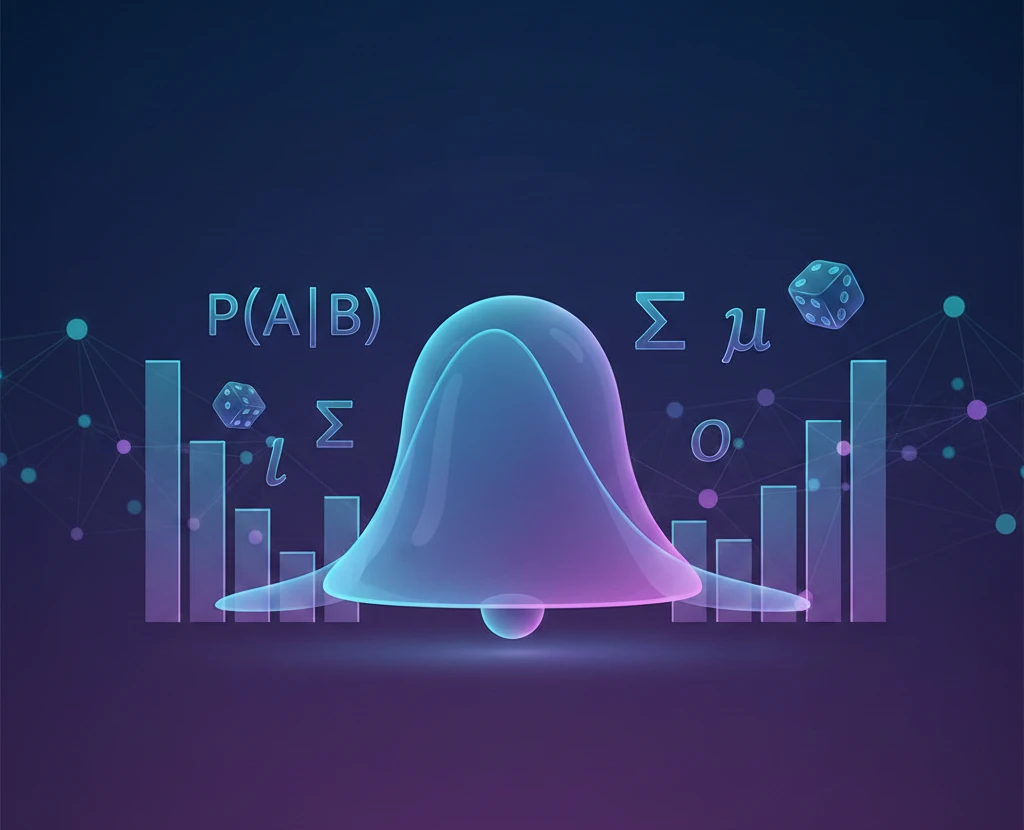
Master the probabilistic foundations of artificial intelligence. Learn probability fundamentals, Bayes' theorem, distributions, expected value, maximum likelihood estimation, and how AI systems handle uncertainty to make predictions.

Master the calculus that powers machine learning. Learn derivatives, partial derivatives, the chain rule, gradients, gradient descent, loss functions, and backpropagation — the essential math behind how models learn.
Master machine learning from the ground up. Learn supervised and unsupervised learning, build models with scikit-learn, and understand the intuition behind algorithms like linear regression, decision trees, and neural networks. Hands-on Python exercises with real datasets.
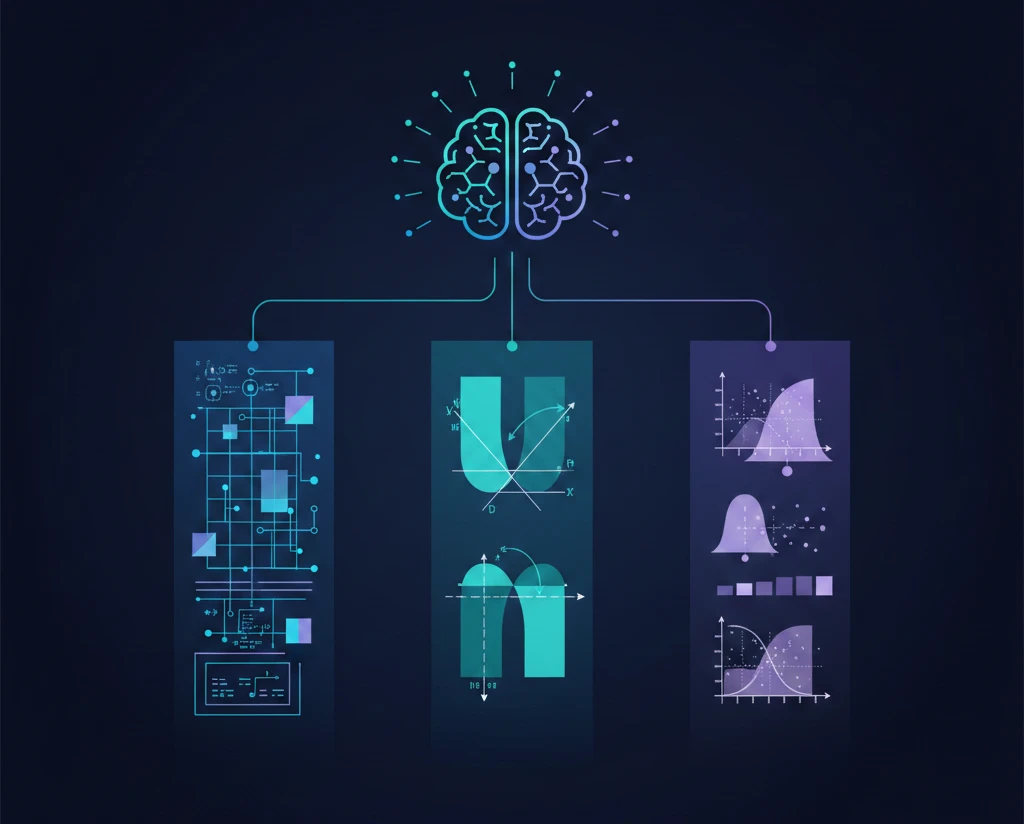
Bridge the gap between AI curiosity and AI understanding. Discover why linear algebra, calculus, and probability are the three pillars of artificial intelligence, see how each one powers real AI systems like neural networks and LLMs, and get a clear learning path to master them all.
Learn to leverage Claude AI for effective code review in 30 minutes. Master prompts for finding bugs, security vulnerabilities, and refactoring suggestions with hands-on practice.
Master database internals, indexing, and schema design for modern AI applications. Learn how SQL databases power production AI systems at TikTok, Uber, and Netflix. Build RAG systems, feature stores, and high-performance pipelines with PostgreSQL and pgvector.