Master the probabilistic foundations of artificial intelligence. Learn probability fundamentals, Bayes' theorem, distributions, expected value, maximum likelihood estimation, and how AI systems handle uncertainty to make predictions.
Probability and statistics are the mathematical backbone of modern AI. This free intermediate course walks you through the core concepts that make machine learning models work, starting from the basics of events and sample spaces, building through conditional probability and independence, and arriving at the techniques AI systems use every day to handle uncertainty and make predictions. You will study Bayes' theorem in depth, seeing how it lets models update their beliefs as new evidence arrives, and explore how probability distributions such as the normal distribution and softmax function shape the outputs of neural networks and large language models.
The second half of the course moves into the statistical machinery behind model training. You will learn what expected value and variance mean in the context of AI predictions, how maximum likelihood estimation drives the learning process, and how loss functions connect theory to optimization. A dedicated module on sampling covers how language models actually pick their next token, including the role of temperature, while the final lessons on evaluation metrics, precision, recall, and confusion matrices give you the tools to measure whether a model is actually performing well.
This course suits students, researchers, and professionals who want to go beyond using AI tools and genuinely understand how probabilistic reasoning shapes the systems underneath. No advanced mathematics background is required beyond basic algebra, but a willingness to engage with formulas and worked examples will help. Complete all lessons and pass the final exam to earn a certificate of completion you can add to your resume or LinkedIn profile.
6 modules • 20 lessons
Finish every lesson and pass the final exam to earn this free, shareable certificate.
Certificate of Completion
has successfully completed
20 lessons · Final exam passed

Michail Ouroumis
Founder, FreeAcademy.ai
Sample preview. Your name appears on the certificate when you complete the course. Learn more
The course covers six modules: probability fundamentals, Bayes' theorem and belief updating, probability distributions, expected value and variance, maximum likelihood estimation, and sampling methods alongside evaluation metrics. Each topic is taught in the context of how AI systems use it, so you see the practical relevance at every step.
Yes, the course is completely free and requires no account to start. If you complete all lessons and pass the final exam, you receive a certificate of completion that you can share on LinkedIn or attach to a job application.
The course is rated intermediate, so some prior exposure to AI or machine learning concepts will help you move faster. You should be comfortable with basic algebra; no calculus or statistics degree is required. If you can read a simple formula and work through a numeric example, you are ready to start.
The course focuses on the mathematical concepts that underpin AI rather than specific software libraries. You will study how softmax and temperature work inside large language models, how MLE and loss functions drive model training, how sampling shapes LLM token selection, and how metrics like precision and recall are used to evaluate classifiers. These ideas apply across frameworks such as PyTorch, TensorFlow, and scikit-learn, even though no single tool is the focus.
Every topic is framed around AI applications. For example, Bayes' theorem is taught alongside its use in AI classifiers, the normal distribution is connected to neural network weight initialization, and variance is explained through the lens of measuring uncertainty in AI predictions. You are not learning statistics in isolation; you are learning why each concept exists inside modern AI systems.
Master linear algebra through the lens of artificial intelligence. Learn vectors, matrices, dot products, eigenvalues, and tensors by seeing exactly how they power neural networks, transformers, embeddings, and other AI systems.
Master machine learning from the ground up. Learn supervised and unsupervised learning, build models with scikit-learn, and understand the intuition behind algorithms like linear regression, decision trees, and neural networks. Hands-on Python exercises with real datasets.

Master the calculus that powers machine learning. Learn derivatives, partial derivatives, the chain rule, gradients, gradient descent, loss functions, and backpropagation — the essential math behind how models learn.
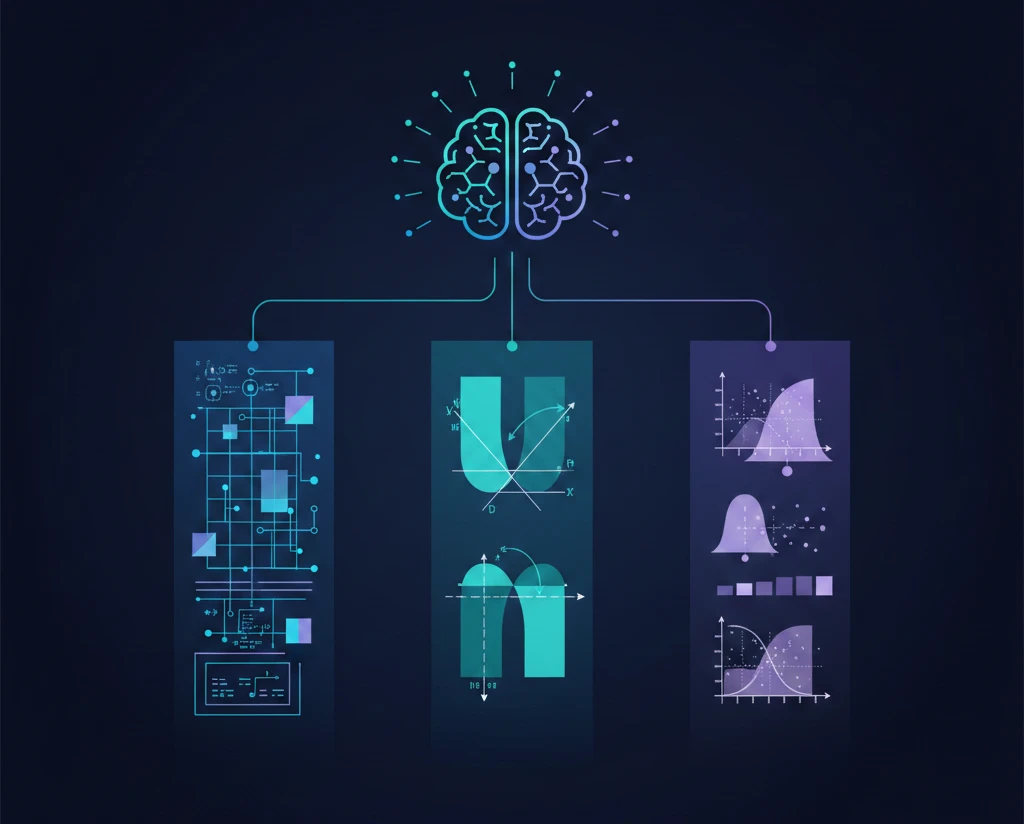
Bridge the gap between AI curiosity and AI understanding. Discover why linear algebra, calculus, and probability are the three pillars of artificial intelligence, see how each one powers real AI systems like neural networks and LLMs, and get a clear learning path to master them all.

Master data visualization using Matplotlib and Seaborn. Learn to create compelling visualizations from basic plots to advanced statistical charts. Practice with real datasets and build visualization skills for data science, analytics, and business reporting.
Master database internals, indexing, and schema design for modern AI applications. Learn how SQL databases power production AI systems at TikTok, Uber, and Netflix. Build RAG systems, feature stores, and high-performance pipelines with PostgreSQL and pgvector.