Go beyond wording a single prompt. Learn to control everything an AI model sees: build a reusable context pack, feed long documents so nothing gets lost, choose between pasting and retrieval, and manage long conversations with clean handoffs. Works with ChatGPT, Claude, Gemini, and any other assistant. No code.
Most advice about getting better results from AI focuses on wording the prompt. But the prompt is only a small part of what the model reads. Every answer also depends on your standing instructions, the files you shared, the whole conversation so far, and anything the tool retrieved in the background. Context engineering is the skill of controlling all of that, and it is often the difference between generic answers and consistently useful ones. This course teaches it in a practical, tool-agnostic way that works with ChatGPT, Claude, Gemini, or any other assistant. You will learn what fills a model's context and why more is not always better, then build a reusable context pack with a clear role, goal, audience, checkable rules, examples, and a definition of done. You will learn how to feed long documents so key details are not lost in the middle, including the extract-then-answer technique, and how to choose between pasting, uploading, and retrieval based on how tools like RAG actually find text. Finally, you will learn why long conversations drift, how to keep them clean, and how to hand off to a fresh chat with a short summary. The capstone has you design a complete context setup for one of your own recurring tasks. No code needed.
2 modules • 5 lessons
Finish every lesson and pass the final exam to earn this free, shareable certificate.
Certificate of Completion
has successfully completed
5 lessons · Final exam passed

Michail Ouroumis
Founder, FreeAcademy.ai
Sample preview. Your name appears on the certificate when you complete the course. Learn more
Context engineering is deciding what an AI model sees when it answers: your standing instructions, background files, conversation history, retrieved documents, and the prompt itself. Prompt engineering focuses on wording one request. Context engineering controls everything around it.
No. Everything in the course works inside normal AI chat tools like ChatGPT, Claude, and Gemini. There is no code.
The prompt engineering courses teach how to word a request well. This course assumes you can write a decent prompt and focuses on the rest: reusable background, long documents, retrieval, and managing long conversations.
No. The techniques are tool-agnostic. The course mentions where features like custom instructions and projects live, and links to tool-specific courses if you want step-by-step setup.
About 45 minutes across five lessons. Each lesson has a quiz, and there is a final exam with a free certificate when you pass.
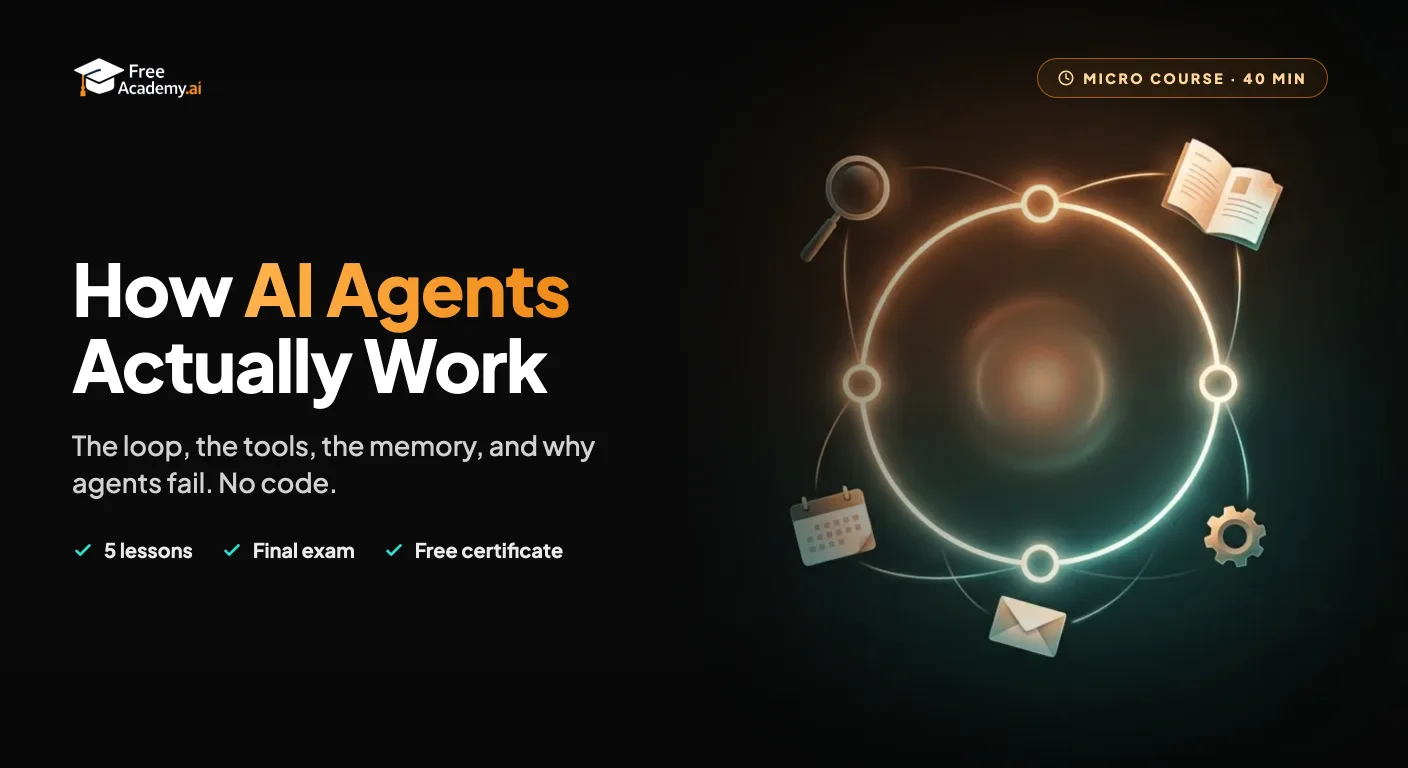
Understand what really happens when an AI agent books, searches, codes, or browses for you. Learn how a chatbot becomes an agent, follow the agent loop step by step through a real trace, see how tools and connectors work, why agents forget, why they fail, and how to judge an agent product before you trust it. No code, no math.
Move beyond writing prompts to engineering them. Build evals and rubrics to measure prompt quality objectively, use AI to write and refine your prompts, get reliable structured outputs, and run optimization loops that cut variance, cost, and latency.

Master Claude's Projects and Artifacts features with hands-on walkthroughs. Learn to set up organized workflows with custom instructions and knowledge files, create interactive artifacts for code, documents, and diagrams, understand the context window, and compare Projects with ChatGPT Custom GPTs.
A short, no-code, no-math explainer of the attention mechanism that powers ChatGPT, Claude, and Gemini. Understand query, key, and value, why models use many attention heads, how word order is encoded, and why transformers read your whole prompt at once.
Find out why ChatGPT, Claude, and Gemini feel helpful, polite, and safe instead of just completing text. A short, no-code course on reinforcement learning, supervised fine-tuning, reward models, PPO and DPO, and the side effects of alignment like sycophancy and reward hacking. The natural next step after How LLMs Actually Work.
Learn the most practical prompt engineering techniques in just 30 minutes. Master the 4-part prompt formula, specificity, iteration, and 5 power techniques that work across all AI tools.