Understand what really happens when an AI agent books, searches, codes, or browses for you. Learn how a chatbot becomes an agent, follow the agent loop step by step through a real trace, see how tools and connectors work, why agents forget, why they fail, and how to judge an agent product before you trust it. No code, no math.
AI agents are everywhere: browsers that click through websites for you, assistants that read your email and draft replies, coding tools that fix bugs on their own. The word gets used for everything, and most explanations are either marketing or code. This short course explains what is really happening inside an agent, in plain language with no code. You will start with the difference between a chatbot and an agent, and the three ingredients that turn a language model into one: a goal, tools, and a loop. Then you will follow the agent loop step by step through a real-style trace, so you can read the "thinking" and "steps" agent products show on screen and spot where things went wrong. You will learn how tools and function calling work, what MCP and connectors are, and why permissions are the most important setting. You will see why agents forget, how context windows fill up during long tasks, and how long-term memory really works. Finally, you will learn the common ways agents fail, from loops and compounding errors to prompt injection, where a person should stay in the loop, and a checklist for judging any agent product before you trust it with real work. It fits well after How LLMs Actually Work, and before building your first agent.
2 modules • 5 lessons
Finish every lesson and pass the final exam to earn this free, shareable certificate.
Certificate of Completion
has successfully completed
5 lessons · Final exam passed

Michail Ouroumis
Founder, FreeAcademy.ai
Sample preview. Your name appears on the certificate when you complete the course. Learn more
No. Everything is explained in plain language with examples and a step-by-step trace. There is no code anywhere in the course.
A chatbot writes one reply to your message and waits. An agent takes a goal and works through several steps on its own, using tools like web search, files, or email, checking results as it goes until the goal is done.
Not directly. It explains how agents work so you can use, judge, and set them up safely. If you want to build one afterward, Build Your First AI Agent in 30 Minutes is a short hands-on next step.
No. The ideas apply to any agent, including browser agents, coding agents, and assistants connected to your apps. Understanding the common loop, tools, and limits helps you with whichever product you use.
About 40 minutes across five short lessons. Each lesson has a quiz, and there is a final exam with a free certificate when you pass.
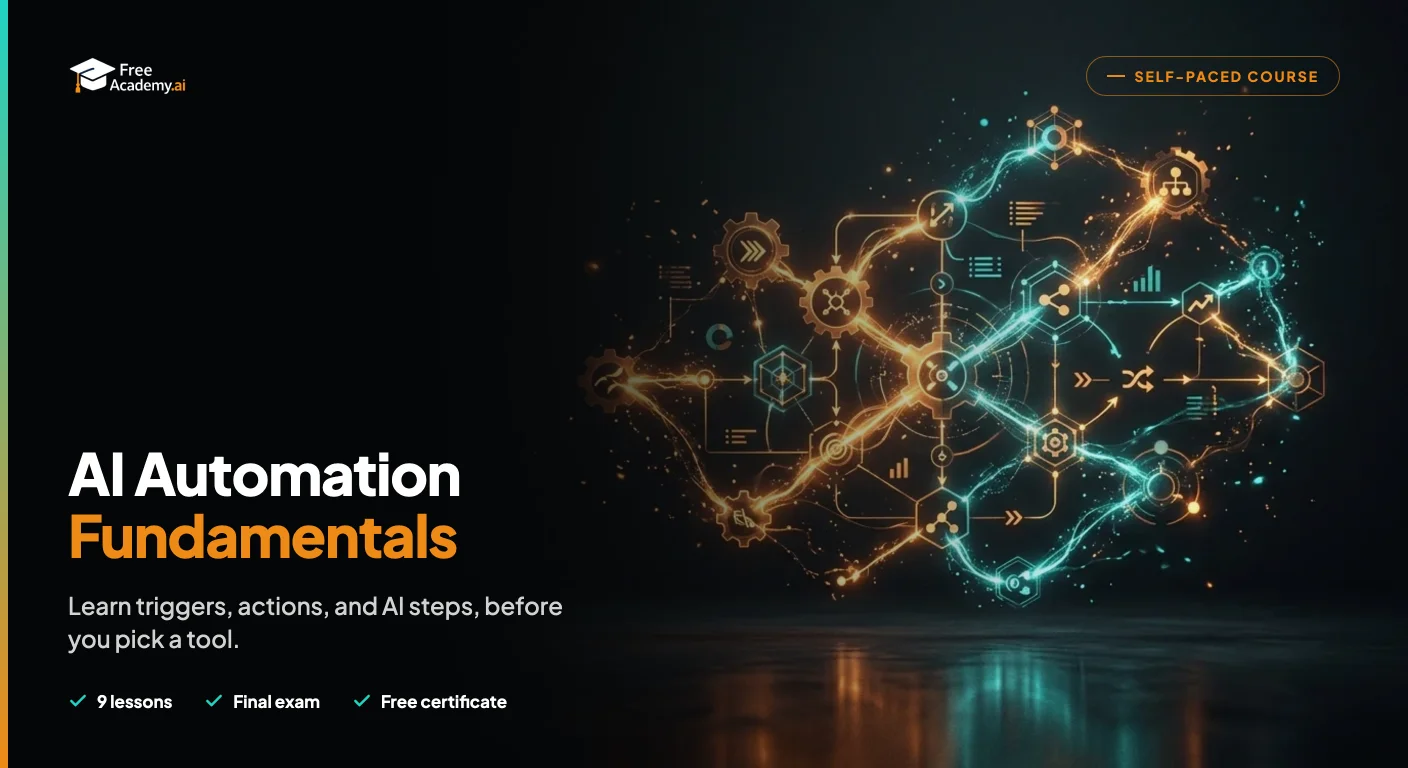
Understand how AI automation works before you commit to a tool. Learn triggers, actions, and workflows, add AI models like ChatGPT and Claude to your automations, compare Zapier, Make, and n8n, and design your first reliable automation without writing code.
A practical, no-code guide to the new class of AI browsers and computer-use agents that browse and act on your behalf. Learn how they work, compare ChatGPT's browsing agent, Perplexity Comet, and Gemini in Chrome, run real research and automation workflows, steer them safely, and defend against prompt injection and data exposure. Earn a free certificate.
Build a working AI agent from scratch in Python. Learn the think-act-observe loop, call an LLM, give your agent a tool it can use, and handle a failed tool call. Framework-agnostic and beginner-friendly.
Find out why ChatGPT, Claude, and Gemini feel helpful, polite, and safe instead of just completing text. A short, no-code course on reinforcement learning, supervised fine-tuning, reward models, PPO and DPO, and the side effects of alignment like sycophancy and reward hacking. The natural next step after How LLMs Actually Work.
Finally see how AI, machine learning, deep learning, and generative AI fit together. Learn where rules end and learning begins, what the "deep" in deep learning actually changes, when simpler machine learning still wins, and how to place any real product on the map. No code, no math.
Understand how tools like Midjourney, DALL-E, and Stable Diffusion actually generate an image, in plain language with no code and no math. Learn what a diffusion model is, how starting from noise leads to a finished picture, what latent space is, how your prompt steers the process, and why diffusion beat older methods like GANs.