Last updated
Learn the idea behind AI search, recommendations, and "chat with your documents" tools. See how embeddings turn meaning into numbers, why close means related, how semantic search beats keyword search, where embeddings show up in everyday apps, why document search sometimes misses, and how to judge tools built on it. No code, no math.
Search boxes that understand what you mean, music apps that suggest songs you end up loving, photo libraries you can search by typing a description, and tools that let you chat with your documents all rely on one idea: embeddings. This short course explains that idea in plain language, with no code and no math. You will learn how an embedding turns a sentence, image, or song into a list of numbers that captures its meaning, using the picture of a map where similar meanings sit close together. You will see how AI measures similarity, why close means related but not necessarily correct, and how nearest-neighbour search and vector databases turn that into fast search. Then you will compare semantic search with classic keyword search and see why the best systems combine both, and explore everyday uses such as recommendations, duplicate detection, grouping feedback into themes, and searching images with text. The second half looks at embeddings inside document Q&A tools: how documents are chunked and embedded, why the search step sometimes misses the right passage, and how builders improve it. You will finish with a 20-minute test plan and a privacy checklist for judging any chat-with-your-documents tool before you trust it with real files.
2 modules • 5 lessons
Finish every lesson and pass the final exam to earn this free, shareable certificate.
Certificate of Completion
has successfully completed
5 lessons · Final exam passed

Michail Ouroumis
Founder, FreeAcademy.ai
Sample preview. Your name appears on the certificate when you complete the course. Learn more
Teaching a class or training a team? Assign this course for free
An embedding is a list of numbers that represents the meaning of a piece of content, like a sentence, image, or song. Similar meanings get similar numbers, which lets computers search, compare, and recommend by meaning instead of exact words.
No. The course uses a simple map picture and everyday examples. There is no code and no math notation.
That course is for developers who want to build with vector databases. This course explains the ideas behind embeddings and search for anyone who uses AI tools, with no code.
Yes. You will learn why these tools sometimes miss or invent details, how to ask questions that retrieve the right passages, and how to test a tool before trusting it with real files.
About 40 minutes across five short lessons. Each lesson has a quiz, and there is a final exam with a free certificate when you pass.
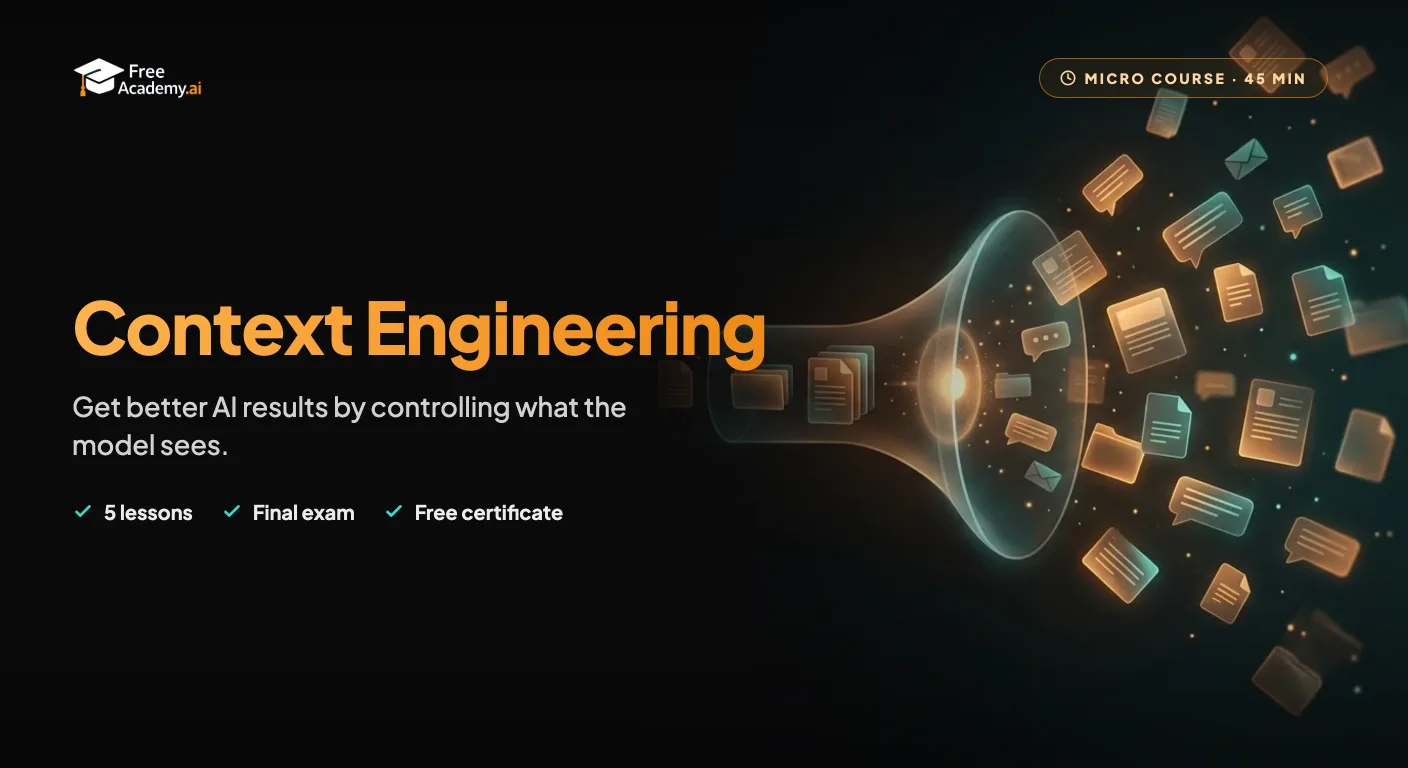
Go beyond wording a single prompt. Learn to control everything an AI model sees: build a reusable context pack, feed long documents so nothing gets lost, choose between pasting and retrieval, and manage long conversations with clean handoffs. Works with ChatGPT, Claude, Gemini, and any other assistant. No code.
Build a private, offline knowledge base over your own notes and PDFs using a local AI model. A hands-on beginner micro course: run a model with Ollama, turn documents into embeddings, store them in a local Chroma database, and ask questions answered from your own files. No cloud APIs, no fees, your data stays on your machine. Want to deploy it as a web app instead? See the Full-Stack RAG course (/courses/fullstack-rag-nextjs-supabase-gemini).
Master vector databases for AI applications. Learn embeddings, similarity search, and hands-on setup of Pinecone, pgvector, and Chroma. Understand indexing strategies, hybrid search, performance optimization, and how to choose the right database for your use case.
Understand what really happens when an AI agent books, searches, codes, or browses for you. Learn how a chatbot becomes an agent, follow the agent loop step by step through a real trace, see how tools and connectors work, why agents forget, why they fail, and how to judge an agent product before you trust it. No code, no math.
Learn what physically happens when AI runs. See which parts of a computer matter for AI, why GPUs and AI chips took over, why memory is the real limit on model size and speed, how quantization shrinks models, and what goes on inside the data centers that train and serve them. No code, no math.
Some AI models pause to "think" before they answer. Learn what reasoning models actually do, why thinking step by step helps, how models are trained to reason, when a reasoning model is worth the extra time and cost, how to prompt one well, and where their thinking still goes wrong. No code, no math.