

Gemini 4 Hydrogen vs Carbon vs Argon: Which Model to Use (and Which Is Free)

Gemini 4 Hydrogen is the model most people should use, and it is the one free users get. Carbon is Google's strongest model, but you need Google AI Ultra or the paid API to use it. Argon came first and still works in the API, but Google no longer lists it on its consumer plans page.
Google released all three in about six weeks. Argon reached the Gemini app on October 13, 2026, Carbon opened to paid users on November 10, and Hydrogen arrived on November 12. A fourth model, Neon, followed on November 18. This guide covers what each model is, who can use it, the limits, the prices, and which one to pick.
The Short Answer
- Use Hydrogen for almost everything: chat, homework help, writing, everyday coding. It is free in the Gemini app and has a free tier in the API.
- Use Carbon for the hardest work: long coding projects, research, or tasks with many steps. It needs Google AI Ultra or the paid API.
- Use Argon only if your app is already built on it. It costs the same as Carbon in the API, and Google says Hydrogen scores a little higher on a common benchmark.
Gemini 4 Hydrogen vs Carbon vs Argon at a Glance
| Gemini 4 Hydrogen | Gemini 4 Carbon | Gemini 4 Argon | |
|---|---|---|---|
| What it is for | Fast, everyday coding and agent work | Google's strongest model, for the hardest tasks | Frontier model for complex work |
| Out since | November 12, 2026 | November 10, 2026 (paid users) | October 13, 2026 |
| Free in the Gemini app | Yes, through auto model selection | No | No |
| Gemini app plans | Free (auto), Plus, Pro, Ultra | Ultra | Not listed on the plans page now |
| API free tier | Yes | No | No |
| API price per 1M tokens (input / output) | $1.50 / $7.50 | $2 / $10, then $4 / $20 from Dec 1, 2026 | $2 / $10, then $4 / $20 from Dec 1, 2026 |
| Context window | 1M tokens | 1M tokens | 1M tokens |
| Default thinking level | High (adds an extra-high level) | Medium | Medium |
| API model ID | gemini-4-hydrogen | gemini-4-carbon | gemini-4-argon |
Sources: Google's Hydrogen, Carbon and Argon launch posts, the Gemini API pricing page, the Google AI plans page and the Google Cloud Gemini 4 docs, all checked November 21, 2026.
Gemini 4 Hydrogen: The Fast One You Get for Free
Google calls Hydrogen its "daily driver for agentic workflows." It is built for speed and low cost. Google's model card says it was adapted from Carbon, so it is a smaller, faster version of the strongest model, not a separate older design.
Who gets it:
- Free Gemini app users. Google says free users get Hydrogen through auto model selection, when it is the right model for the prompt. You do not always pick it yourself, and not every prompt goes to it.
- Google AI Plus, Pro and Ultra. Hydrogen is in the model menu.
- Google Search. Google says Search answers now use Hydrogen for all users.
- Developers. Hydrogen is in the Gemini API and Google AI Studio, with a free tier. Pro and Ultra subscribers can also use it in Google Antigravity, Google's coding tool.
How good is it? Google reports that Hydrogen scores 51 on the Artificial Analysis Intelligence Index at its default setting, against 50 for Argon. At its new extra-high thinking level it reaches 54. These are Google's own numbers from its launch post.
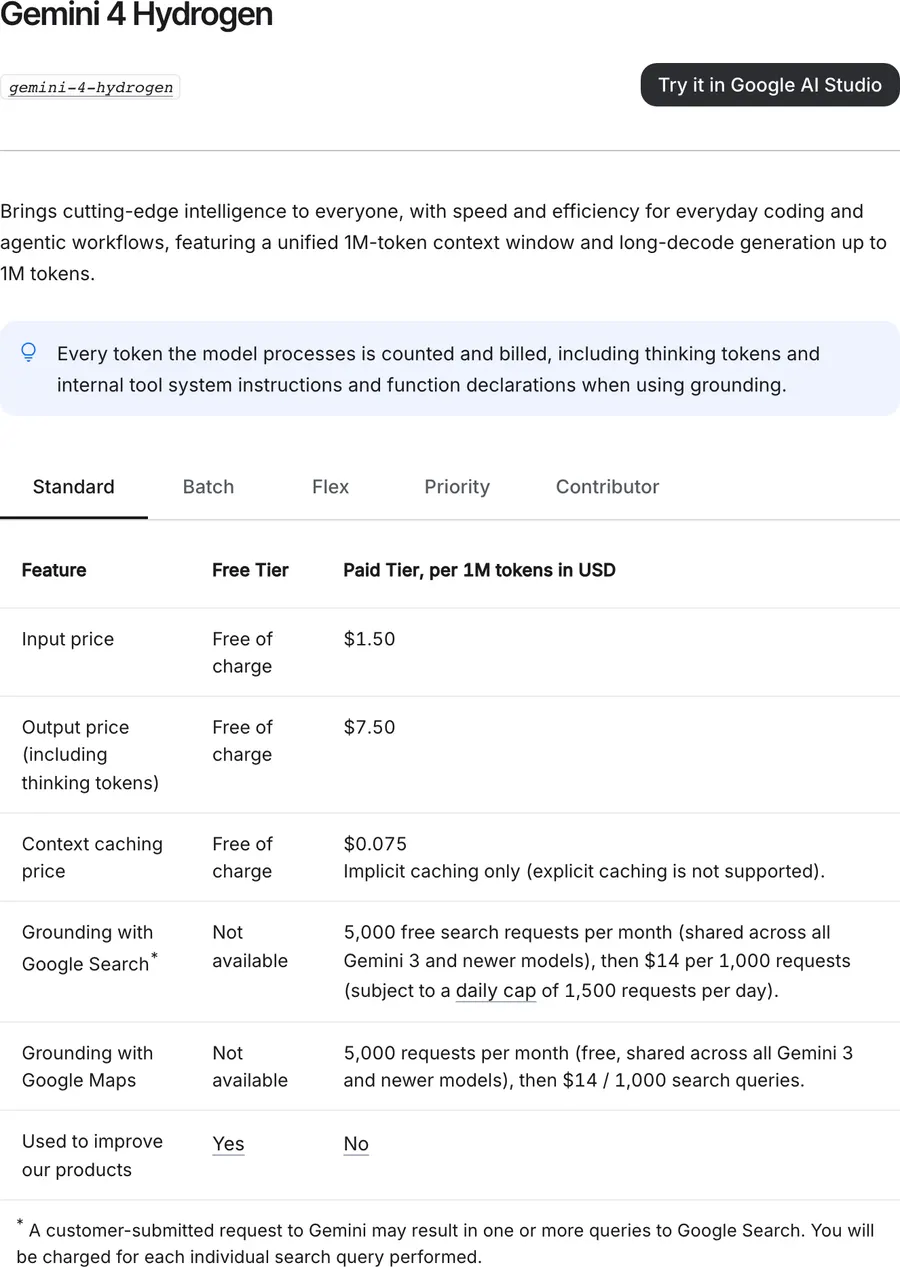
Gemini 4 Hydrogen API pricing, standard tier. Source: Google AI Studio pricing, captured November 21, 2026.
Gemini 4 Carbon: The Strongest, for Ultra and Paid API Users
Google calls Carbon its strongest model so far. It is aimed at the hardest work: long coding and debugging jobs, open-ended science, and cyber security. Google says Carbon uses more tokens than Argon, because it spends more time checking its work.
Who gets it:
- Google AI Ultra subscribers, in the Gemini app, AI Mode in Search, and Google Antigravity.
- Paying developers and businesses, through the Gemini API, Google AI Studio and Gemini for business. There is no free API tier.
- Some scientists, who can apply for 6 months of free access. Google picks people based on eligibility and capacity.
- Cyber defenders, through Google's Fairwind Program. This is how Carbon first launched on October 28, before it opened to paid users.
If you read our Gemini 4 Carbon vs Claude Opus 5.5 comparison when it came out, note that access has changed since. Carbon was limited to the Fairwind Program then. Now Ultra subscribers and paying developers can use it.
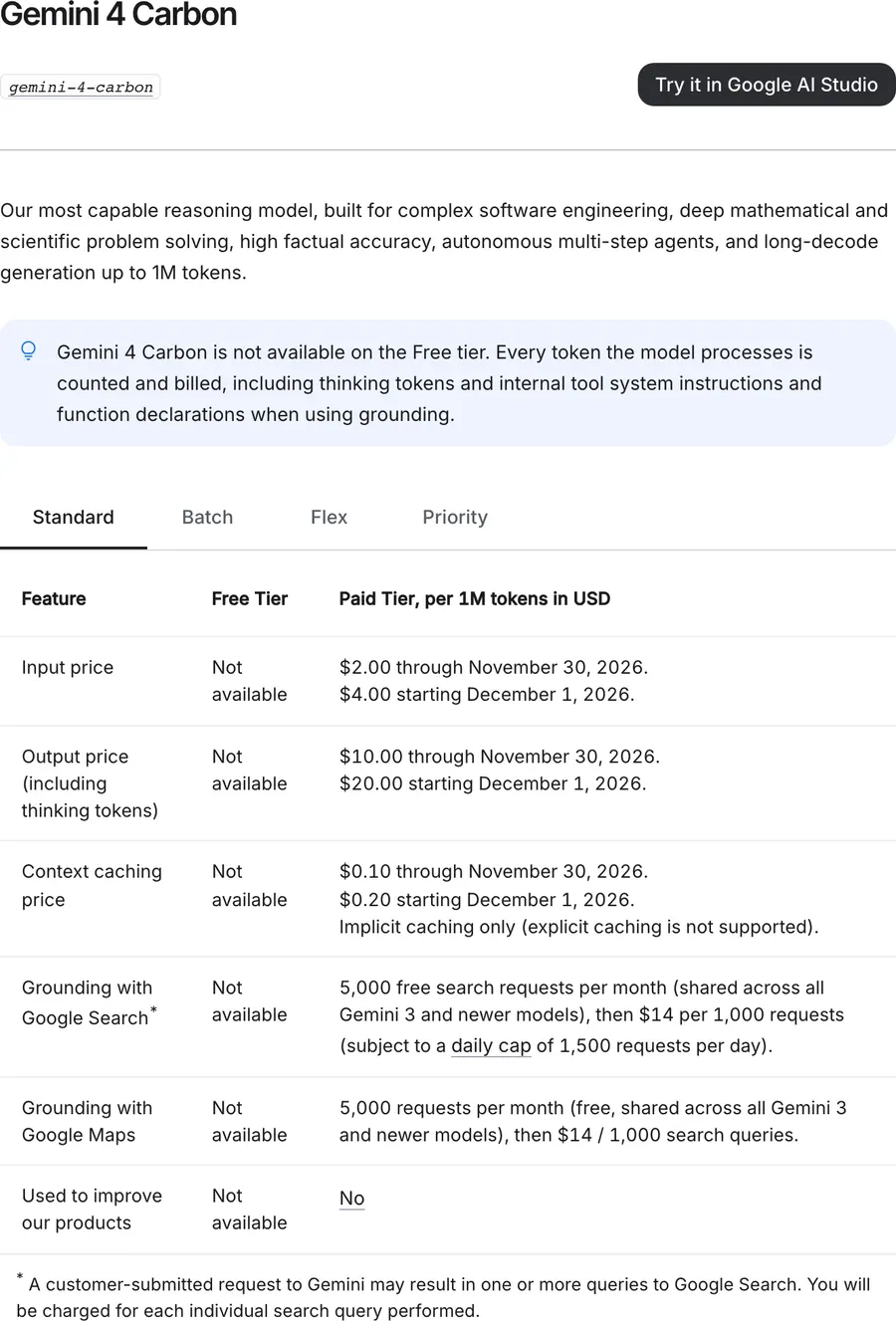
Gemini 4 Carbon API pricing, standard tier. Argon has the same prices. Source: Google AI Studio pricing, captured November 21, 2026.
Gemini 4 Argon: The First Gemini 4 Model
Argon was the first Gemini 4 model. Google announced it on September 30, 2026, and opened it to the Gemini API and to Google AI Pro and Ultra subscribers on October 13. Google describes Argon and Carbon with the same words: a frontier model for "deep work in complex, real-world tasks."
When Carbon came out on November 10, Google said Argon "remains the ideal choice for the majority of software engineering and knowledge work." Since then, two things changed:
- Hydrogen arrived. It costs less and, by Google's own numbers, scores one point higher on the Artificial Analysis Intelligence Index.
- Neon arrived. Google's plans page now lists Neon and Hydrogen for Google AI Pro, and Carbon, Neon and Hydrogen for Ultra. Argon is not on the page anymore.
Argon is still in the Gemini API, at the same price as Carbon. If you built an app on Argon, it still works. Plan for the price change on December 1.
What About Gemini 4 Neon?
Neon is the fourth Gemini 4 model. It came out on November 18, 2026. Google places it between the two: Carbon for the hardest long projects, Hydrogen for fast everyday work, and Neon as a balance of depth and speed.
Neon is in the Gemini app for Pro and Ultra subscribers and on the paid API tier. It costs $3 per million input tokens and $15 per million output tokens. There is no free tier.
Gemini App Limits by Plan
Google does not publish a fixed number of prompts per day. Its help page gives limits as multiples of the free plan, and says limits refresh every 5 hours until you reach a weekly cap. When paid users hit the cap, they can keep going with Flash-Lite, Google's lightest model.
| Plan | Price per month | Gemini 4 models in the app | Usage limit | Context window |
|---|---|---|---|---|
| Free | $0 | Hydrogen through auto model selection | Standard | 32k tokens |
| Google AI Plus | $4.99 | Hydrogen | 2x standard | 128k tokens |
| Google AI Pro | $19.99 | Neon, Hydrogen | 4x standard | 1M tokens |
| Google AI Ultra | From $99.99 ($199.99 for the higher limit) | Carbon, Neon, Hydrogen (highest access) | 5x or 20x the Pro limit | 1M tokens |
Prices are from Google's plans page and can be different where you live. Limits are from the Gemini Apps limits help page. To see your own usage, open Gemini, go to Settings, then Usage Limits.
For a full look at what each paid plan adds beyond models, such as storage and video tools, see Gemini Free vs Google AI Pro vs Ultra.
API Limits and Prices
All three models share the same size limits in Google's docs:
- Context window: 1,048,576 tokens, shared by input and output.
- Output per request: 65,536 tokens by default. A "long decode" mode can go up to 1M tokens minus the input.
- Billing: every token counts, including thinking tokens.
| Price per 1M tokens | Hydrogen | Carbon | Argon | Neon |
|---|---|---|---|---|
| Input | $1.50 | $2, then $4 from Dec 1 | $2, then $4 from Dec 1 | $3 |
| Output | $7.50 | $10, then $20 from Dec 1 | $10, then $20 from Dec 1 | $15 |
| Batch input / output | $0.75 / $3.75 | $1 / $5, then $2 / $10 | $1 / $5, then $2 / $10 | $1.50 / $7.50 |
| Free tier | Yes | No | No | No |
Google does not print free tier rate limits for Hydrogen on its rate limits page. It says you can see them in Google AI Studio.
One thing to notice: after December 1, Carbon and Argon cost more than Neon. Until then, they cost less.
Which Gemini 4 Model Should You Use?
Use Hydrogen if:
- You use the free Gemini app. You already get it on many prompts.
- You are a student or learner who wants help with studying, writing or small coding tasks.
- You are building an app and want the free API tier to test ideas.
- You need fast answers at low cost.
Use Carbon if:
- You have Google AI Ultra or a paid API account.
- The task is long and hard, like a big coding project, deep research, or an agent that runs many steps.
- A wrong answer costs you more than the extra tokens.
Use Argon if:
- Your app already runs on Argon and works well.
- Even then, test Hydrogen and Neon on your own tasks before December 1, when Argon's price doubles.
Benchmarks only tell you part of the story. Run the same few real tasks through two models and compare the answers yourself.
Key Takeaways
- Hydrogen is the fast, cheap Gemini 4 model. Free users get it through auto model selection, and it is the only Gemini 4 model with a free API tier.
- Carbon is Google's strongest model. It needs Google AI Ultra or the paid API.
- Argon was first. It is still in the API but no longer on Google's consumer plans page, where Neon now sits for Pro users.
- Carbon and Argon API prices double on December 1, 2026, from $2 / $10 to $4 / $20 per million tokens.
A better model helps, but a clear prompt helps more. Learn how to get good answers from any Gemini model in our free Google Gemini Mastery course, with a certificate at the end. To see how Gemini compares with other assistants, take the free ChatGPT vs Claude vs Gemini course or read Gemini vs ChatGPT.
Enjoyed this article?
Join The FreeAcademy Weekly
One practical AI email every Tuesday. New free courses, AI tips, and a short note from the founder.
Free forever. Unsubscribe anytime.
Related articles
Gemini 4 Carbon vs Claude Opus 5.5: Benchmarks, Price, and Which to Use
Gemini 4 Carbon edges Claude Opus 5.5 by one point on the Artificial Analysis Intelligence Index. Here are the benchmarks, prices, and which one you can use today.
Gemini Free vs Google AI Pro vs Ultra: Is Google AI Pro Worth It in 2026?
Is Google AI Pro worth it? Compare Gemini Free, Google AI Plus, Pro (formerly Gemini Advanced) and Ultra, with prices and the October 2026 changes.
Gemini vs ChatGPT (2026): Plans, Limits and Which to Pick
Gemini vs ChatGPT compared: both main plans cost about $20, but free plans, models and strengths differ. Prices, limits, and which one fits your work.