

Gemini 4 Carbon vs Claude Opus 5.5: Benchmarks, Price, and Which to Use

Gemini 4 Carbon is a little smarter than Claude Opus 5.5 on paper, but you probably cannot use it yet. Carbon leads by one point on the main independent leaderboard, while Opus 5.5 is the one you can open in Claude today.
Google announced Gemini 4 Carbon on October 28, 2026, and called it its strongest model. Anthropic released Claude Opus 5.5 on September 22, 2026. This guide puts the two side by side: benchmarks, price, access, and which one to pick for coding, writing, and research.
The Short Answer
- Pick Claude Opus 5.5 if you need a top model now. It is in the Claude apps on paid plans and in the API.
- Watch Gemini 4 Carbon if you work on security, long documents, or agents. It scores higher on most tests, and its intro API price is half of Opus.
- The gap is small. One point on a 100-point index is not something most people will notice in daily work.
Gemini 4 Carbon vs Claude Opus 5.5 at a Glance
| Gemini 4 Carbon | Claude Opus 5.5 | |
|---|---|---|
| Made by | Anthropic | |
| Announced | October 28, 2026 | September 22, 2026 |
| Who can use it | Selected cyber defenders and partners (Fairwind Program) | Claude Pro, Max, Ultra, Team, Enterprise, plus the API |
| AA Intelligence Index v5.0.1 | 60 | 59 |
| API price (per 1M tokens) | $2 in / $10 out at launch, then $4 / $20 | $4 in / $20 out |
| Context window | 1M tokens (per Artificial Analysis) | 1M tokens |
| Input types | Text, image, speech, video (per Artificial Analysis) | Text, image |
| Cost per AA index task | $7.76 | $10.04 |
Prices and scores were checked on November 4, 2026. Both can change, so check the source pages before you spend money.
Benchmarks: What Google Says
Google's launch post compares Carbon with its own Gemini 4 Argon, OpenAI's GPT-6 Astra, and Anthropic's Claude Opus 5.5 and Fable 5.1. Here is the table as Google published it.
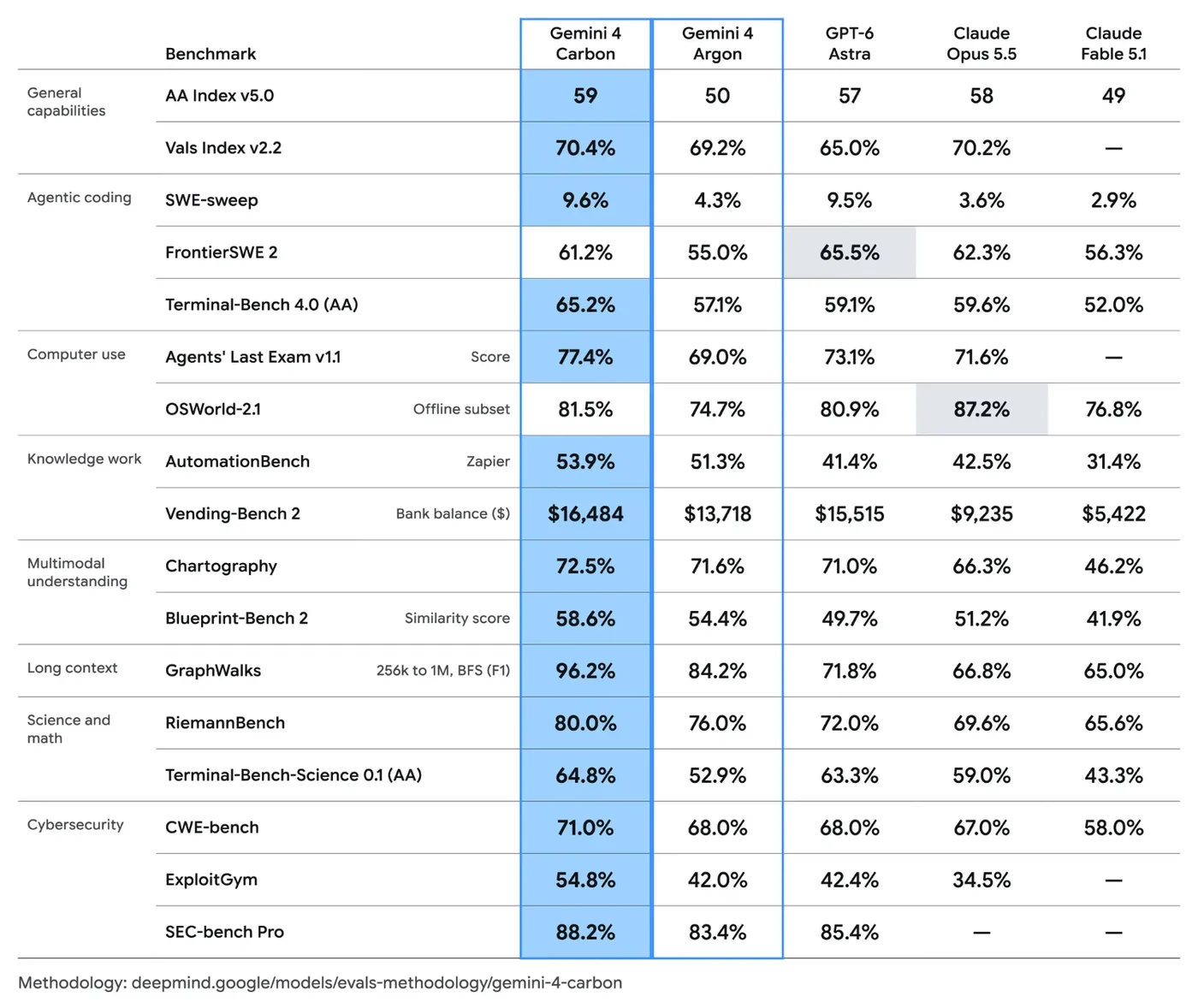
Google's own benchmark table for Gemini 4 Carbon. Highlighted cells are the best score in each row. Source: Google, "Gemini 4 Carbon: our next frontier model", captured November 4, 2026.
A few things stand out:
- Carbon wins most rows. Google marks Carbon as the best model on 15 of the 17 tests in its table.
- Opus 5.5 wins computer use. On OSWorld-2.1, Opus scores 87.2% and Carbon scores 81.5%.
- GPT-6 Astra wins FrontierSWE 2. Neither Carbon (61.2%) nor Opus (62.3%) is first there. Opus is ahead of Carbon on this one.
- The biggest gap is long context. On GraphWalks (256k to 1M tokens), Google reports 96.2% for Carbon and 66.8% for Opus.
Keep in mind these are Google's numbers, picked and run by Google. That is why the independent scores below matter more.
Benchmarks: What Artificial Analysis Measured
Artificial Analysis runs the same tests on every model and combines them into one Intelligence Index. Its terms do not allow us to copy its charts, so we rebuilt its numbers in our own chart.
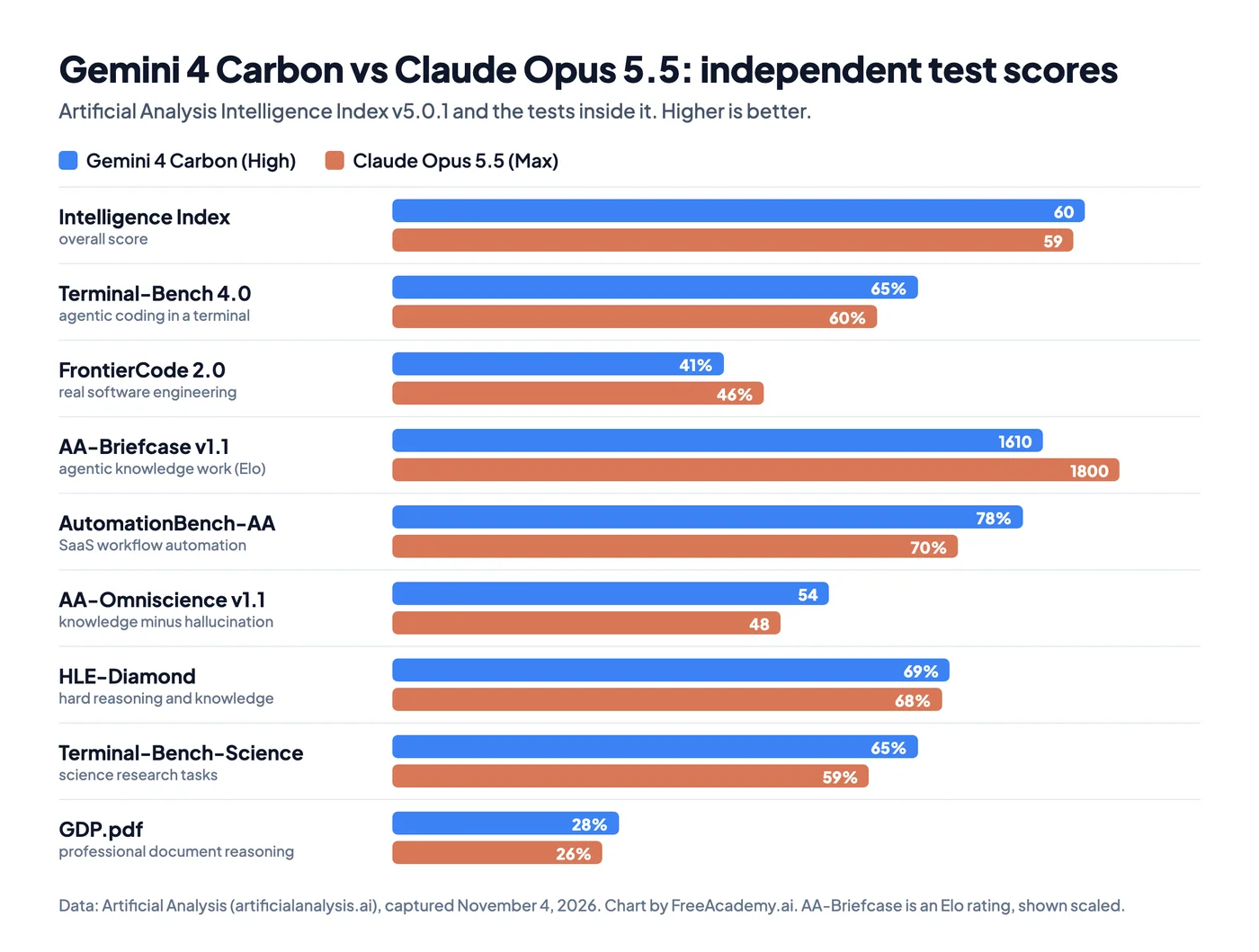
Gemini 4 Carbon (High) vs Claude Opus 5.5 (Max) on the tests inside the Artificial Analysis Intelligence Index v5.0.1. Chart by FreeAcademy.ai. Data: Artificial Analysis model comparison, captured November 4, 2026.
What the independent numbers say:
- Carbon leads overall, 60 to 59. At launch Google quoted 59 vs 58 on index v5.0. Artificial Analysis has since moved to v5.0.1, and the one-point gap stayed the same.
- Opus 5.5 wins two tests. It scores 46% vs 41% on FrontierCode 2.0 (real software engineering in open-source repos) and 1800 vs 1610 Elo on AA-Briefcase (agentic knowledge work like research briefs).
- Carbon wins the rest, including Terminal-Bench 4.0, AutomationBench, and science tasks.
- Carbon is cheaper per task. Artificial Analysis puts it at $7.76 per index task vs $10.04 for Opus, partly because Opus uses more reasoning tokens.
- Opus is slower to start at max effort. Artificial Analysis measured about 627 seconds to the first token for Opus 5.5 (Max) vs about 152 seconds for Carbon (High). Once they start, both write at about 90 tokens per second.
What about hallucinations?
Some news coverage said Carbon has the lowest hallucination rate of any model. That is close, but not exact.
On the Artificial Analysis AA-Omniscience test, which rewards right answers and penalizes made-up ones, Carbon (High) scores 54 and Opus 5.5 (Max) scores 48. Carbon (High) has an 11% hallucination rate there. That means when it does not know the right answer, it gives a wrong one instead of saying so 11% of the time. The lowest rate on that test, 4%, belongs to Carbon at Medium effort and to Gemini 4 Argon. Google's own claim is narrower: in its internal tests, Carbon makes about half as many unsupported claims as Argon.
So if a low rate of made-up answers matters most to you, the Gemini 4 family is ahead of Opus 5.5 on this test.
Real-World Strengths
Benchmarks are a guide, not a promise. Here is how the scores map to normal work.
Coding
Both are strong coders. Carbon scores higher on terminal and agent tests, and Google says it was built for long-running coding work. Opus 5.5 scores higher on FrontierCode 2.0, which is closer to fixing real bugs in real projects.
The practical point: you can use Opus 5.5 in Claude Code today. You cannot use Carbon in your editor yet.
Writing
Neither company published a writing benchmark for this launch, so we will not pick a winner on writing quality. Opus 5.5 is the one you can test today in the Claude app. If writing is your main use, also read our Claude vs ChatGPT for writing guide.
Research and long documents
This is where Carbon looks strongest on paper. Its long-context score in Google's table is much higher, its AA-Omniscience score is higher, and it accepts speech and video as input. Opus 5.5 still wins AA-Briefcase, which tests agentic research and report work.
Security work
Carbon is aimed at cyber defense first. Google reports 88.2% on SEC-bench Pro, 54.8% on ExploitGym, and 71.0% on CWE-bench. That focus is also why access is limited for now.
Pricing
Here is Google's pricing note for Carbon.
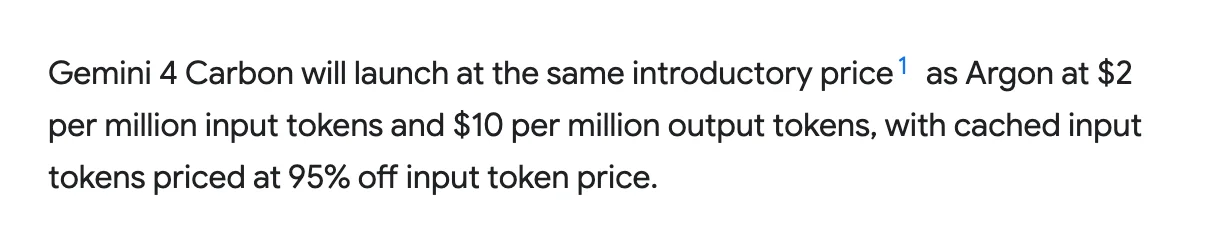
Gemini 4 Carbon introductory API pricing. Google's footnote says $4 per million input tokens and $20 per million output tokens apply after the introductory period. Source: Google, captured November 4, 2026.
And here is Anthropic's pricing for Opus 5.5.
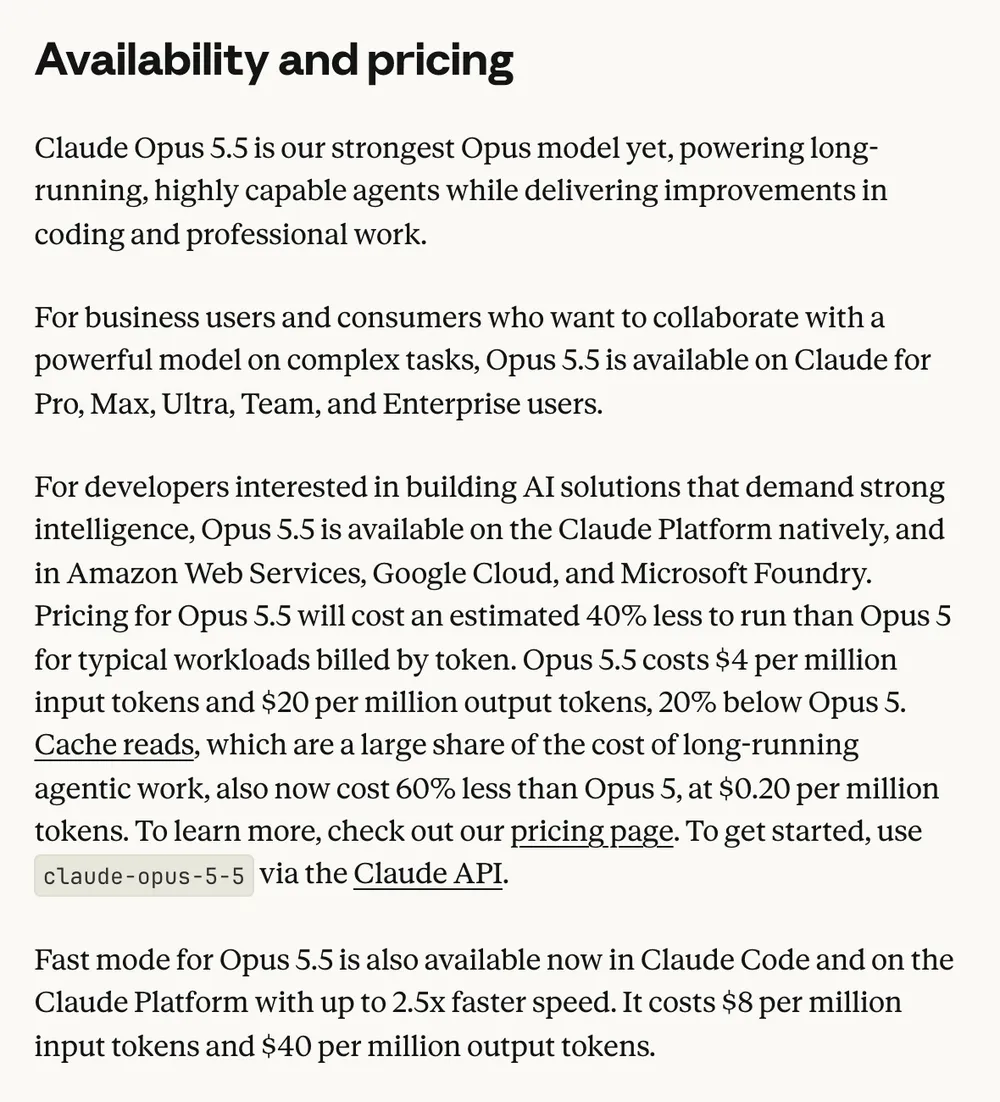
Claude Opus 5.5 availability and API pricing. Source: Anthropic, Claude Opus, captured November 4, 2026.
| Price per 1M tokens | Gemini 4 Carbon | Claude Opus 5.5 |
|---|---|---|
| Input | $2 at launch, then $4 | $4 |
| Output | $10 at launch, then $20 | $20 |
| Cached input | 95% off input | $0.20 |
| Faster option | Not announced | Fast mode, $8 in / $40 out |
After Google's intro period ends, list prices are the same. Carbon still came out cheaper per task in Artificial Analysis tests because it used fewer tokens.
If you use the apps instead of the API, the price is your plan. See our Claude Free vs Pro vs Max guide and our Gemini free vs paid guide.
Who Should Pick Which
Choose Claude Opus 5.5 if:
- You need a top model this week, in an app or the API.
- You code in Claude Code or build agents that use a computer.
- You already pay for Claude Pro, Max, or a team plan.
Keep an eye on Gemini 4 Carbon if:
- You work in security and can apply through Google's Fairwind Program.
- You work with long documents, video, or audio.
- You care most about fewer made-up answers, or about a lower API bill once it opens up.
Not sure which Claude model fits your work at all? Our guide to picking a Claude model covers Opus, Sonnet, Haiku, and Fable. For the wider picture, see ChatGPT vs Claude vs Gemini.
Key Takeaways
- Gemini 4 Carbon leads Claude Opus 5.5 by one point, 60 to 59, on the Artificial Analysis Intelligence Index.
- Carbon wins most single tests. Opus wins FrontierCode 2.0, AA-Briefcase, and OSWorld-2.1 computer use.
- Carbon is only open to selected security teams right now. Opus 5.5 is open to paid Claude users and developers.
- List API prices end up the same, $4 in and $20 out, but Carbon starts at half that and used fewer tokens per task.
The model matters less than how you use it. A clear prompt gets more out of either one. Start with our free Claude for Beginners course, and try Gemini Mastery so you are ready when Carbon opens up.
Enjoyed this article?
Join The FreeAcademy Weekly
One practical AI email every Tuesday. New free courses, AI tips, and a short note from the founder.
Free forever. Unsubscribe anytime.
Related articles
Which Claude Model Should You Use in 2026? Opus vs Sonnet vs Haiku vs Fable
Four Claude models are available today: Haiku, Sonnet 5, Opus, and the restored Fable 5. Here is how to pick by task, with a clear price table.
ChatGPT vs Claude vs Gemini (2026): Which AI Should You Use?
ChatGPT vs Claude vs Gemini compared for writing, coding, research and everyday work, with current models and prices. A clear answer for each use.
Gemini Free vs Google AI Pro vs Ultra: Is Google AI Pro Worth It in 2026?
Is Google AI Pro worth it? Compare Gemini Free, Google AI Plus, Pro (formerly Gemini Advanced) and Ultra, with prices and the October 2026 changes.