Master the principles, architecture, and core components required to build production-ready RAG applications. Learn to create custom knowledge chatbots using Next.js, Supabase with pgvector, and Google's Gemini API. Perfect for JavaScript/Next.js developers who want to integrate advanced AI features.
Retrieval-Augmented Generation (RAG) is one of the most practical ways to build AI applications that answer questions from your own data rather than relying on a model's training knowledge alone. This free course walks you through every layer of a production-ready RAG system: the foundational theory of how large language models work with vector embeddings, the full indexing pipeline that turns documents into searchable knowledge, and the retrieval and generation loop that powers a grounded, citation-aware chatbot. You will work with Next.js for the frontend and API layer, Supabase with pgvector for vector storage and Postgres-native semantic search, and Google's Gemini API for text generation.
The course is structured around two complementary phases. First, you learn to build the knowledge base: chunking documents effectively, vectorizing and storing them in Supabase, and writing Postgres RPC functions for similarity search. Then you move into the RAG core itself, covering retrieval science, prompt engineering for grounding, streaming responses from Gemini, and wiring everything together through a secure Next.js backend with row-level access controls. Later modules address the realities of shipping software: conversational RAG with memory, attribution and citations in the UI, and techniques for improving retrieval quality while managing cost and latency.
This is an advanced course suited to JavaScript or Next.js developers who already have a working grasp of web development and want to add a sophisticated AI feature to a real product. No prior experience with RAG or vector databases is assumed, but comfort with TypeScript and API routes will help you move quickly. Finishing the course and passing the final exam earns a certificate of completion you can share on LinkedIn or add to a resume.
7 modules • 17 lessons
Finish every lesson and pass the final exam to earn this free, shareable certificate.
Certificate of Completion
has successfully completed
17 lessons · Final exam passed

Michail Ouroumis
Founder, FreeAcademy.ai
Sample preview. Your name appears on the certificate when you complete the course. Learn more
You will build a custom knowledge chatbot that answers questions from your own documents. The project covers the complete pipeline: document chunking and vectorization, semantic search via Supabase pgvector, prompt engineering for grounded responses, and a Next.js chat interface that streams answers from Google Gemini and displays source citations.
Yes, the course is completely free to take. You can work through all modules and lessons at your own pace, and completing the course plus the final exam earns you a certificate of completion at no cost.
The course is aimed at JavaScript or Next.js developers with a working understanding of web development and API routes. You do not need prior experience with RAG, vector databases, or Supabase, but comfort with TypeScript will help you follow the code examples more easily.
The course focuses on Next.js for the full-stack application layer, Supabase with the pgvector extension for vector storage and Postgres-native semantic search using RPC functions, and Google's Gemini API for text generation. You will also work with concepts like document chunking strategies, embedding models, row-level security, and conversational memory.
Yes. Completing all the modules and passing the final exam earns you a certificate of completion that you can add to your LinkedIn profile or resume to demonstrate your practical RAG skills.
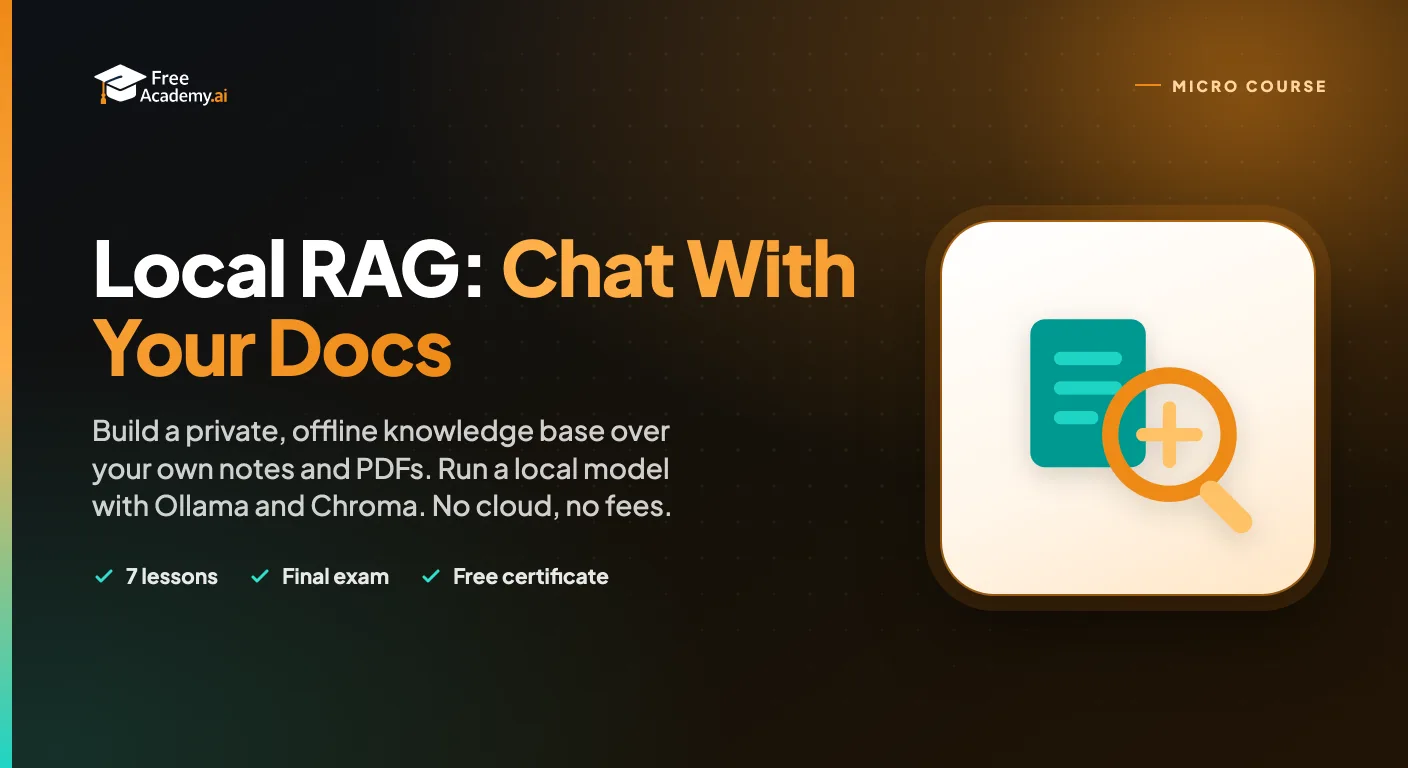
Build a private, offline knowledge base over your own notes and PDFs using a local AI model. A hands-on beginner micro course: run a model with Ollama, turn documents into embeddings, store them in a local Chroma database, and ask questions answered from your own files. No cloud APIs, no fees, your data stays on your machine. Want to deploy it as a web app instead? See the Full-Stack RAG course (/courses/fullstack-rag-nextjs-supabase-gemini).
Move beyond chatbots. Build autonomous agents that work for business. Learn to create production-ready AI agents using JavaScript, TypeScript, Next.js, and the Vercel AI SDK. Perfect for JavaScript developers who want to build AI applications without learning Python.
Master database internals, indexing, and schema design for modern AI applications. Learn how SQL databases power production AI systems at TikTok, Uber, and Netflix. Build RAG systems, feature stores, and high-performance pipelines with PostgreSQL and pgvector.
Master vector databases for AI applications. Learn embeddings, similarity search, and hands-on setup of Pinecone, pgvector, and Chroma. Understand indexing strategies, hybrid search, performance optimization, and how to choose the right database for your use case.
Learn OpenClaw, the viral open-source autonomous AI agent. Understand the Gateway architecture, install and configure your own agent, master skills and memory, secure your setup with Docker sandboxing, build multi-agent teams, publish skills to ClawHub, and optimize performance.
Master Next.js from App Router fundamentals to advanced patterns. Learn server vs client components, data fetching strategies, rendering modes, and production optimization for developers who know React and want to fill knowledge gaps.