What Is Kimi K3? Moonshot AI's Open Model Explained (2026)

If you follow AI news, you probably saw the headlines. In mid July 2026 a Beijing lab called Moonshot AI released a model named Kimi K3, and within days it was being compared to the best systems from Anthropic and OpenAI. Chip stocks wobbled. Analysts called it a "new DeepSeek shock." So what is Kimi K3, why did it cause such a stir, and how can you actually try it?
This guide explains Kimi K3 in plain English for people who are learning AI, not trading it. We will cover what the model is, how its architecture works, how it stacks up against Claude Fable 5, GPT-5.6, and Claude Opus 4.8, what "open weights" really means, and how to use Kimi K3 for free today. Everything here is current as of July 19, 2026, and we flag clearly which numbers come from Moonshot itself and which come from independent testers.
What Is Kimi K3 in one paragraph
Kimi K3 is a large language model built by Moonshot AI, a Beijing based startup, and released on July 16, 2026. It is a text and vision model, meaning it can read images as well as words. It has a 1 million token context window, so it can hold roughly a small book worth of text in mind at once. Most notably it carries 2.8 trillion parameters, which makes it the largest open weight model announced to date. Moonshot has said it will publish the model weights by July 27, 2026, which is why the AI community is watching it so closely.
If some of those words are new to you, our beginner guide to large language models is a good companion read, and our Introduction to Machine Learning course builds the mental model from scratch with no code required.
Why Kimi K3 made global headlines
The reaction was not just about benchmark scores. It was about who built the model and how it was released.
For most of the last few years, the very best AI models came from a small group of American labs. When a Chinese lab ships a model that trades blows with those leaders, and promises to give away the weights for free, it changes the competitive picture. That is exactly what happened in early 2026 with DeepSeek, and investors remembered. When Kimi K3 launched, it triggered a selloff in some chip and AI stocks that outlets like Bloomberg, CNBC, Fortune, and Axios described as a "new DeepSeek shock."
The short version is this. A frontier class model that anyone may eventually download for free puts pressure on the pricing and moats of closed labs. Markets react to that story, not only to the model.
The architecture in plain English
You do not need a research background to understand what makes Kimi K3 interesting. Here are the key ideas.
A giant model that only uses part of itself
Kimi K3 has 2.8 trillion parameters, but it does not fire all of them for every word. It uses a design called mixture of experts, or MoE. Think of it as a large panel of specialists where only a few are consulted for any given question. For each token, Kimi K3 activates 16 of its 896 experts, using what Moonshot calls a Stable LatentMoE design. This is how a model can be enormous on paper yet remain practical to run, because only a small slice does the work at any moment.
If the phrase "parameters" is fuzzy, our post on LLM context windows and our Machine Learning Fundamentals course both unpack the underlying concepts.
A new way of paying attention
The other headline feature is how Kimi K3 handles attention, the mechanism a model uses to decide which earlier words matter for the next one. Moonshot introduced two ideas here: Kimi Delta Attention, a hybrid linear attention mechanism, and a technique it calls Attention Residuals. In plain terms, these are engineering tricks aimed at making the model faster and cheaper to run over very long inputs.
Moonshot claims, and this is a company figure rather than an independent result, up to 6.3 times faster decoding at million token context and around 25 percent higher training efficiency. Those numbers are impressive if they hold up in outside testing, so treat them as a vendor claim for now.
Long memory and eyes
Two more practical points. The 1 million token context window means Kimi K3 can work across huge documents, long codebases, or lengthy conversations without losing the thread. And because it is multimodal with native vision, it can analyze screenshots, charts, and photos, not only plain text.
How Kimi K3 compares to Claude Fable 5, GPT-5.6, and Opus 4.8
This is where careful reading matters, because there are two kinds of numbers floating around: independent measurements and Moonshot self reported results. We separate them below.
What independent testers found
On the Artificial Analysis leaderboard, Kimi K3 debuted at number 3, behind Anthropic's Claude Fable 5 and OpenAI's GPT-5.6 Sol. That alone is a strong result for a newcomer, and for an open weight one especially.
On front end coding, it did even better. Kimi K3 leads Arena.ai front end coding leaderboard with a score of 1679, ahead of both Fable 5 at 1631 and GPT-5.6 Sol at 1618. The ranking is still marked preliminary because Kimi K3 has collected fewer votes than the established models, so expect the exact score to move as more people test it. On the independent BenchLM evaluation it ranks number 4 out of 200 models with a score of 80.96 out of 100, with especially strong marks in multimodal and knowledge tasks.
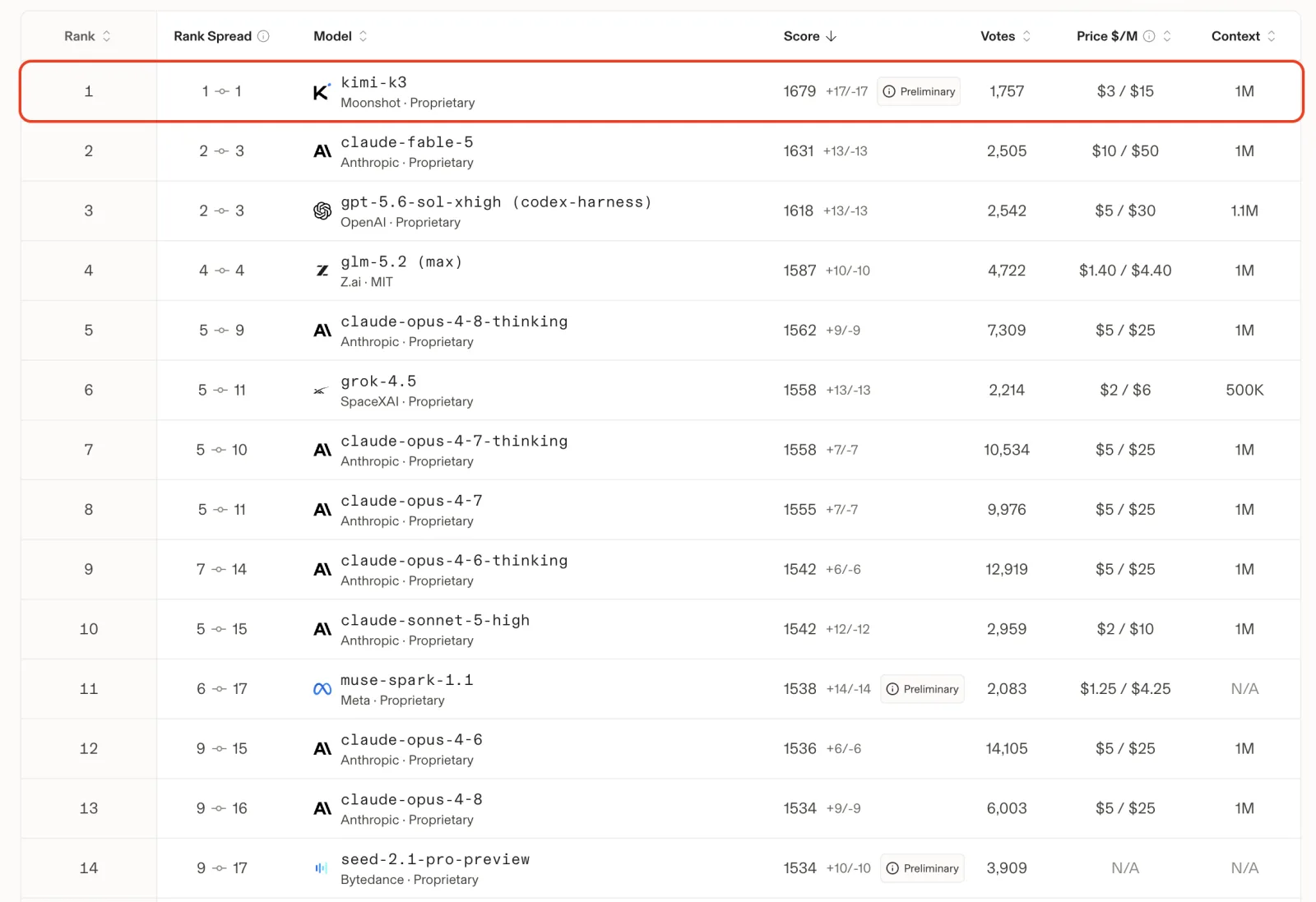
Kimi K3 at number 1 on the front end coding leaderboard as of July 19, 2026, ahead of Claude Fable 5 and GPT-5.6 Sol. You can also see the 3 dollar in, 15 dollar out pricing and the 1 million token context window in the right hand columns.
Here is a quick snapshot of the third party benchmark picture.
| Benchmark (independent) | Kimi K3 result |
|---|---|
| Artificial Analysis leaderboard | Number 3, behind Claude Fable 5 and GPT-5.6 Sol |
| Arena.ai front end coding | Number 1 with a score of 1679, ahead of Fable 5 (1631) and GPT-5.6 Sol (1618) |
| BenchLM (200 models) | Number 4, score 80.96 out of 100 |
| BenchLM subscores | Multimodal 90.3, Knowledge 89.5, Coding 78.0, Agentic 66.6 |
There is also a cost angle that is easy to miss. On Artificial Analysis long horizon knowledge work evaluation, Kimi K3 scores an Elo of 1547, behind only Claude Fable 5, at roughly 0.94 dollars per task. For comparison the same eval puts GPT-5.6 Sol at about 1.04 dollars per task and Claude Opus 4.8 at around 1.80 dollars per task. In other words Kimi K3 delivers near top tier quality at a lower cost per task than several closed rivals.
What Moonshot claims
Moonshot self reported benchmarks show Kimi K3 beating Claude Opus 4.8 at its maximum setting and GPT-5.5 at a high setting. The company also says Kimi K3 ranked first in 4 of 8 real world automation benchmarks, including Automation Bench, SpreadsheetBench 2, and BrowseComp. These are company figures, so weigh them accordingly. Vendors choose the tests that flatter their model, which is exactly why independent leaderboards matter.
The honest summary: by neutral measures Kimi K3 is a genuine top three or top four model, and it leads on at least one important coding benchmark. It is not, by independent scoring, ahead of Claude Fable 5 overall. If you want to understand how to read leaderboards like these without being misled, our post on how to evaluate LLM outputs is a useful next step.
What "open weights" actually means
You will see Kimi K3 called an "open weight" or "open source" model. It helps to know what that does and does not promise.
The weights are the trained numbers inside the model, the thing that actually encodes what it has learned. When a lab releases the weights, developers and researchers can in principle download the model, run it on their own hardware, study it, fine tune it for a specific task, and build products on it without asking permission for every request. That is very different from a closed model like Claude or GPT, where you can only reach the model through an API you do not control.
Open weights matter for a few reasons. They lower cost, because you are not renting every token from one vendor. They improve privacy, because sensitive data can stay on your own machines. And they support learning and research, because you can look inside rather than treating the model as a black box. Our comparison of local versus cloud LLMs walks through these tradeoffs in detail.
One important caveat for Kimi K3 specifically. As of July 19, 2026 the weights are not yet public. Moonshot has promised to release them by July 27, 2026, but the license terms have not been announced. "Open weights" can range from a permissive license that allows commercial use to a restrictive one with conditions. Until Moonshot publishes the actual license, it is wise not to assume what you will and will not be allowed to do. We will update this post once the release lands.
How to try Kimi K3 for free right now
You do not have to wait for the weights to experiment with the model. There are three easy paths.
1. Chat at kimi.com
The simplest option is to go to kimi.com and start a conversation, the same way you would use ChatGPT or Claude. This is the fastest way to get a feel for how Kimi K3 writes, reasons, and reads images, with nothing to install.
2. Call the Moonshot API
Developers can use Moonshot AI API. A nice detail here is that the API is compatible with the OpenAI SDK. In practice that means if you already have code written for OpenAI, you can often point it at Moonshot endpoint and model name and it will work with minimal changes. That low switching cost is part of why these models spread quickly. If you want to learn how to wire a model into your own scripts, our Build Your First AI Agent in 30 Minutes course is a hands on starting point.
3. Route through OpenRouter
Kimi K3 is also available on OpenRouter, a service that lets you reach many models through a single interface. This is handy when you want to compare Kimi K3 against Claude, GPT, or Gemini side by side without signing up for each provider separately.
A note on pricing
Through the Moonshot API, Kimi K3 costs about 3 dollars per million input tokens and 15 dollars per million output tokens. That makes it the most expensive Chinese lab model to date, a sign of how confident Moonshot is in its quality. Even so, it is far cheaper than Claude Fable 5, which runs around 50 dollars per million output tokens. So while Kimi K3 is not the budget option among Chinese models, it is still a value play against the closed frontier leaders.
What to watch next
The single biggest event on the calendar is the weights release, promised by July 27, 2026. When that happens, two things become clear. First, we learn the license, which decides whether businesses and hobbyists can freely build on the model. Second, independent researchers can finally verify Moonshot speed and efficiency claims on their own hardware instead of taking them on faith.
Beyond that, watch whether Kimi K3 holds its leaderboard position as more testers run it, and whether the front end coding lead translates into tools that developers actually adopt. Leaderboards move fast, and a strong debut is not the same as a durable lead.
Key takeaways
- Kimi K3 is a 2.8 trillion parameter open weight model from Moonshot AI, released July 16, 2026, with a 1 million token context window and native vision.
- Its architecture uses a mixture of experts design that activates 16 of 896 experts per token, plus new attention techniques aimed at speed at long context. The big speed and efficiency figures are Moonshot claims, not yet independently verified.
- By independent measures it debuted at number 3 on Artificial Analysis, leads Arena.ai front end coding, and ranks number 4 on BenchLM. Company benchmarks claim wins over Claude Opus 4.8 and GPT-5.5, but read those with caution.
- Pricing is about 3 dollars in and 15 dollars out per million tokens, expensive for a Chinese model yet far below Claude Fable 5.
- You can try it free at kimi.com, through the OpenAI compatible Moonshot API, or via OpenRouter. The weights themselves are promised by July 27, 2026, and the license is still unannounced.
Kimi K3 is a reminder that the AI field moves in weeks, not years. The best way to keep up is not to memorize benchmark tables but to understand the ideas behind them. If you want that foundation, start free with our Introduction to Machine Learning course, then sharpen how you talk to any model, Kimi included, with our Prompt Engineering course. Both are free, and both will still be useful long after today's leaderboard has changed.
Enjoyed this article?
Join The FreeAcademy Weekly
One practical AI email every Tuesday. New free courses, AI tips, and a short note from the founder.
Free forever. Unsubscribe anytime.
Related articles
DeepSeek vs ChatGPT vs Claude: Which AI Wins in 2026?
DeepSeek vs ChatGPT vs Claude compared on reasoning, coding, writing, pricing, privacy, and open weights. Find the right AI for your work in 2026.

What Is an LLM? A Beginner's Guide to How AI Works in 2026
What is an LLM? A clear, beginner-friendly guide to large language models, how they work, why they matter, and how to start using them in 2026.
Best AI Tools for Developers (According to Arena.ai)
Explore the leading AI models for developers in 2026—ranked by community votes and benchmarks on Arena.ai's leaderboard across Text, Code, Vision, Search, Document, and Text-to-Image.