The Stack I Would Learn in 2026 If I Were Starting Over
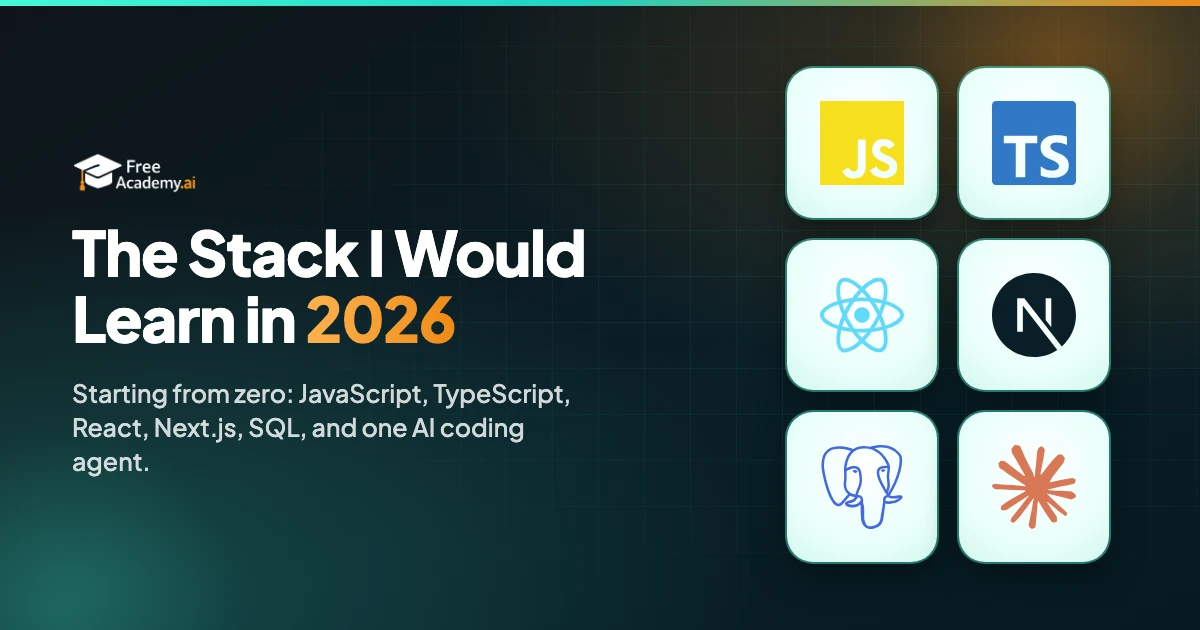
If I had to start from zero in 2026, I would learn this stack: JavaScript, then TypeScript, React with Next.js, SQL with PostgreSQL, and one AI coding agent. That is the whole list.
This is not a guess. It is the stack I use every day. I built FreeAcademy with it, I run my other sites with it, and I have shipped production code with these tools for years. If they stopped working for me, this list would change.
Start with JavaScript
JavaScript is still the only language the browser runs. That fact has not changed in thirty years, and it is why JavaScript keeps its place at the top of every jobs list.
Learn plain JavaScript first. Variables, functions, arrays, objects, promises. Build something small with no framework at all. A tip calculator. A to-do list. If you cannot build it in plain JavaScript, a framework will not save you. It will only hide what you do not understand.
If you are starting today, the free JavaScript Fundamentals course covers this exact ground.
Then TypeScript
TypeScript is JavaScript with types. Types catch your mistakes before you run the code instead of after. On a small project that feels like extra work. On a real project it is the difference between changing code with confidence and changing code with fear.
Almost every serious JavaScript job in 2026 expects TypeScript. Learn it after JavaScript, not instead of it. The TypeScript Fundamentals course is a good next step once plain JavaScript feels comfortable.
React, then Next.js
React has been the safe choice for years and it still is. It has the most jobs, the most tutorials, and the most answered questions on the internet. When you get stuck at 2am, that last one matters more than any benchmark.
Next.js is the framework I build every one of my sites with. It sits on top of React and handles routing, server code, and SEO. The site you are reading this on is a Next.js app.
Learn React first. Move to Next.js when you want to ship a real site.
SQL, and do not skip it
SQL is the oldest thing on this list and the one I am most sure about. Frameworks come and go. Databases stay. The SQL I learned years ago works the same today, and it will work the same in 2040.
Every real application is a database with an interface in front of it. If you can only work on the interface, you can only do half the job. Start with SQL Basics and write your own queries until they feel natural.
For the database itself I use PostgreSQL through Supabase. Supabase gives you a Postgres database, auth, and an API in one free tier. One person can ship a complete product with it. I know because I do.
The boring parts that pay off
Three things are not fun to learn and pay off every single day.
Git. You will use it every day for the rest of your career. Commit, branch, merge, resolve a conflict. The Git and GitHub course covers all of it.
Enough CSS to lay out a page. Flexbox and grid. You do not need to be a designer. You need your page to not fall apart on a phone. The CSS Selectors and Layout course is enough.
How the web works. What a request is, what a response is, what a URL is made of. It takes a weekend and it makes every bug easier to find.
One AI coding agent
This is the part that did not exist when I started. I use an AI coding agent every day. It writes code, runs tests, and fixes bugs while I review the results. Pick one, Claude Code or Cursor or another, and learn to work with it. This is now part of the job.
But I want to be direct about the risk. If the AI writes everything and you copy and paste, you will not learn to program. You will not be able to tell good code from bad code, and telling good from bad is the skill that matters most now that code is cheap to produce.
So use AI the way you would use a senior colleague. Ask it to explain code you do not understand. Ask it to review code you wrote. Let it unblock you when you are stuck. While you are learning, type the code yourself.
Working with AI models is also a skill of its own. The free Prompt Engineering course is the fastest way to get the basics down.
What I would skip
Python first, unless you want data or machine learning work. Python is a fine language. But the browser does not run it, so web developers end up learning JavaScript anyway. One language on both client and server is a real advantage when you are starting out. If your goal is data science or ML, flip this advice and start with Python.
Framework hopping. A new JavaScript framework gets attention every few months. Ignore all of them until you have shipped something. The stack you finish learning beats the stack you keep switching to.
Kubernetes, microservices, and system design courses. You do not need them for your first job. I run several production sites without them. A single Next.js app on a managed host takes you much further than people admit.
The order I would follow
- HTML, CSS, and plain JavaScript. About three months of steady practice.
- Git from week one, alongside everything else.
- TypeScript and React. Two to three months.
- SQL in parallel, a little every week.
- Next.js and Supabase. Build one real project and put it online.
- An AI coding agent through all of it, with the rule above: it explains and reviews, you type.
That is under a year to a portfolio project you can show in an interview. Not easy, but a clear path.
Start with one thing
Every course linked in this post is free, including the certificate at the end. That is the point of FreeAcademy.
Do not try to start all of it this week. Pick JavaScript, build something small, and show it to someone. That first small finished thing teaches you more than any list, including this one.

About the author
Michail Ouroumis
Founder & Developer
I'm a software engineer and the founder of FreeAcademy.ai. I built the platform because I believe practical AI skills shouldn't be locked behind expensive courses. Everything here is free: the courses, the certificates, the interactive code playgrounds.
I've spent years building web and mobile products with React, Next.js, Node.js, TypeScript, Supabase, and PostgreSQL. FreeAcademy grew out of that work. The courses stay close to how these tools are really used, because I use them every day.
Enjoyed this article?
Join The FreeAcademy Weekly
One practical AI email every Tuesday. New free courses, AI tips, and a short note from the founder.
Free forever. Unsubscribe anytime.
Related articles
Best Free Courses to Learn Web Development Without a Degree
Discover the best free web development courses in 2026. Learn HTML, CSS, JavaScript, and modern frameworks without a degree. Complete learning path with comparison table and success strategies.
JavaScript to AI Developer Roadmap: Your Complete Learning Path from Frontend to Building AI Agents
Follow this comprehensive roadmap to transition from JavaScript developer to AI engineer. Learn the exact skills, tools, and courses you need to build production AI applications—no Python required.
Cursor vs Claude Code in 2026: IDE Agent vs Terminal Agent for Coding
Cursor vs Claude Code for coding in 2026: how the IDE-embedded agent compares to the terminal autonomous agent, when each style wins, pricing, and which fits your workflow.