How to Verify AI Output: A Checklist Before You Trust Any Answer

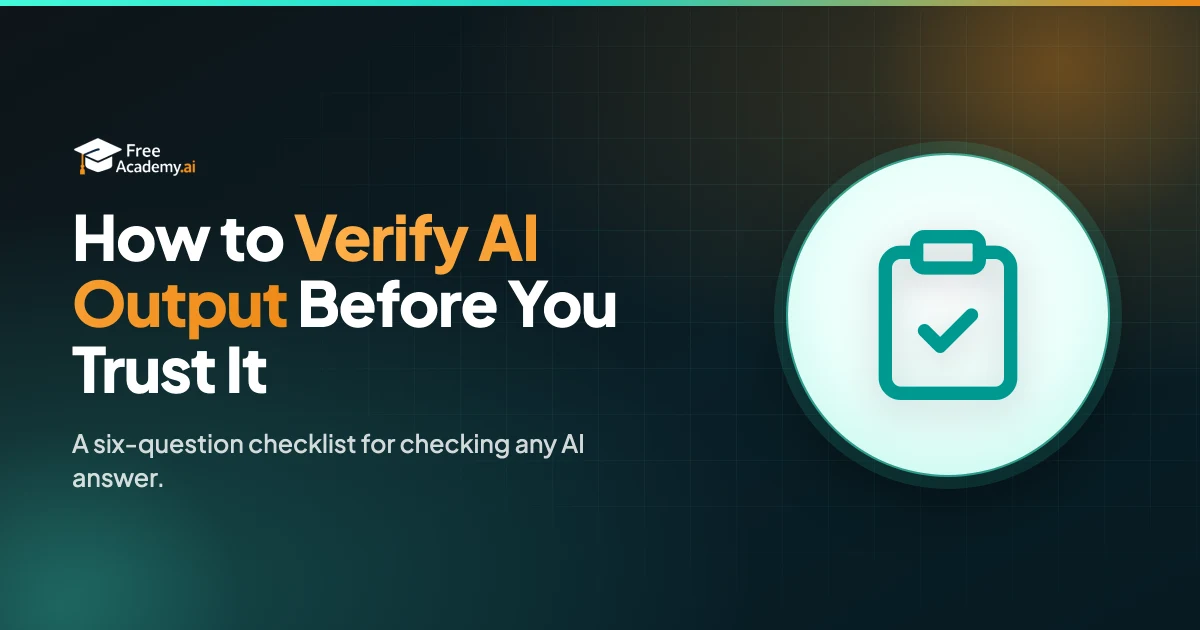
Most AI answers are fine. Some are wrong in a way that sounds exactly as confident as the right ones. This checklist is a short list of questions to run through before you act on an AI answer, so you catch the wrong ones before they cost you something.
This is not about spotting fake images or deepfakes. Our AI Literacy: Spot AI Content & Misinformation course covers that. This is about the plain text answers you get every day from a chat assistant, and deciding how much to trust each one.
Why this checklist exists
An AI model predicts likely words. It does not check facts against the world before it answers you. That means a made-up statistic and a real one can come out in the exact same tone, calm and certain.
This is called hallucination: the model states something false as if it were true, with no signal that it is guessing. There is no tone of voice that warns you. The only defense is to build a habit of checking, and to check harder on the answers that matter more.
The checklist
Run through these six questions before you trust an AI answer for anything that matters.
1. Can I check this against a real source?
If the AI gives you a fact, a statistic, a quote, or a citation, look for the original source. A real fact usually traces back to something: a study, an article, an official document. If you cannot find where it came from, treat it as unverified, not true.
2. Is this a fact, or a plausible guess dressed up as a fact?
AI is good at filling gaps with something that sounds right. Ask yourself if the AI could plausibly know this, or if it is the kind of specific detail (an exact date, a percentage, a name) that it may have invented because a vague answer felt unsatisfying.
3. Does the confidence match the actual difficulty of the question?
A model will answer a genuinely hard or obscure question with the same steady tone it uses for an easy one. If the question is niche, recent, or has little written about it online, lower your trust regardless of how sure the answer sounds.
4. Would I bet money on this?
This is a fast gut check. If you would not put money on the specific fact being correct, do not put your name, your work, or your client's trust on it either. Go verify it first.
5. Is this the kind of thing AI is known to get wrong?
Some categories carry higher risk: dates, math, citations, legal and medical specifics, quotes, and anything involving a named person or company. If your answer falls into one of these, check it. If it is a general explanation of a well-known concept, the risk is lower.
6. Does this need a human to sign off?
Some answers are low stakes: a draft email, a brainstorm, a first pass at an outline. Others are not: a number in a report, advice you give a client, anything published under your name. Match the checking effort to the stakes, and get a second pair of human eyes on anything in the second group.
A faster version for daily use
The full checklist is for anything with real stakes. For everyday low-stakes use, two questions do most of the work:
- Where did this fact come from, and can I find it myself?
- What is the worst outcome if this specific detail is wrong?
If you cannot answer the first question and the second answer is "something bad," slow down and check.
What this looks like in practice
Say an AI assistant gives you a statistic for a report: "62 percent of small businesses now use AI tools." Before you put that in your report, search for the actual source. If you cannot find a study or article that says this, do not use the number. Either find a real source that supports a similar claim, or write the sentence without the specific figure.
Say it gives you a code snippet or a spreadsheet formula. Run it. Do not read it and assume it works. This is the version of "check against a real source" for anything with logic instead of facts: the real source is whether it actually executes correctly.
Say it gives you a summary of a long document you gave it. Skim the original again next to the summary. Check that nothing important got dropped or overstated.
Key takeaways
- AI answers wrong and right facts in the same confident tone, so confidence is not a signal of accuracy.
- Run the six-question checklist on anything with real stakes: source, fact-vs-guess, confidence-vs-difficulty, would-you-bet-on-it, known-risk-category, needs-a-human.
- Dates, citations, statistics, quotes, and legal or medical specifics carry the highest risk of being wrong.
- For daily low-stakes use, two questions cover most of it: where did this come from, and what happens if it is wrong.
- This is the second half of AI literacy. Knowing how to prompt well gets you an answer. Knowing how to check it is what makes the answer usable.
If you want the full picture, spotting fake or AI-generated media is a related but separate skill, covered in how to spot deepfakes and AI-generated content. For a broader look at why checking AI output is becoming a baseline skill rather than a nice-to-have, see why AI fluency is becoming the new baseline skill.
To practice this hands-on with a free certificate at the end, the AI Literacy: Spot AI Content & Misinformation course walks through verification step by step, including fact-checking AI output against primary sources.
Enjoyed this article?
Join The FreeAcademy Weekly
One practical AI email every Tuesday. New free courses, AI tips, and a short note from the founder.
Free forever. Unsubscribe anytime.
Related articles
How to Spot Deepfakes and AI-Generated Content: A 2026 Guide
A practical media-literacy guide to spotting deepfakes and AI-generated images, video, text, and audio in 2026 - with red flags, tools, and a checklist.
Why AI Fluency Is Becoming the New Baseline Skill in 2026
AI fluency skills are shifting from nice-to-have to baseline. Here is what Boston schools, MIT, and a 10,000-student survey reveal, and what it means for you.

AI for Beginners: 10 Core Concepts to Understand Before You Start (2026)
AI for beginners made simple. Master 10 core concepts—LLMs, tokens, embeddings, RAG, agents and more—before diving into your first AI project in 2026.