Why AI Fluency Is Becoming the New Baseline Skill in 2026

For most of the last decade, knowing how to use AI was a bonus line on a resume. In 2026 that is changing fast. AI fluency skills are quietly moving from a competitive edge to a baseline expectation, the same way basic spreadsheet skills became assumed rather than impressive. If you have wondered whether you are falling behind by not learning AI, this is the honest answer: the bar is rising, but it is still very early, and the gap is closable in weeks, not years.
This is an analysis of where the signal is coming from, why it matters for your career and studies, and how to respond without panicking. It is not a curriculum. When you are ready to actually start learning, we will point you to the right place.
Three signals that AI fluency is becoming the default
No single headline proves a trend. But when schools, elite universities, and the students themselves all move in the same direction within a few months, that is a pattern worth reading carefully.
1. A major US school district is building AI fluency into graduation
In March 2026, Boston announced it would become the first major-city school district in the United States to bring AI literacy into every public high school, with the program rolling out starting in September 2026. The goal is for every graduate to understand and critically use AI, not just passively click buttons. Teachers are being trained over the summer using a curriculum developed with UMass Boston and a local industry group, and some students will be able to take credit-bearing AI courses.
The detail that matters most is the framing. Boston is not teaching students to use one chatbot. Mayor Wu described a curriculum grounded in ethics and critical engagement, not passive tool use. That is the difference between AI fluency and simply having an account on an AI app. When a public school system decides this belongs next to reading and math, it is signaling that employers and colleges will soon assume you have it.
2. Students already expect AI to shape their careers
The demand side is moving too. An April 2026 survey by the education firm EAB of nearly 10,000 students, all prospects to begin college, found that 42 percent expect AI to influence their career choice. Roughly 10 percent said they had already changed their major because of AI.
Read that twice. These are not mid-career professionals reacting to layoffs. These are people choosing what to study before they have set foot on campus, and four in ten already factor AI into the decision. The same survey found a lot of uncertainty: when asked to pick words describing their feelings, 50 percent chose "uncertain" and only 13 percent chose "optimistic." So the expectation that AI matters is widespread, but confidence about what to do with it is not. That gap, high awareness and low confidence, is exactly the space where focused learning pays off the most.
3. Elite institutions are making AI fluency free and approachable
In May 2026, MIT Open Learning launched Universal AI, a self-paced online program designed to take non-technical learners from beginner to AI fluency. MIT described it as a pathway to AI fluency that is accessible and approachable to anyone, anywhere, and the first course, covering programming and machine learning fundamentals, is available for free to learners everywhere.
The word choice is not an accident. An institution like MIT using "AI fluency" as the explicit goal, and removing the price barrier on the on-ramp, tells you where the conversation is heading. The skill is being treated as a public baseline, not a specialist credential.
What "AI fluency" actually means (and what it does not)
Because the term gets thrown around loosely, it helps to be precise. AI fluency is not the ability to build a neural network from scratch. For the vast majority of people, it is the ability to use AI tools effectively and critically in your own work or study.
In practice, an AI-fluent person can:
- Recognize when a task is a good fit for AI and when it is not.
- Write a clear prompt and refine it when the first answer falls short.
- Judge whether an AI output is accurate, biased, or made up, rather than trusting it blindly.
- Combine AI with their own domain knowledge instead of outsourcing their thinking.
- Use AI to move faster on real tasks: drafting, summarizing, analyzing, planning, and learning.
Notice that none of these require coding. They require judgment, practice, and a bit of structure. That is good news, because it means fluency is reachable for a nursing student in Mumbai, an accountant in Lagos, or a history major in Manila just as much as for a software engineer in San Francisco.
This also reframes the anxiety. The question is not "can I compete with people who code." It is "can I apply AI well in the field I already care about." Almost always, the answer is yes.
Why this matters for your career, specifically
If AI fluency becomes a baseline, two things happen at once.
First, the floor rises. Tasks that used to signal competence, like writing a clean summary or pulling together a first-draft analysis, get done faster by people using AI well. If you are not among them, your work quietly looks slower and more expensive by comparison. This is the uncomfortable part, and pretending otherwise does not help anyone.
Second, and more hopeful, the ceiling rises too. When routine work compresses, the value shifts to judgment, domain expertise, and the ability to direct AI toward the right problems. Someone who deeply understands their field and is fluent with AI becomes far more valuable, not less. The people most at risk are not those who use AI, but those who neither use it well nor offer the human judgment that AI lacks.
For students and early-career professionals, especially across India and the wider Global South where talent is abundant and opportunity is competitive, this is an opening. AI fluency is one of the rare high-value skills where the learning resources are genuinely free and the playing field is, for now, relatively level. You do not need an expensive degree or a Silicon Valley address. You need access, time, and a structured place to practice.
How to respond without the panic
The worst response to a rising baseline is to freeze. The second worst is to binge random tutorials with no plan. Here is a calmer framing.
Anchor it to your own field. Do not try to learn "AI" in the abstract. Pick the specific work you already do or study, and learn to apply AI to that. A marketing student should learn AI for campaigns and copy. A finance student should learn AI for analysis and modeling. This is both more motivating and more useful than generic theory.
Build a tiny portfolio of real tasks. Fluency is demonstrated, not claimed. Keep a short record of three to five things you did faster or better with AI: a research summary, a data analysis, a study guide you generated and then verified. This is what you point to in an interview when someone asks if you "know AI."
Get a credential you can actually show. Saying you are AI fluent is weak. Backing it with a certificate and concrete examples is strong. FreeAcademy courses are free and come with a certificate you can add to your LinkedIn profile or resume, which matters when a recruiter is scanning for signal.
Learn the critical-thinking half, not just the tool. Boston's program is built on ethics and critical engagement for a reason. Knowing when to distrust an AI answer is as much a part of fluency as knowing how to prompt for one. Treat verification as a skill, not an afterthought.
Where to actually start
This piece is the why. For the how, we have already built the paths, so there is no reason to retread them here.
- If you want a step-by-step route from zero to job-ready, follow the free AI learning path for students. It sequences what to learn and in what order.
- If you want the vocabulary and mental models first, read AI for beginners: 10 core concepts so the rest stops feeling like jargon.
- If you want a curated set of free courses to pick from, see the best free AI courses for students in 2026.
For the hands-on payoff, the highest-leverage first move for almost anyone is learning to communicate with AI tools well. Start with the free Prompt Engineering course, then layer on a course built for your situation, such as AI for Students or, if you are brand new to the tools, ChatGPT for Complete Beginners. From there, FreeAcademy has profession-specific courses so you can apply AI directly to the field you are studying or working in.
Key takeaways
- AI fluency skills are shifting from optional to baseline, signaled by a major US school district adding AI literacy to graduation, MIT making an AI fluency pathway free, and students factoring AI into their majors.
- Fluency means using AI effectively and critically in your own field. It is about judgment, not coding, which makes it reachable for almost anyone with internet access.
- The floor is rising, but so is the ceiling. Pairing real domain expertise with AI fluency is becoming one of the most valuable combinations in the job market.
- The smart response is calm and structured: anchor learning to your field, build a small portfolio, earn a credential you can show, and learn to verify AI output, not just generate it.
- You are not late. Awareness is high but confidence is low, which means a few focused weeks of free, structured practice can put you ahead of most peers.
The baseline is moving. The good news is that catching up has never been cheaper or more accessible. Pick one path above, start this week, and let your work, not your worry, do the talking.
Ready to begin? The free Prompt Engineering course is the fastest way to turn AI from something you read about into something you can use, with a certificate to prove it.
Enjoyed this article?
Join The FreeAcademy Weekly
One practical AI email every Tuesday. New free courses, AI tips, and a short note from the founder.
Free forever. Unsubscribe anytime.
Related articles
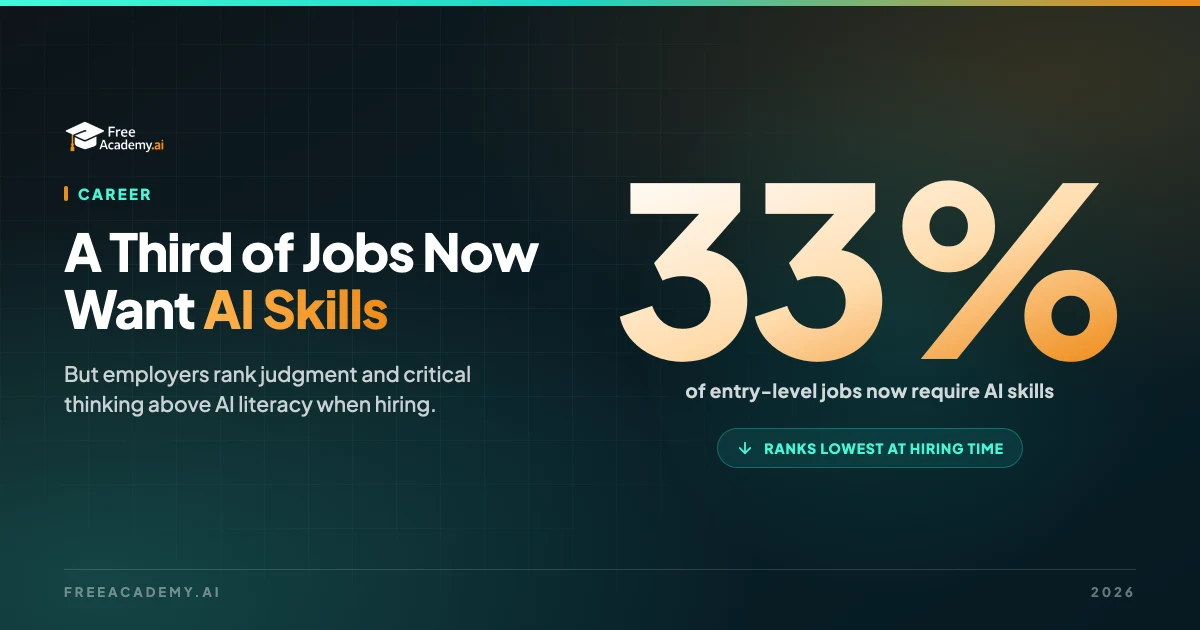
A Third of Entry-Level Jobs Now Ask for AI Skills. Employers Want Something Else More.
AI-skill requirements in entry-level jobs nearly tripled since fall 2025, yet hiring managers rank critical thinking above AI literacy. Here is how to read the data.

The 5 AI Skills That Will Make You Irreplaceable in 2026
Discover the five AI skills that employers desperately need but struggle to find. Learn what separates AI-augmented professionals from those being replaced, and how to future-proof your career.
How to Become a Data Analyst with AI: The Practical 2026 Roadmap
A practical roadmap to becoming a data analyst with AI in 2026. Learn the skills that matter, the AI workflow employers want, and how to build a portfolio and break in.