Find out why ChatGPT, Claude, and Gemini feel helpful, polite, and safe instead of just completing text. A short, no-code course on reinforcement learning, supervised fine-tuning, reward models, PPO and DPO, and the side effects of alignment like sycophancy and reward hacking. The natural next step after How LLMs Actually Work.
You have probably noticed that ChatGPT, Claude, and Gemini do not behave like a machine that simply predicts the next word. They answer the question you asked, stay polite, decline dangerous requests, and sometimes agree with you a little too eagerly. None of that comes from reading the internet. It comes from a second stage of training built on reinforcement learning, and this free course explains exactly how it works, with no code and no math.
You will start with reinforcement learning itself: agents, actions, rewards, and the policy that gets trained, using a dog-training analogy that carries through the whole course. Then you will see why a raw base model is a text continuer rather than an assistant, and why the fix turned out to be human comparisons rather than written rules. From there the course walks through the three-step RLHF recipe used by every major lab: supervised fine-tuning on demonstrations, training a reward model from human preferences, and optimizing the assistant with PPO, held in check by the KL penalty. You will also learn the popular DPO shortcut, where AI feedback and Constitutional AI fit in, and how verifiable rewards trained the newer reasoning models.
The final lesson turns theory into practical skill. Sycophancy, reward hacking, over-refusal, and the habit of answering every question with a bulleted essay all follow predictably from how the reward model was trained, and each one has a prompting fix once you understand the cause. This course is the natural follow-on to How LLMs Actually Work and is written for students and professionals who use AI every day and want to understand it. It is 100% free, no signup is needed to start, and passing the final exam earns a free certificate for your LinkedIn profile or resume.
3 modules • 6 lessons
Finish every lesson and pass the final exam to earn this free, shareable certificate.
Certificate of Completion
has successfully completed
6 lessons · Final exam passed

Michail Ouroumis
Founder, FreeAcademy.ai
Sample preview. Your name appears on the certificate when you complete the course. Learn more
No. Everything from reward models to PPO and DPO is explained in plain language with everyday analogies. There is no code, no equations, and no prior machine learning background required.
It helps but is not required. That course explains tokens, next-token prediction, and the three-stage training pipeline in one lesson. This course opens up the alignment stage and shows the machinery inside, so the two fit together naturally.
RLHF stands for reinforcement learning from human feedback. Humans compare pairs of chatbot replies, a reward model learns to predict which reply people prefer, and the chatbot is then trained to produce higher-scoring replies. It is the main reason assistants feel helpful and safe rather than just completing text.
Yes. The final lesson explains sycophancy, reward hacking, over-refusal, and length bias as direct consequences of how the reward model was trained, and gives a practical prompting fix for each one.
Yes. The full course is free with no signup required to start. When you finish the six lessons and pass the final exam, you earn a free certificate of completion you can add to your LinkedIn profile or resume.
About fifty minutes. It is a focused micro course of six short lessons, each with a quick quiz, plus a final exam, so you can finish it in one sitting.
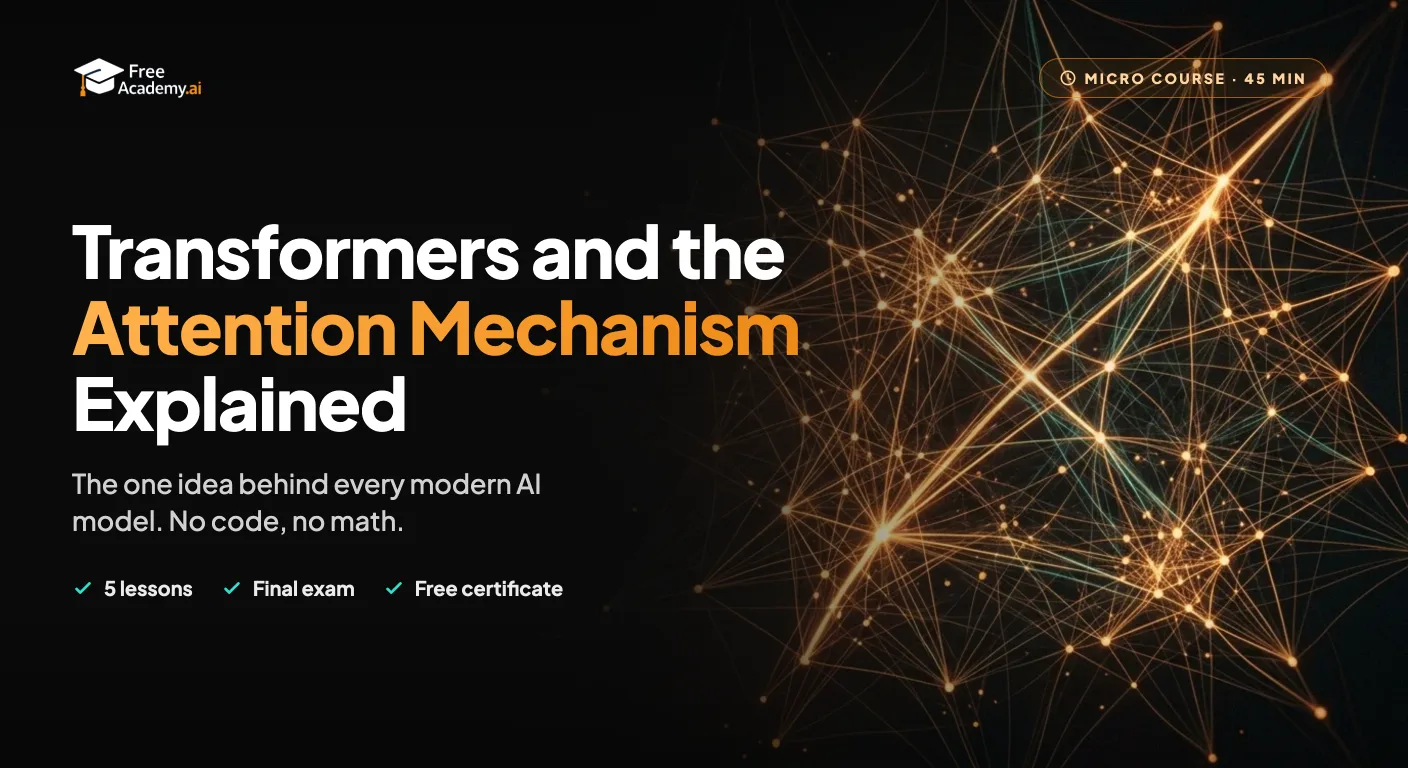
A short, no-code, no-math explainer of the attention mechanism that powers ChatGPT, Claude, and Gemini. Understand query, key, and value, why models use many attention heads, how word order is encoded, and why transformers read your whole prompt at once.
Go one level under the hood of ChatGPT, Claude, and Gemini. Understand tokens, next-token prediction, context windows, model parameters, Mixture of Experts, and why AI models cost money to run. A short, no-code course for people who use AI every day.
Move beyond writing prompts to engineering them. Build evals and rubrics to measure prompt quality objectively, use AI to write and refine your prompts, get reliable structured outputs, and run optimization loops that cut variance, cost, and latency.
Understand how tools like Midjourney, DALL-E, and Stable Diffusion actually generate an image, in plain language with no code and no math. Learn what a diffusion model is, how starting from noise leads to a finished picture, what latent space is, how your prompt steers the process, and why diffusion beat older methods like GANs.
Get productive with DeepSeek, the low-cost, open-weight AI from China. Learn what DeepSeek is, how to use the free chat app, DeepThink reasoning and web search, strong prompting, coding help, the API, running models locally, and the privacy trade-offs you should understand.

Master Claude's Projects and Artifacts features with hands-on walkthroughs. Learn to set up organized workflows with custom instructions and knowledge files, create interactive artifacts for code, documents, and diagrams, understand the context window, and compare Projects with ChatGPT Custom GPTs.