Lesson 1: Why Attention Matters: From One Word at a Time to All at Once
Free, no sign-up needed.
Last updated
A short, no-code, no-math explainer of the attention mechanism that powers ChatGPT, Claude, and Gemini. Understand query, key, and value, why models use many attention heads, how word order is encoded, and why transformers read your whole prompt at once.
Every AI assistant you use runs on the same architecture, and almost nobody can explain the one idea at the center of it. This free micro course fixes that. In about forty-five minutes, across five short lessons, you will understand the attention mechanism that powers ChatGPT, Claude, and Gemini, with no code, no math, and no equations anywhere.
You will start with the problem attention solves: why older models read text one word at a time, lost track of anything distant, and trained too slowly to reach real scale. Then you will build the mechanism piece by piece. Query, key, and value become obvious once you see them as a library search. Attention weights turn out to be a fixed budget that every token must spend, which is a mechanical reason behind prompt advice you have already heard. From there you will see why models run many attention heads at once instead of one, how word order is put back into a system that is otherwise blind to it, and what a transformer block actually contains besides attention.
The final lesson turns all of it into things you can use. Why transformers could be trained on internet-scale data when nothing before them could. Why doubling your prompt length more than doubles the work, and what that means for long documents and long chats. Why the first word of an answer takes longer to arrive than the rest, and why input tokens cost less than output tokens.
This course is written for students and working professionals who want a genuinely accurate mental model rather than a vague analogy. It pairs with How LLMs Actually Work, which covers tokens, context windows, and parameters, though you can take either one first. Like every FreeAcademy course it is completely free, and when you finish the lessons and pass the final exam you earn a free certificate of completion for your LinkedIn profile or resume.
2 modules • 5 lessons
Finish every lesson and pass the final exam to earn this free, shareable certificate.
Certificate of Completion
has successfully completed
5 lessons · Final exam passed

Michail Ouroumis
Founder, FreeAcademy.ai
Sample preview. Your name appears on the certificate when you complete the course. Learn more
Teaching a class or training a team? Assign this course for free
No. There is no code and no equations anywhere in the course. Every idea, including query, key, and value, softmax weighting, and positional encoding, is explained in plain language with everyday analogies.
That course covers the layers around the model: tokens, next-token prediction, context windows, parameter counts, and Mixture of Experts. This one covers the mechanism inside it, the attention that turns those tokens into a good prediction. They fit together and you can take either first.
It is marked intermediate because it goes one level deeper than a general intro to AI, but it assumes no technical background. If you are comfortable using AI tools and curious how they work, you will be fine.
Yes. Understanding that attention weights are a fixed budget explains why concise, well-placed instructions work better than buried ones, why long chats drift, and why pasting an entire document costs more than pasting the relevant part.
Yes, the course is completely free. After you finish the five lessons and pass the final exam, you earn a certificate of completion you can add to your LinkedIn profile or resume.
Learn what physically happens when AI runs. See which parts of a computer matter for AI, why GPUs and AI chips took over, why memory is the real limit on model size and speed, how quantization shrinks models, and what goes on inside the data centers that train and serve them. No code, no math.
Find out why ChatGPT, Claude, and Gemini feel helpful, polite, and safe instead of just completing text. A short, no-code course on reinforcement learning, supervised fine-tuning, reward models, PPO and DPO, and the side effects of alignment like sycophancy and reward hacking. The natural next step after How LLMs Actually Work.
Go one level under the hood of ChatGPT, Claude, and Gemini. Understand tokens, next-token prediction, context windows, model parameters, Mixture of Experts, and why AI models cost money to run. A short, no-code course for people who use AI every day.

Master the fundamentals of artificial intelligence without the technical jargon. Understand what AI is, how it works, and how it's transforming our world. Perfect for complete beginners, business leaders, and anyone curious about the AI revolution. No coding required.
Master prompt engineering through hands-on exercises. Learn prompt structure, few-shot learning, chain-of-thought reasoning, and advanced techniques with instant feedback. Build real-world prompts for code generation, content writing, and data analysis.
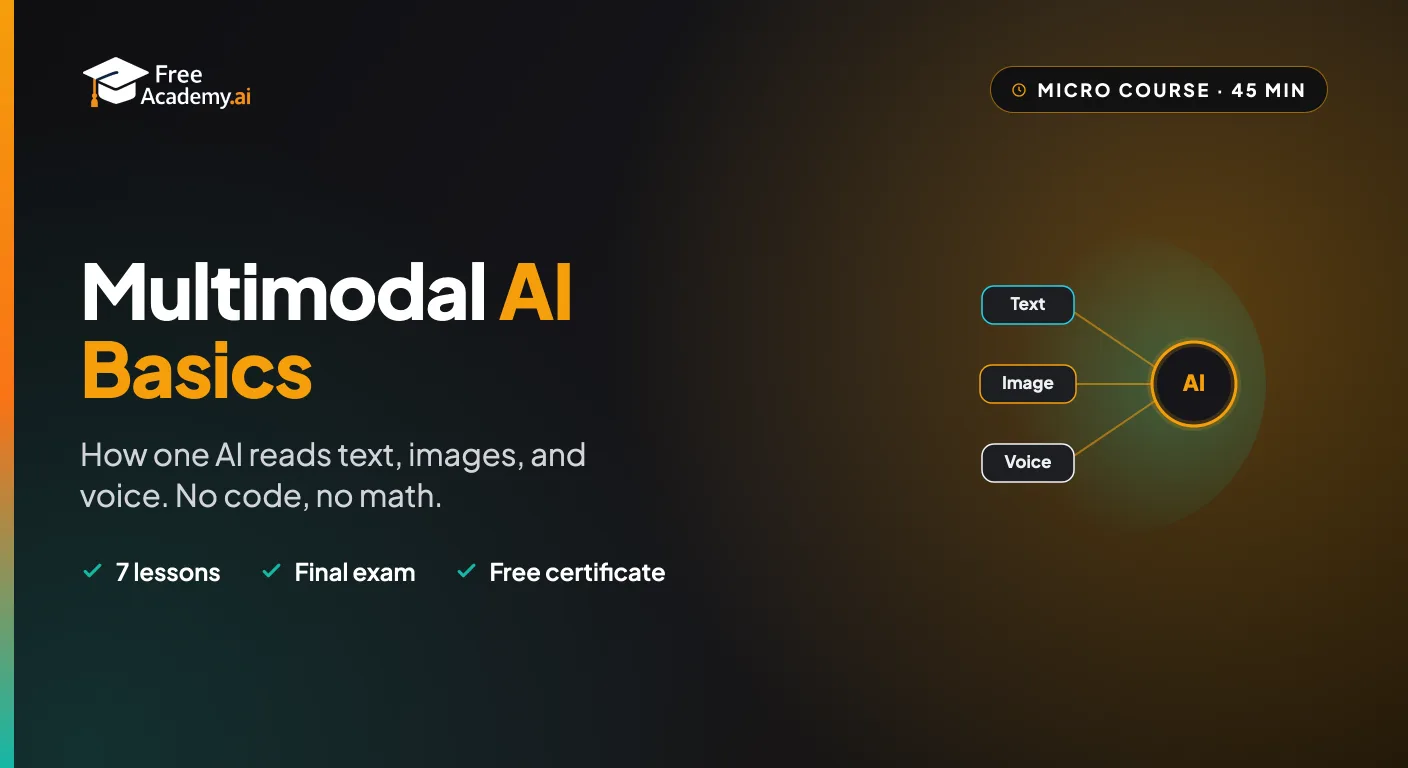
The one AI idea that ties everything together. Learn what 'multimodal' means, how a single AI model reads text, images, and voice together, what you can do with it, and where it shows up in ChatGPT, Gemini, and Claude. A short, no-code, no-math course for complete beginners.