Do You Actually Need Advanced Math for AI?

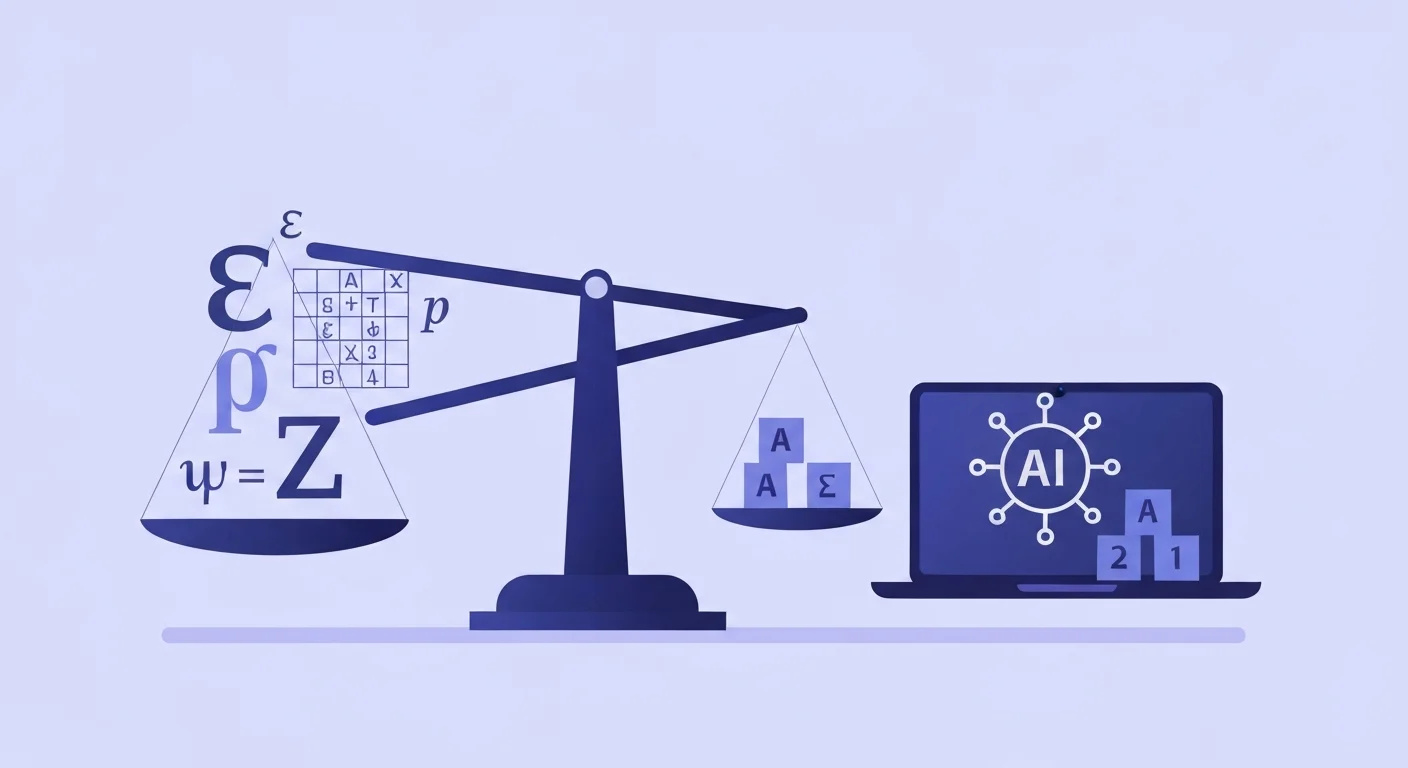
"How much math do I need for AI?" is the question that stops more people than any hard concept ever does. You hear that you need years of calculus and a stats degree, so you never start. The honest answer is more freeing than that. The math for AI you actually need depends entirely on what you want to build.
Most people who work with AI today write very little math by hand. The heavy lifting sits inside libraries and models. What matters is knowing enough to make good decisions, read documentation, and debug when things go wrong. Let's break down what to learn, what to skip, and where to learn it for free.
First, Pick Your Lane
There is no single "AI job." There are at least three, and each needs a different amount of math.
The AI User and Builder
You use AI tools, write prompts, and wire models into apps through APIs. This is where most new roles are being created. You call ChatGPT or Claude, you build a chatbot, you automate a workflow.
The math you need here is close to zero. You need logical thinking and a feel for probability, like knowing that a model gives likely answers, not certain ones. That's it. If this is your path, skip the math anxiety and start building.
The Applied Machine Learning Practitioner
You train models, tune them, and ship them. You use tools like scikit-learn, PyTorch, or TensorFlow. You care about accuracy, overfitting, and why your model behaves the way it does.
Here you need working knowledge of a few areas, but not proofs. You need to understand the ideas well enough to choose the right tool and read an error. We'll cover exactly which topics below.
The Researcher
You invent new architectures, write papers, and push the field forward. This is the only lane where deep, formal math is not optional. If this is you, you already know you need real calculus, linear algebra, and probability theory. This post is not really for you, and that's fine.
For everyone else, the bar is much lower than the internet suggests.
What to Actually Learn
If you want to do applied machine learning, focus your math for AI on four areas. Learn the intuition first, and only go deeper when a real problem forces you to.
Linear Algebra (the useful parts)
Data in AI is stored as vectors and matrices. Every image, sentence, and user is a list of numbers. You want to understand what a vector is, what a matrix multiplication does, and what a dot product measures. That last one powers similarity search, embeddings, and recommendations.
You do not need to invert matrices by hand or memorize eigenvalue proofs. You need to picture what the operations do to data.
Statistics and Probability (the practical parts)
This is the most valuable area for real work. Understand averages, distributions, and variance. Know what a probability is and how to read one. Grasp the idea of correlation, sampling, and why a biased dataset gives a biased model.
This is the difference between someone who trusts a model blindly and someone who asks the right questions about it.
Calculus (just the concept)
Models learn by reducing error step by step. That process, gradient descent, is built on derivatives. You should understand the idea: a derivative tells you which direction reduces the error, so the model nudges itself that way.
You almost never compute a derivative by hand in applied work. The library does it. You just need the mental model of "roll downhill toward less error."
A Little Discrete Math and Logic
Clear thinking about conditions, sets, and steps helps you write better code and cleaner prompts. You likely already have most of this from programming.
What You Can Safely Skip
Here is the part nobody tells beginners. For applied AI you can skip:
- Hand proofs and theorems
- Advanced multivariable calculus
- Most of real analysis
- Solving differential equations manually
- Deep number theory
Skipping these does not make you a fake. It makes you efficient. You can always circle back if a specific project demands it. Learning math "just in case" is how motivated people burn out before they build anything.
A Smarter Order to Learn In
Many people fail because they try to master all the math before touching a model. Flip that.
- Build something small first, like a simple classifier with scikit-learn.
- When you hit a term you do not understand, learn just that piece.
- Let real projects pull the math into your head.
This "learn on demand" approach sticks better because every concept arrives with a reason to remember it. You will learn what a confusion matrix means when your model keeps guessing wrong, not from a textbook chapter you forced yourself through.
Free Resources That Actually Help
You do not need to pay for any of this. Strong free options exist for every level.
- Khan Academy for the fundamentals of linear algebra, statistics, and calculus, explained slowly and clearly.
- 3Blue1Brown on YouTube for visual intuition. His "Essence of Linear Algebra" and neural network series make abstract ideas click.
- StatQuest on YouTube for machine learning statistics in plain language.
- FreeAcademy.ai courses for AI and machine learning basics that connect the math to real building, so you see why each idea matters.
Pair one math resource with one hands-on course. Watch a concept, then use it the same week. That loop beats months of passive study.
The Bottom Line
Do you need advanced math for AI? For research, yes. For almost everything else, no. You need solid intuition in linear algebra, statistics, probability, and the concept of calculus, plus the willingness to build.
The biggest risk is not weak math. It is waiting to feel "ready" and never starting. Pick your lane, learn the useful parts on demand, and let projects teach you the rest.
Ready to begin? Explore the free AI and machine learning courses on FreeAcademy.ai and start building today. The math will make more sense once you have something real in front of you.
Enjoyed this article?
Join The FreeAcademy Weekly
One practical AI email every Tuesday. New free courses, AI tips, and a short note from the founder.
Free forever. Unsubscribe anytime.
Related articles
Where to Read Free AI Books Online: 9 Best Platforms in 2026
A practical guide to the best free AI book platforms in 2026. Where to find and read legal, no-cost AI and machine learning books online.

Best Free AI Image Generation Courses for Beginners 2026
Discover the best free AI image generation courses for beginners in 2026. Learn Midjourney, DALL-E, Stable Diffusion, and Flux with hands-on tutorials.
Coursera Alternatives: 12 Free Platforms Better in 2026
Explore 12 free Coursera alternatives that deliver better courses, real projects, and recognized certificates without the paywall in 2026.