

ChatGPT vs Google Search: When to Use Each in 2026

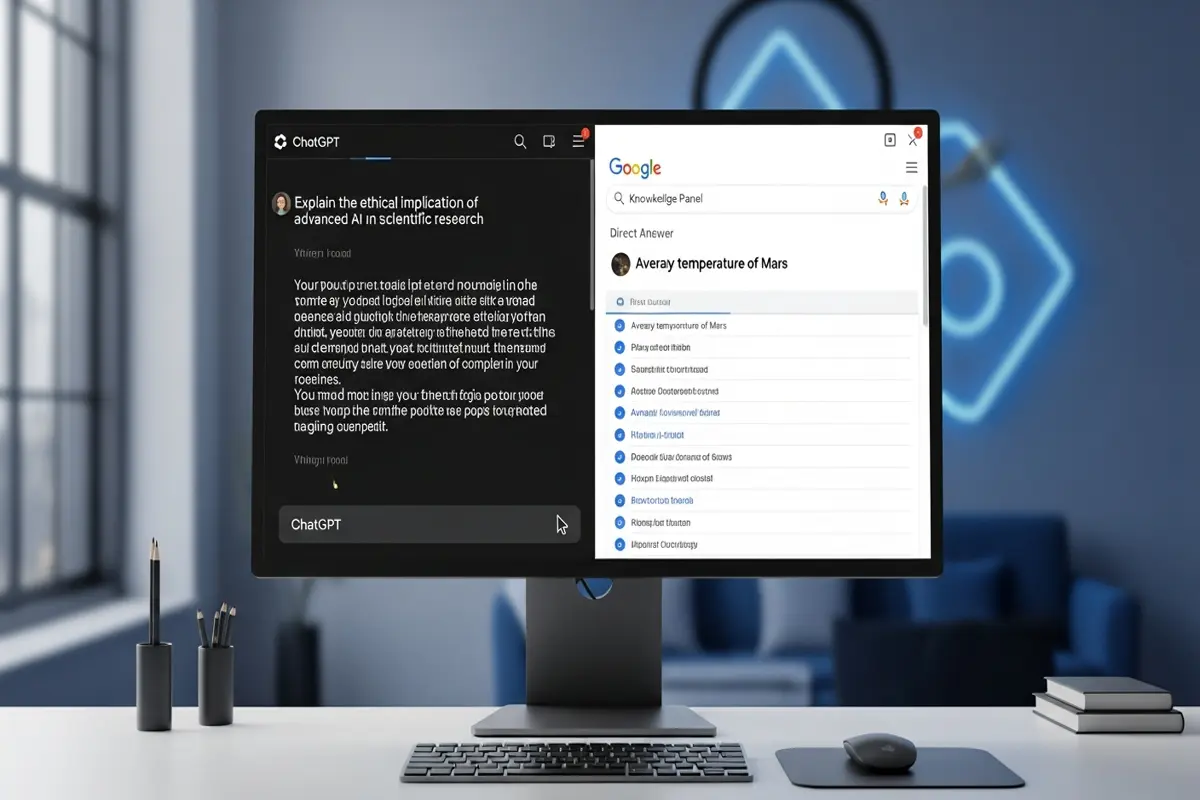
"Just Google it" is becoming complicated advice. In 2026, the question isn't whether ChatGPT can replace Google — it's about understanding what each tool is actually built for, and routing your questions accordingly.
The short version: they're different tools for different jobs. Using the wrong one wastes time. Using both intelligently makes you significantly faster at finding answers.
The Fundamental Difference
Google Search is a retrieval engine. It indexes the web and returns links to existing content. It's incredibly powerful for finding specific pages, current information, and navigating to places you know exist.
ChatGPT is a language model. It doesn't search the web by default (on the free tier, it uses knowledge with a training cutoff). It synthesises information it was trained on and generates a response. It's a thinking partner and writer, not a browser.
This difference explains almost every situation where one is clearly better than the other.
When to Use Google Search
Finding Current Information
Google is always live. ChatGPT's free tier has a knowledge cutoff — it doesn't know what happened last week. For anything time-sensitive:
- "What is the FTSE 100 today?"
- "Has [software version] been released yet?"
- "What's the news about [recent event]?"
Use Google.
Navigating to Specific Websites or Pages
If you know where you want to go or are looking for a specific page, Google is faster:
- "AWS S3 documentation pricing"
- "Django official tutorial"
- "[Company name] contact page"
Google is basically a universal address bar. ChatGPT can't give you working URLs reliably.
Local Searches
- "Best Thai restaurant near Liverpool Street"
- "Pharmacy open now in Manchester"
- "Plumber in Edinburgh"
Google knows where you are and indexes local business data. ChatGPT doesn't. Local search is Google's home turf.
Finding Primary Sources
Research papers, official government documents, company filings, verified statistics — Google returns the actual source. ChatGPT might summarise a statistic but can't link you to where it came from (and sometimes confabulates sources).
Shopping and Product Research
- Comparing prices across retailers
- Finding product reviews
- Checking stock availability
Google Shopping and the broader index does this better. ChatGPT doesn't have real-time pricing.
When to Use ChatGPT
Explaining Complex Concepts
This is ChatGPT's superpower. Google returns pages about a topic; ChatGPT explains the topic to you at your level.
- "Explain compound interest as if I'm 12 years old"
- "What is machine learning? I understand basic stats but have never coded"
- "Why do central banks raise interest rates to fight inflation? Walk me through the mechanism"
Google shows you Wikipedia and textbooks. ChatGPT gives you a personalised explanation with the depth and framing that matches your context.
Drafting and Writing
- Writing emails, reports, proposals
- Summarising long documents (paste the text)
- Editing and improving existing writing
- Translating content
Google can't write anything. ChatGPT excels here.
Brainstorming
- "Give me 10 angles for a blog post about remote work productivity"
- "What are some creative ways to market a new coffee shop on a small budget?"
- "I'm stuck on how to structure this presentation. Here's my goal: [explain]. Suggest an outline."
Google returns existing content. ChatGPT generates new ideas tailored to your specific context.
Working Through Problems Step by Step
- "I'm trying to negotiate a pay rise. Here's my situation: [context]. What's my strategy?"
- "My Python script is giving this error: [paste error]. Why is this happening?"
- "I need to decide between these two job offers: [details]. What questions should I be asking?"
The conversational, multi-turn nature of ChatGPT is built for working through complex decisions and problems. Google returns articles that may or may not match your specific situation.
Learning New Subjects Fast
- Ask ChatGPT: "I have 2 hours to understand the basics of [topic]. What should I learn and in what order?"
- Then: "Explain point 1 to me. Ask me a question at the end to test my understanding."
This self-paced tutoring is something Google can't replicate — it requires back-and-forth, context retention, and adaptive explanation.
Head-to-Head: The Decision Matrix
| Situation | Use |
|---|---|
| Breaking news or current events | |
| Explaining a concept in plain language | ChatGPT |
| Finding a specific website | |
| Drafting an email or document | ChatGPT |
| Local business search | |
| Brainstorming ideas | ChatGPT |
| Comparing prices / shopping | |
| Debugging code | ChatGPT |
| Finding primary sources | |
| Summarising long content | ChatGPT |
| Medical symptoms lookup | Both (Google for sources, ChatGPT to explain them) |
| Learning a new skill | ChatGPT-led, Google for supplementary material |
The Power Move: Use Both Together
The highest-leverage approach isn't choosing one — it's routing correctly in real time.
Example workflow for a research task:
-
ChatGPT first: "Give me an overview of electric vehicle battery recycling challenges. What are the main technical and economic issues?" → Get a solid conceptual foundation fast.
-
Google next: Search for recent news and specific data to fact-check or supplement. → Find current statistics, named companies, recent studies.
-
Back to ChatGPT: "Based on these specific findings [paste], what are the implications for a startup entering this space?" → Apply what you found to your specific question.
This flow takes 15 minutes and gives you more insight than either tool alone.
What About ChatGPT with Web Search?
ChatGPT Plus ($20/month) includes web browsing, which significantly narrows the gap for real-time queries. But even then, Google is still faster for pure navigation and local search, while ChatGPT is still better for synthesis and writing.
The free tier of ChatGPT (GPT-4o mini) is powerful for reasoning and writing tasks without needing web access. For most day-to-day questions, the knowledge cutoff is not the constraint — the question type is.
Learn to Use ChatGPT More Effectively
If you want to get better at asking ChatGPT the right questions — which is genuinely a skill — our free course is the fastest way to level up: ChatGPT for Complete Beginners.
It covers prompting fundamentals, practical use cases, and how to get consistently good results from AI tools. Free, no credit card required. Once you're past the basics, the free ChatGPT Power User course takes you into advanced workflows, custom instructions, and the techniques that separate casual users from people who actually save hours every week.
Final Thoughts
The question isn't which tool is better. It's about being intentional. The people who get the most out of AI tools aren't the ones who use ChatGPT for everything — they're the ones who know which tool fits the job and switch fluently between them.
Build that reflex, and you'll move faster than almost everyone around you.
If you're just starting your AI journey, our guide to the best free AI courses for absolute beginners covers the top courses to help you learn AI tools like ChatGPT from the ground up.
Enjoyed this article?
Join The FreeAcademy Weekly
One practical AI email every Tuesday. New free courses, AI tips, and a short note from the founder.
Free forever. Unsubscribe anytime.
Related articles
How to Use Perplexity AI for Research: The Complete Free Guide
Learn how to use Perplexity AI for research with this step-by-step free guide. Compare it to Google Search and get more accurate, cited answers fast.
How Translators Use AI: Post-Editing, Glossaries & Interpreter Prep
A practical guide to how translators and interpreters use AI: machine translation post-editing, glossary building, consistency checks, and interpreter prep workflows.

How to Use AI to Summarize a Book in 5 Minutes
Learn how to use AI to summarize a book quickly and effectively. This step-by-step guide covers chapter-by-chapter summaries, extracting key takeaways, creating action items, and example prompts for business, academic, and fiction books.