How to Use AI to Write a Cover Letter That Gets Interviews

Sending out dozens of cover letters and hearing nothing back is exhausting. You know each application deserves a tailored letter, but writing one from scratch every time feels impossible when you're applying to 10 or more roles a week.
That's where AI comes in. When used correctly, tools like ChatGPT, Claude, and Gemini can help you craft personalized, compelling cover letters in minutes instead of hours. The key word is correctly. A lazy, copy-paste approach will get your application filtered out faster than having no cover letter at all.
This guide shows you exactly how to use AI to write a cover letter that sounds like you, speaks directly to the role, and actually gets you interviews.
Why AI-Written Cover Letters Work (When Done Right)
Hiring managers spend an average of 7 seconds scanning a cover letter. That means your opening line, your relevance to the role, and your tone all need to land immediately.
AI helps you:
- Analyze job descriptions to identify exactly what the employer values
- Match your experience to specific requirements with precise language
- Maintain a professional tone while keeping your authentic voice
- Iterate quickly so each application gets a genuinely tailored letter
But AI is a drafting tool, not a finished product. The best results come from giving it the right inputs and then refining the output with your own judgment.
Step 1: Analyze the Job Description
Before you write anything, you need to understand what the employer is actually looking for. AI is excellent at pulling out the key requirements from a job posting.
Prompt to Extract Key Requirements
Analyze this job description and identify:
1. The top 5 skills or qualifications they emphasize most
2. The company's core values or culture signals
3. Any specific problems this role is meant to solve
4. Keywords that appear multiple times

Job Description:
[Paste the full job description here]
This gives you a clear map of what your cover letter needs to address. Instead of guessing what matters, you're working from the employer's own priorities.
Example Output
For a Marketing Manager role, the AI might identify:
- Top skills: Data-driven campaign optimization, cross-functional collaboration, B2B SaaS experience, marketing automation (HubSpot), content strategy
- Culture signals: Fast-paced, ownership mentality, results-oriented
- Problems to solve: Scaling lead generation from 500 to 2,000 MQLs per quarter
- Repeated keywords: "Growth," "pipeline," "cross-functional," "data-driven"
Now you know exactly what to emphasize in your letter.
Step 2: Feed AI Your Background
The biggest mistake people make is asking AI to write a cover letter with no personal context. You need to give it raw material to work with.
Prompt to Build Your Profile
I'm going to share my background so you can help me write a cover letter. Don't write anything yet — just confirm you understand my experience.

Role I'm applying for: [Job Title] at [Company Name]

My relevant experience:
- Current/most recent role: [Title at Company, duration]
- Key accomplishments: [List 3-5 with specific numbers]
- Relevant skills: [List technical and soft skills]
- Why I'm interested in this company: [1-2 genuine reasons]
- Something unique about me: [A differentiator — career pivot, side project, industry insight]

Resume (optional):
[Paste your resume text]
The more specific your inputs, the better the output. Vague inputs like "I'm a good communicator" produce vague cover letters. Specific inputs like "I led a cross-functional team of 8 to launch a product that generated $2M in first-year revenue" produce compelling ones.
Step 3: Generate the First Draft
Now combine the job analysis with your background in a single, detailed prompt.
The Cover Letter Generation Prompt
Write a cover letter for the [Job Title] role at [Company Name] using the job analysis and my background from our conversation.

Requirements:
- Opening line that's specific to this company (not generic)
- 3 short paragraphs maximum after the opening
- Each paragraph should connect one of my achievements to a specific job requirement
- Use natural, confident language — not overly formal or robotic
- Include at least 2 quantified results from my experience
- End with a forward-looking statement, not "I look forward to hearing from you"
- Total length: 250-350 words
- Tone: Professional but conversational, like talking to a respected colleague
The constraints in this prompt are critical. Without them, AI tends to produce long, generic, overly formal text that hiring managers can spot immediately.
Step 4: Refine and Personalize
The first draft is never the final version. Here's where most people stop, and it's exactly where you need to push further.
Before and After: The Difference Refinement Makes
Before (Raw AI Output):
Dear Hiring Manager,
I am writing to express my strong interest in the Marketing Manager position at TechCorp. With over 5 years of experience in digital marketing and a proven track record of driving results, I believe I would be an excellent addition to your team. I am passionate about leveraging data-driven strategies to optimize marketing campaigns and drive growth.
After (Refined with Follow-Up Prompts):
When I saw that TechCorp is scaling its B2B pipeline from 500 to 2,000 MQLs per quarter, I recognized the exact challenge I solved at DataFlow — where I rebuilt our demand gen engine and tripled qualified leads in 8 months.
The difference is stark. The first version could be sent to any company for any marketing role. The second immediately shows you've read the job description and done something directly relevant.
Follow-Up Prompts for Refinement
Rewrite the opening line to reference a specific company initiative,
recent news, or detail from the job description. Make it impossible
for this line to apply to any other company.
Replace any sentence that uses phrases like "proven track record,"
"passionate about," or "excellent addition" with specific evidence
from my experience.
Read this draft as a skeptical hiring manager who has seen 200
applications today. What would make them stop and keep reading?
Revise accordingly.
Step 5: The Final Quality Check
Before you send anything, run your cover letter through this final check.
The Detection and Quality Prompt
Review this cover letter and flag:
1. Any phrases that sound like generic AI output
2. Sentences that could apply to any company or any candidate
3. Claims without specific evidence or numbers
4. Tone inconsistencies (too formal, too casual, shifts in voice)
5. Any clichés or overused cover letter phrases

Then rewrite only the flagged sections.

[Paste your current draft]
This self-review step catches the subtle tells that make hiring managers think "AI wrote this" — and not in a good way.
What NOT to Do: 5 Common AI Cover Letter Mistakes
Knowing how to use AI to write a cover letter also means knowing what to avoid. These mistakes will get your application rejected.
1. Don't Use AI Output Without Editing
Raw AI output has a recognizable style: overly structured, evenly balanced paragraphs, hedge words like "various" and "numerous," and a lack of genuine personality. Always edit the draft in your own voice.
2. Don't Use the Same Prompt for Every Application
If your prompt doesn't include the specific job description and company name, you're generating a generic letter. Hiring managers can tell. Customize your prompt for every single application.
3. Don't Include Information You Can't Back Up
AI sometimes embellishes or fabricates details that sound plausible. If the letter mentions a metric or achievement, make sure it's real and you can discuss it in an interview.
4. Don't Ignore the Company's Tone
A cover letter for a startup that says "I am writing to formally express my interest" misreads the room entirely. Research the company's website and social media to match their communication style.
5. Don't Make It Too Long
AI loves to elaborate. A great cover letter is 250–350 words. If yours is pushing 500+, ask AI to cut it down:
Shorten this cover letter to under 300 words. Keep the strongest
evidence and most specific details. Cut anything generic.
Adapting for Different Scenarios
Career Changers
I'm transitioning from [current field] to [target field]. Rewrite
this cover letter to emphasize transferable skills rather than
direct experience. Frame my [current field] background as an
advantage, not a gap.
Entry-Level Applicants
I have limited professional experience. Rewrite this cover letter
to highlight relevant coursework, projects, internships, and
demonstrated learning ability. Replace experience-based claims
with evidence of potential and initiative.
Senior-Level Roles
This is a VP-level role. Adjust the tone to emphasize strategic
thinking, leadership impact, and business outcomes rather than
tactical execution. Focus on team and organizational results,
not individual tasks.
A Complete Workflow Example
Here's the entire process applied to a real scenario.
Role: Senior Data Analyst at FinServe Inc.
Step 1 — Analyze: AI identifies that the role emphasizes SQL expertise, stakeholder communication, and reducing reporting turnaround time.
Step 2 — Background: You share that you built automated dashboards at your current job that cut reporting time by 60% and that you've presented insights to C-suite executives monthly.
Step 3 — Generate: AI creates a draft connecting your dashboard automation to their reporting pain point and your executive presentations to their stakeholder communication need.
Step 4 — Refine: You notice the opening is generic. You prompt AI to reference FinServe's recent quarterly earnings mention of "investing in data infrastructure" and weave that into the intro.
Step 5 — Check: AI flags two phrases ("proven ability" and "I am confident") and replaces them with specific evidence.
Result: A 280-word letter that reads like it was written by someone who researched the company, understands the role, and has directly relevant results.
Conclusion
Learning how to use AI to write a cover letter isn't about outsourcing the work entirely. It's about using AI as a strategic drafting partner that helps you move faster without sacrificing quality.
The job seekers who get interviews aren't the ones who paste a job title into ChatGPT and hit send. They're the ones who give AI detailed context, refine the output ruthlessly, and make sure every letter sounds like it was written for one specific role at one specific company.
Start with the prompts in this guide, adapt them to your situation, and treat every AI-generated draft as a starting point — never a finished product. Your cover letter is often your first impression. Make it count. FreeAcademy's free ChatGPT at Work: 10x Your Productivity course covers professional AI workflows — including writing, communication, and job search tasks — in practical depth.
Once you land the role, the same persuasive structure works for internal proposals too — Cynked's how to build an AI business case that actually gets approved breaks down the same "match specific outcomes to stated priorities" pattern at the org level.
Enjoyed this article?
Join The FreeAcademy Weekly
One practical AI email every Tuesday. New free courses, AI tips, and a short note from the founder.
Free forever. Unsubscribe anytime.
Related articles
50 ChatGPT Prompts for Job Seekers: Resume, Cover Letter & Interview Prep
Land your dream job with these 50 ChatGPT prompts for job seekers. Get help writing resumes, crafting cover letters, preparing for interviews, and optimizing your LinkedIn profile.
How to Use AI to Prepare for a Job Interview
Learn how to use AI to prepare for your next job interview. From researching companies and generating likely questions to practicing STAR method answers and negotiating salary, this step-by-step guide covers everything you need.
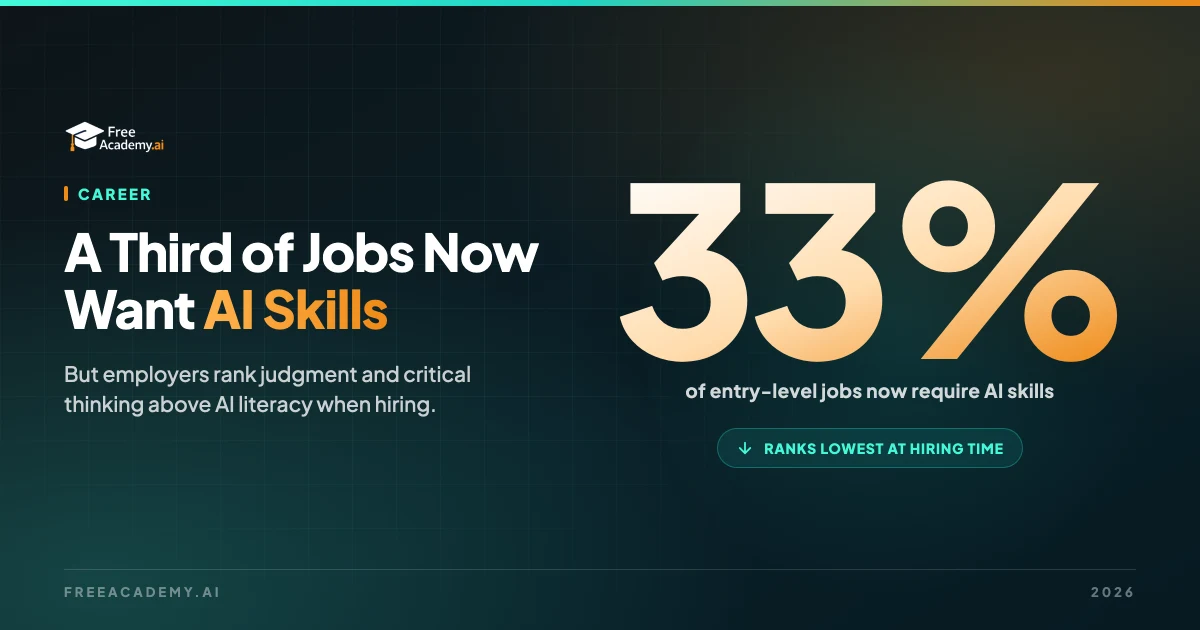
A Third of Entry-Level Jobs Now Ask for AI Skills. Employers Want Something Else More.
AI-skill requirements in entry-level jobs nearly tripled since fall 2025, yet hiring managers rank critical thinking above AI literacy. Here is how to read the data.