

Claude Fable 5 vs Mythos 5: What Is the Difference?

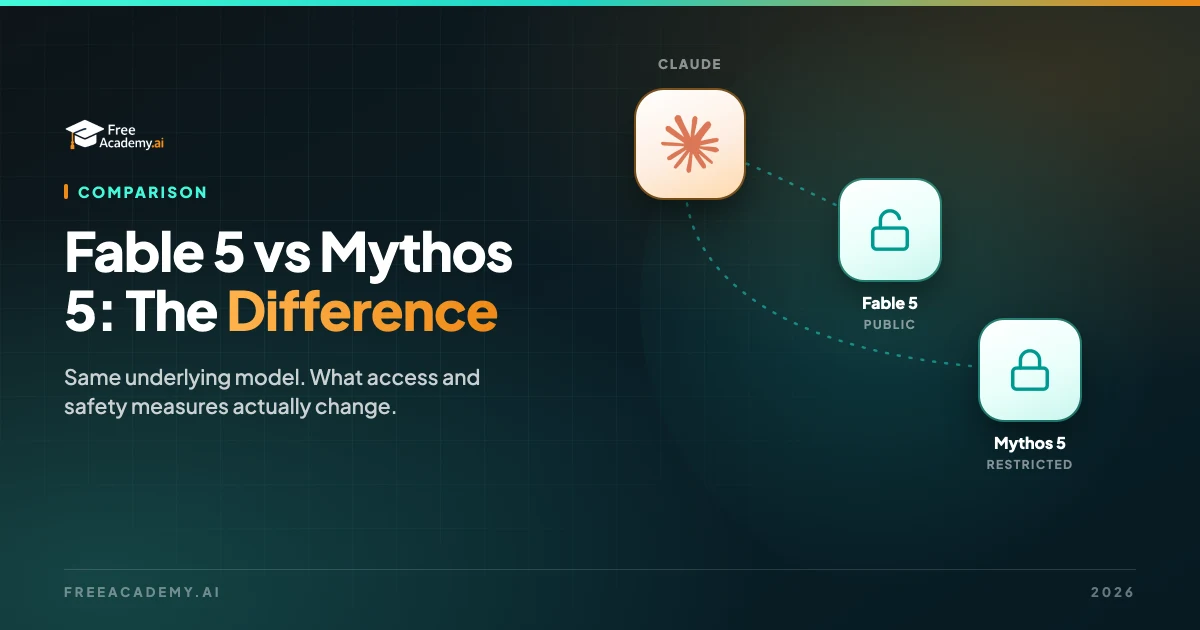
Claude Fable 5 and Claude Mythos 5 share the same underlying model. The difference is not intelligence. It is access: Fable 5 is the version anyone can use and it ships with additional safety measures, while Mythos 5 is offered without those measures to a small set of organizations Anthropic has approved.
That is the whole answer in two sentences. The rest of this post explains why Anthropic split one model into two names, what "dual-use" means here, and what any of this changes for you.
Where Fable 5 and Mythos 5 Sit in the Claude Lineup
Anthropic launched Fable 5 and Mythos 5 on June 9, 2026 as the first models in the Claude 5 family. They also introduced a new tier name for them: Mythos-class, which sits above Claude Opus in capability.
So the lineup, from light to heavy, now looks like this:
- Haiku: fastest and cheapest, for simple high-volume tasks.
- Sonnet 5: the everyday default on claude.ai.
- Opus 4.8: the flagship for hard reasoning and deep coding.
- Fable 5 / Mythos 5: the Mythos-class tier, Anthropic's most capable models.
If your question is which of these to use for a given task, that is a different post: our Claude model guide covers it. This post is only about the Fable vs Mythos split.
One Model, Two Doors
Think of Fable 5 and Mythos 5 as two doors into the same room.
Fable 5 is the public door. It is Anthropic's most intelligent generally available model. You can use it on paid claude.ai plans, through the API, and in Claude Code. It includes additional safety measures aimed at dual-use capabilities.
Mythos 5 is the restricted door. It is the same underlying model without those extra measures, and it is available only to organizations Anthropic has approved. You cannot sign up for it, and there is no Mythos option in the model picker.
"Dual-use" is the key term. It means capabilities that are useful for legitimate work but could also cause harm in the wrong hands. Think of advanced security research or certain areas of biology and chemistry. A vetted lab or defense contractor may have a real need to work at that edge. A general consumer product should not serve those requests to anyone with a credit card. Splitting the model into two named versions lets Anthropic do both at once.
What This Means in Practice
For almost everyone reading this, three things:
Fable 5 is the one you use. When people compare "the best AI models" in 2026, Fable 5 is Anthropic's entry. It is the model on paid Claude plans and the API. If you are choosing a plan, our Claude free vs Pro vs Max comparison covers where Fable 5 shows up.
You lose nothing meaningful to the safety measures. The restrictions target a narrow band of sensitive dual-use requests. Normal work, including coding, writing, analysis, and study, is not what they are about. For everyday tasks, Fable 5 and Mythos 5 would give you the same answers.
Mythos 5 is not a secret better model. It is easy to read "restricted version" as "stronger version". It is not. Same model, same intelligence. The difference is who is allowed to use it with fewer guardrails, based on vetting rather than payment.
Why You May Have Heard These Names Together
Fable 5 and Mythos 5 made news beyond their launch. In June 2026, days after release, both models were named in a US government export-control directive, and Anthropic suspended them globally rather than partially comply. Access was restored on July 1, 2026 after the order was lifted. We covered the full story in our Fable 5 suspension explainer.
That episode is also a good illustration of why the two-name split exists. When regulators, researchers, or journalists talk about frontier capability, having a precise name for each access level of the model makes the conversation concrete. Anthropic explains its own reasoning in the Fable 5 and Mythos 5 announcement.
Key Takeaways
- Fable 5 and Mythos 5 share the same underlying model and launched together on June 9, 2026 as Anthropic's Mythos-class tier, above Opus.
- Fable 5 is generally available and includes additional safety measures for dual-use capabilities.
- Mythos 5 is the same model without those measures, offered only to organizations Anthropic approves. You cannot subscribe to it.
- Mythos 5 is not smarter than Fable 5. The split is about access and guardrails, not capability.
- For day-to-day model choice, Fable 5 is simply the top of the normal Claude lineup.
If you want to get more out of Claude at any tier, start with the free Claude for Beginners course, then go deeper with Prompt Engineering for Claude.
Enjoyed this article?
Join The FreeAcademy Weekly
One practical AI email every Tuesday. New free courses, AI tips, and a short note from the founder.
Free forever. Unsubscribe anytime.
Related articles

Claude Fable 5 Suspended: What Happened (Update: Access Restored)
Claude Fable 5 and Mythos 5 were suspended after a US government directive, then restored on July 1, 2026. Here is the full story and what it means now.
Which Claude Model Should You Use in 2026? Opus vs Sonnet vs Haiku vs Fable
Four Claude models are available today: Haiku, Sonnet 5, Opus, and the restored Fable 5. Here is how to pick by task, with a clear price table.
Claude Free vs Pro vs Max (2026): Usage Limits, Prices, and Which Plan Is Worth It
Claude Pro gives at least 5x the Free usage and Max gives 5x or 20x Pro. How the 5-hour and weekly limits work, what uses them up, and which plan fits you.