

Best Programming Languages for Microservices Architecture in 2026

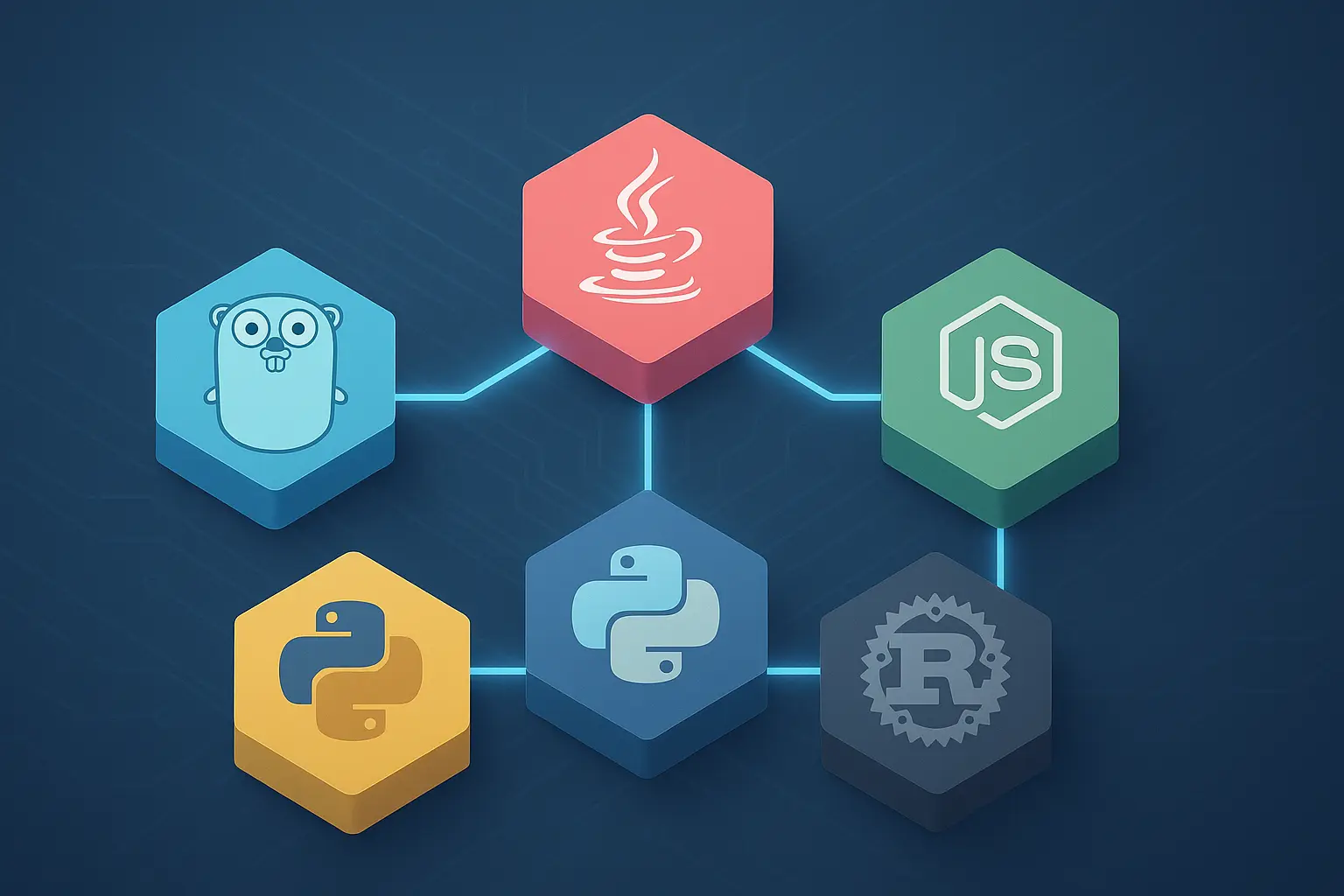
Microservices architecture has become the dominant paradigm for building scalable, maintainable applications. But with so many programming languages available, which ones are best suited for microservices development? Let's explore the top contenders and understand when to use each one.
What Makes a Language Good for Microservices?
Before diving into specific languages, let's consider what characteristics make a language well-suited for microservices:
- Fast startup time — Services need to scale up quickly
- Low memory footprint — Running hundreds of services requires efficiency
- Strong concurrency support — Handling many simultaneous requests
- Rich ecosystem — Libraries for HTTP, messaging, databases, and observability
- Easy containerization — Small container images and fast builds
- Developer productivity — Fast iteration and debugging cycles
Top Languages for Microservices
1. Go (Golang) — The Microservices Champion
Go was practically designed for microservices. Created by Google to handle their massive infrastructure needs, it excels at building lightweight, concurrent services.
Why Go shines:
- Blazing fast compilation — Build times measured in seconds
- Single binary deployment — No runtime dependencies
- Built-in concurrency — Goroutines make concurrent programming simple
- Tiny memory footprint — Services often use just 10-20MB RAM
- Excellent standard library — HTTP server, JSON handling, and more built-in
Best for: API gateways, high-performance services, infrastructure tools, services requiring maximum efficiency.
Popular frameworks: Gin, Echo, Fiber, Go-kit
// A simple Go microservice with Gin
package main

import "github.com/gin-gonic/gin"

func main() {
    r := gin.Default()

    r.GET("/health", func(c *gin.Context) {
        c.JSON(200, gin.H{"status": "healthy"})
    })

    r.GET("/users/:id", func(c *gin.Context) {
        id := c.Param("id")
        c.JSON(200, gin.H{"id": id, "name": "John Doe"})
    })

    r.Run(":8080")
}
Pros:
- Exceptional performance with minimal resource usage
- Simple deployment (single binary, no dependencies)
- Strong typing catches errors at compile time
- Built-in tooling (formatting, testing, profiling)
- Growing ecosystem and community
Cons:
- Less expressive than some languages
- Error handling can be verbose
- Smaller talent pool compared to Java or JavaScript
2. Java/Kotlin — The Enterprise Standard
Java remains the most widely used language for microservices in enterprise environments. With frameworks like Spring Boot and Quarkus, Java has adapted well to the microservices era.
Why Java shines:
- Mature ecosystem — Decades of libraries and tooling
- Strong typing — Catches errors at compile time
- Excellent IDE support — IntelliJ, Eclipse offer unmatched tooling
- Enterprise adoption — Most large companies have Java expertise
- GraalVM native images — Addresses the cold start problem
Best for: Enterprise applications, complex business logic, teams with existing Java expertise, systems requiring extensive library support.
Popular frameworks: Spring Boot, Quarkus, Micronaut, Helidon
// Spring Boot microservice
@RestController
@RequestMapping("/api")
public class UserController {

    @GetMapping("/health")
    public Map<String, String> health() {
        return Map.of("status", "healthy");
    }

    @GetMapping("/users/{id}")
    public ResponseEntity<User> getUser(@PathVariable Long id) {
        User user = userService.findById(id);
        return ResponseEntity.ok(user);
    }
}
Pros:
- Vast ecosystem of battle-tested libraries
- Excellent observability and monitoring tools
- Strong enterprise support and long-term stability
- Kotlin offers modern syntax while maintaining JVM compatibility
- Quarkus and GraalVM native images dramatically improve startup times
Cons:
- Higher memory footprint than Go or Rust
- Slower cold starts (mitigated by native images)
- Can be verbose (Kotlin helps with this)
3. Node.js/TypeScript — The Full-Stack Favorite
Node.js, especially with TypeScript, offers a compelling option for microservices, particularly when your team already works with JavaScript on the frontend.
Why Node.js shines:
- Same language everywhere — Frontend and backend in one language
- Massive npm ecosystem — A package for everything
- Fast development — Rapid prototyping and iteration
- Event-driven architecture — Natural fit for I/O-bound services
- TypeScript safety — Optional static typing for reliability
Best for: BFF (Backend for Frontend) services, real-time applications, teams with JavaScript expertise, rapid prototyping.
Popular frameworks: NestJS, Fastify, Express, Hono
// NestJS microservice
import { Controller, Get, Param } from '@nestjs/common';

@Controller('api')
export class UserController {
  constructor(private readonly userService: UserService) {}

  @Get('health')
  health(): { status: string } {
    return { status: 'healthy' };
  }

  @Get('users/:id')
  async getUser(@Param('id') id: string): Promise<User> {
    return this.userService.findById(id);
  }
}
Pros:
- Unified language across frontend and backend
- Excellent for I/O-heavy workloads
- Huge ecosystem and community
- TypeScript adds type safety without sacrificing flexibility
- Great tooling for microservices (NestJS, Fastify)
Cons:
- Single-threaded (worker threads help but add complexity)
- Not ideal for CPU-intensive tasks
- Runtime errors can slip through without TypeScript
- Dependency management can be challenging (node_modules)
4. Python — The Data and ML Powerhouse
Python might not be the fastest language, but its simplicity and powerful data science libraries make it invaluable for certain microservices.
Why Python shines:
- Readable and maintainable — Clear, concise syntax
- ML/AI dominance — TensorFlow, PyTorch, scikit-learn
- Data processing — Pandas, NumPy for data manipulation
- FastAPI performance — Modern async framework rivals Node.js
- Quick development — Prototype to production fast
Best for: ML inference services, data processing pipelines, ETL services, internal tools, services where development speed trumps runtime performance.
Popular frameworks: FastAPI, Flask, Django, Litestar
# FastAPI microservice
from fastapi import FastAPI, HTTPException
from pydantic import BaseModel

app = FastAPI()

class User(BaseModel):
    id: int
    name: str
    email: str

@app.get("/health")
async def health():
    return {"status": "healthy"}

@app.get("/users/{user_id}")
async def get_user(user_id: int) -> User:
    user = await user_service.find_by_id(user_id)
    if not user:
        raise HTTPException(status_code=404, detail="User not found")
    return user
Pros:
- Fastest development cycle
- Unbeatable for ML/AI workloads
- FastAPI provides excellent performance and automatic OpenAPI docs
- Huge community and extensive libraries
- Easy to learn and hire for
Cons:
- Slower runtime performance than compiled languages
- GIL limits true parallelism (mitigated by async and multiprocessing)
- Dynamic typing can lead to runtime errors
- Higher memory usage
5. Rust — The Performance King
Rust is gaining traction for microservices where performance and reliability are critical. It offers C-level performance with memory safety guarantees.
Why Rust shines:
- Zero-cost abstractions — High-level code, low-level performance
- Memory safety — No null pointers, no data races
- Tiny binaries — Even smaller than Go
- Predictable performance — No garbage collection pauses
- Growing ecosystem — Actix-web, Axum offer mature frameworks
Best for: Performance-critical services, systems programming, services handling sensitive data, infrastructure components, edge computing.
Popular frameworks: Actix-web, Axum, Rocket, Warp
// Axum microservice
use axum::{routing::get, Router, Json, extract::Path};
use serde::Serialize;

#[derive(Serialize)]
struct Health {
    status: String,
}

#[derive(Serialize)]
struct User {
    id: u64,
    name: String,
}

async fn health() -> Json<Health> {
    Json(Health { status: "healthy".to_string() })
}

async fn get_user(Path(id): Path<u64>) -> Json<User> {
    Json(User { id, name: "John Doe".to_string() })
}

#[tokio::main]
async fn main() {
    let app = Router::new()
        .route("/health", get(health))
        .route("/users/:id", get(get_user));

    let listener = tokio::net::TcpListener::bind("0.0.0.0:8080")
        .await
        .unwrap();

    axum::serve(listener, app).await.unwrap();
}
Pros:
- Best-in-class performance
- Memory safety without garbage collection
- Predictable latency (no GC pauses)
- Excellent for security-critical services
- Small binary sizes and fast startup
Cons:
- Steep learning curve
- Slower development velocity initially
- Smaller talent pool
- Longer compile times
Language Comparison Matrix
| Criteria | Go | Java | Node.js | Python | Rust |
|---|---|---|---|---|---|
| Startup Time | Excellent | Good* | Good | Good | Excellent |
| Memory Usage | Excellent | Moderate | Moderate | Moderate | Excellent |
| Concurrency | Excellent | Excellent | Good | Good | Excellent |
| Ecosystem | Good | Excellent | Excellent | Excellent | Growing |
| Learning Curve | Low | Moderate | Low | Low | High |
| Hiring Pool | Moderate | Excellent | Excellent | Excellent | Limited |
| Development Speed | Good | Moderate | Excellent | Excellent | Moderate |
| Type Safety | Good | Excellent | Good** | Moderate*** | Excellent |
*With GraalVM native images or modern frameworks like Quarkus **With TypeScript ***With type hints and mypy
Making the Right Choice
There's no universally "best" language for microservices. Consider these factors:
Choose Go when:
- Building high-throughput API services
- Resource efficiency is critical (cloud costs matter)
- You need simple deployment (single binary)
- Building infrastructure or DevOps tools
- Your team values simplicity over expressiveness
Choose Java/Kotlin when:
- Working in an enterprise environment with existing Java expertise
- Complex business logic with many edge cases
- You need extensive library support (banking, healthcare, etc.)
- Long-term maintainability is paramount
- You want the mature Spring ecosystem
Choose Node.js/TypeScript when:
- Full-stack JavaScript teams want consistency
- Building BFF (Backend for Frontend) services
- Real-time features are needed (WebSockets, SSE)
- Rapid development and iteration is priority
- Your services are primarily I/O-bound
Choose Python when:
- Building ML/AI inference services
- Data processing and ETL pipelines
- Development speed matters more than runtime performance
- Prototyping services that may be rewritten later
- Your team's expertise is in Python
Choose Rust when:
- Maximum performance is required (low latency, high throughput)
- Memory safety is critical (security-sensitive services)
- Building system-level or infrastructure services
- Predictable performance without GC pauses is needed
- You're willing to invest in the learning curve
The Polyglot Approach
Many successful organizations use multiple languages in their microservices architecture. This "polyglot" approach lets you pick the right tool for each job:
- Go for API gateways, load balancers, and high-traffic services
- Java for complex business services and enterprise integrations
- Python for ML inference, data processing, and analytics services
- Node.js for BFF services and real-time features
- Rust for performance-critical edge services
The key is establishing good inter-service communication standards (REST, gRPC, message queues) so services can interact regardless of their implementation language.
Best Practices for Polyglot Microservices
- Standardize communication protocols — Use OpenAPI/Swagger, gRPC, or AsyncAPI
- Consistent observability — Same logging format, tracing (OpenTelemetry), and metrics
- Shared infrastructure — Common CI/CD pipelines, container orchestration
- Clear ownership — Each team owns services in languages they're expert in
- Documentation — Document why each language was chosen for each service
Real-World Examples
Netflix
Uses a polyglot architecture with:
- Java for core business services
- Node.js for API gateway and BFF
- Python for data pipelines and ML
Uber
- Go for high-performance services (geofence, dispatch)
- Java for business logic services
- Python for ML and data science
- Node.js for web applications
Cloudflare
- Rust for performance-critical edge services
- Go for infrastructure tooling
- TypeScript for dashboard and API services
Conclusion
The "best" language for microservices depends on your specific needs, team expertise, and use case:
- Go and Rust excel at performance-critical services with minimal resource usage
- Java dominates in enterprises requiring stability, extensive libraries, and long-term support
- Node.js/TypeScript wins for full-stack teams and rapid development
- Python is unbeatable for data science, ML workloads, and quick prototyping
Start with what your team knows best, but don't be afraid to introduce new languages for specific services where they provide clear advantages. The beauty of microservices is that each service can be implemented in the language best suited for its particular requirements.
The key is to make informed decisions based on your specific context—team skills, performance requirements, ecosystem needs, and long-term maintainability—rather than following trends.
What language are you using for your microservices? The best choice is the one that helps your team ship reliable software efficiently.
Ready to put these skills into practice? FreeAcademy's free Docker Essentials for Developers course covers containerizing microservices, and the Interactive REST API Design course walks you through building production-ready APIs step by step.
Enjoyed this article?
Join The FreeAcademy Weekly
One practical AI email every Tuesday. New free courses, AI tips, and a short note from the founder.
Free forever. Unsubscribe anytime.
Related articles
Python vs Go for Microservices: Performance, Scalability & DX Comparison (2026)
An in-depth comparison of Python and Go for microservices development. Benchmark data on latency, throughput, and memory usage plus real code examples for FastAPI, Flask, Gin, and Fiber.
Building AI Agents with Node.js and TypeScript: A JavaScript Developer's Guide to the AI Revolution
Discover how JavaScript developers can build production-ready AI agents without learning Python. Learn about autonomous agents, tool calling, RAG, and full-stack AI applications using Node.js, TypeScript, and the Vercel AI SDK.
CrewAI vs AutoGen for Multi-Agent Orchestration in 2026
How CrewAI and AutoGen orchestrate multi-agent systems: role-based crews, conversational teams, and the workflow patterns that fit each approach.
