Best Free AI Course for High School Students (With Certificate)

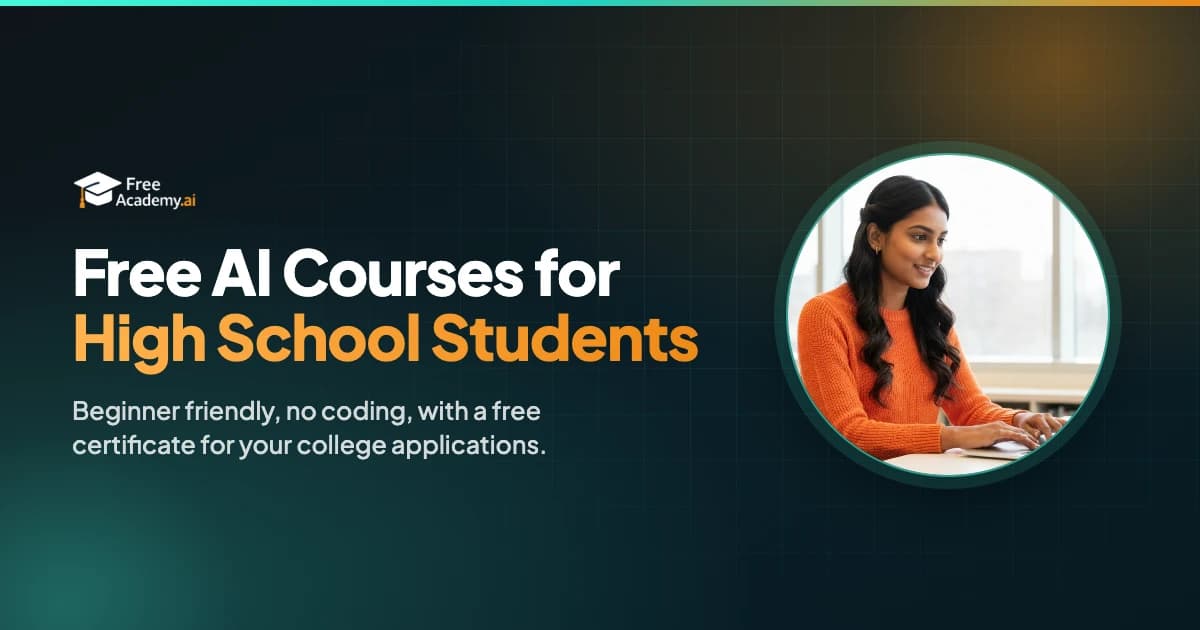
If you are in high school right now, you are growing up alongside the most powerful learning tools ever made. AI assistants like ChatGPT, Claude, and Gemini can explain a tricky physics concept three different ways, quiz you before an exam, or help you plan a science fair project. The students who learn to use these tools well, and use them honestly, will have a real head start in college and beyond.
The good news: you do not need money, a fast computer, or any coding background to start. This guide rounds up the best free AI courses for high school students, all available on FreeAcademy.ai, all beginner friendly, and all with a free certificate you can show on college applications or an early LinkedIn profile.
Why high school is the perfect time to learn AI
Learning AI as a teenager is different from learning it as a working professional. You are not trying to automate a job. You are trying to learn faster, think more clearly, and build skills that compound for years.
Here is what makes this the right moment:
- You learn habits early. Forming good AI habits now, like checking facts and writing your own first draft, is far easier than unlearning bad ones later.
- It helps with actual schoolwork. Used the right way, AI is a patient tutor that never gets tired of your questions.
- It looks great on applications. A free certificate shows initiative and self-directed learning, two things admissions officers and early employers notice.
- It is genuinely fun. Generating images, building a simple project, or having AI explain a meme reference can make learning feel less like a chore.
A quick note for parents and teachers reading this: the courses below emphasize responsible, honest use. They teach students to treat AI as a study partner that supports thinking, not a machine that replaces it.
How we chose these courses
We focused on courses that are:
- Truly free, with no trial, no credit card, and a free certificate on completion.
- Beginner level, assuming no coding and no prior AI experience.
- Short enough to finish. Shorter, focused courses get completed far more often than long ones, which matters when you are juggling school. We lead with quick micro courses for that reason.
- Globally relevant, with examples that work whether you are in Mumbai, Manila, Lagos, or London.
The best free AI courses for high school students
1. AI for Everyday Life (start here)
AI for Everyday Life is the gentlest possible on-ramp. It walks you through using ChatGPT, Claude, and Gemini for real daily tasks with zero technical background.
Why it fits a high schooler: It does not assume you know anything. You learn the basic moves, how to ask a question well, how to follow up, and how to spot when the AI is wrong, using situations from ordinary life.
What you will be able to do: Confidently open any AI assistant and get useful help with writing, research, planning, and explanations.
Free, with certificate. A perfect first course before anything else.
2. ChatGPT for Complete Beginners
ChatGPT for Complete Beginners is a friendly, step by step guide to the most popular AI tool. You set up an account, have your first conversations, and learn to write prompts that actually get good answers.
Why it fits a high schooler: ChatGPT is probably the first AI tool your classmates are using. This course makes sure you understand it properly instead of just guessing.
What you will be able to do: Use ChatGPT to break down hard reading, draft and improve your own writing, and study for tests with custom practice questions.
Free, with certificate.
3. Claude for Beginners
Claude for Beginners introduces Claude, an AI assistant that is especially strong at careful explanations and longer writing. This is a micro course, so you can finish it in one sitting.
Why it fits a high schooler: It is great to know more than one tool. Claude is excellent for working through essays, summarizing long documents, and explaining your reasoning back to you so you can check it.
What you will be able to do: Use Claude to outline essays, summarize textbook chapters, and get step by step help on problems.
Free, with certificate.
4. AI Essentials: Understanding AI
AI Essentials answers the bigger question: what actually is AI, and how does it work? It covers the fundamentals without the heavy jargon.
Why it fits a high schooler: Knowing how AI works helps you trust it less blindly. You will understand why it sometimes makes things up, which makes you a smarter, safer user.
What you will be able to do: Explain in plain language what AI is, how large language models generate answers, and why fact-checking matters.
Free, with certificate. A strong pick if you are curious about studying computer science or AI later.
5. Prompt Engineering in 30 Minutes
Prompt Engineering in 30 Minutes teaches the single skill that separates good AI results from frustrating ones: how to ask. You will learn a simple prompt formula you can reuse forever.
Why it fits a high schooler: The difference between a vague answer and genuinely helpful study support is almost always the prompt. This is a quick, high-payoff win.
What you will be able to do: Write clear, specific prompts that get better study help, better feedback on your writing, and better project ideas.
Free, with certificate. If you only have half an hour, this is a great use of it. For more practice, Write Better ChatGPT Prompts covers a handy framework too.
6. Research 10x Faster with AI
Research 10x Faster with AI is built for exactly the kind of work high schoolers do: essays, projects, and science fair research. It shows you how to use AI for research while fact-checking properly.
Why it fits a high schooler: Research projects eat time. This course teaches you to find sources faster and, just as importantly, to verify them so you do not repeat AI mistakes.
What you will be able to do: Frame research questions, gather and check information quickly, and avoid passing along false facts.
Free, with certificate.
7. AI Ethics and Responsible AI
AI Ethics and Responsible AI covers the part that matters most for students: using AI honestly and safely. It explores bias, privacy, hallucinations, deepfakes, and what responsible use really means.
Why it fits a high schooler: Schools have rules about AI for good reasons. Understanding the ethics helps you stay on the right side of academic honesty and protect your own privacy online.
What you will be able to do: Recognize when AI output is biased or wrong, protect your personal information, and use AI in line with your school's rules.
Free, with certificate. A smart course to pair with any of the tool-based ones above.
A simple learning path
You do not have to take all seven at once. Here is an order that works well around a school schedule:
- Start: AI for Everyday Life, to get comfortable.
- Pick a tool: ChatGPT for Complete Beginners or Claude for Beginners.
- Level up: Prompt Engineering in 30 Minutes, so your results improve fast.
- Apply it: Research 10x Faster with AI for your next project or essay.
- Stay responsible: AI Ethics and Responsible AI, and AI Essentials if you want the bigger picture.
Each finished course adds a certificate, so by the end you have a small but real set of credentials.
How to use AI for school without cheating
This is the part every student, parent, and teacher cares about. The line is simpler than it sounds.
Honest, helpful uses:
- Asking AI to explain a concept you do not understand, in simpler terms.
- Generating practice questions to quiz yourself before a test.
- Getting feedback on an essay you wrote yourself.
- Brainstorming project ideas, then doing the work yourself.
- Checking your reasoning on a math or science problem after you attempt it.
Uses that cross the line:
- Copying AI-written text and submitting it as your own.
- Having AI do an assignment you were meant to do yourself.
- Using AI during a test or in any way your school forbids.
A good rule of thumb: AI should help you understand and improve your own work, not replace it. If you would be uncomfortable showing your teacher exactly how you used it, that is a sign to stop. The AI Ethics and Responsible AI course goes deeper on this.
What about the certificate?
Every course here gives you a free completion certificate when you finish. It is proof that you completed the course. You can:
- Add it to a college or scholarship application to show initiative.
- List it on an early LinkedIn profile as you start building one.
- Keep it as a record of skills you are building over time.
Be honest about what it is, a completion certificate, not a degree, and it becomes a genuine signal that you take learning seriously.
Key takeaways
- High school is an ideal time to learn AI: you build good habits early and pick up skills that help with schoolwork right now.
- The best starting courses are free, beginner friendly, require no coding, and are short enough to finish.
- Begin with AI for Everyday Life, then add a tool course, prompt skills, and research skills.
- Use AI to support your thinking, not to replace it, and stay inside your school's rules.
- Every course gives a free certificate you can use on applications and an early LinkedIn profile.
Already in college, or close to it? Our companion guide to the best free AI courses for students covers tools and workflows aimed at university coursework and internships. And if you want ready-made prompts to try right away, see 50 ChatGPT prompts for students.
Start learning today
You can start your first free AI course in the next five minutes, no payment and no setup headaches. Begin with AI for Everyday Life to get comfortable, then keep going at your own pace. Learn the tools now, use them honestly, and give your future self a real advantage.
Enjoyed this article?
Join The FreeAcademy Weekly
One practical AI email every Tuesday. New free courses, AI tips, and a short note from the founder.
Free forever. Unsubscribe anytime.
Related articles
Best Free Prompt Engineering Courses in 2026 (Ranked by Quality)
Top 8 free prompt engineering courses ranked by quality. Interactive exercises, video tutorials, and hands-on practice to master AI prompting in 2026.
Best Free AI Courses for Students in 2026 (With Certificates)
Discover the best free AI courses for students in 2026. Learn artificial intelligence, prompt engineering, and more — with free certificates to boost your resume.
Best Courses for Building AI Apps with APIs in 2026
Compare the top courses for building AI applications with OpenAI, Claude, Gemini, and other APIs. Free tutorials, hands-on projects, and learning paths for every skill level.