Free AI Learning Path for Students in 2026: Beginner to Job-Ready


Artificial intelligence is reshaping every industry, and students who build AI skills now will have a major advantage in the job market. The good news is that you do not need to spend thousands of dollars to get started. With the right ai for students free course options, you can go from complete beginner to job-ready professional without paying a cent.
This guide lays out a clear, step-by-step learning path that any student can follow in 2026. Whether you are a freshman exploring career options or a senior preparing for interviews, this roadmap will help you build real AI skills that employers actually want.
Why Every Student Needs an AI Learning Path in 2026
The demand for AI skills has exploded. According to LinkedIn's 2026 Jobs on the Rise report, AI-related roles grew by over 60 percent year-over-year. But here is the challenge: most students do not know where to start, and the sheer volume of available resources can feel overwhelming.
A structured learning path solves this problem. Instead of jumping between random tutorials, you follow a logical progression that builds knowledge layer by layer. And with so many high-quality ai for students free course platforms available today, cost is no longer a barrier.
If you want a curated list of the top platforms, check out our guide on the best free AI courses for students.
Phase 1: Build Your Foundation (Weeks 1-4)
Understand AI Concepts and Terminology
Before diving into code, you need a solid grasp of what AI actually is and how it works at a high level. Start with introductory courses that cover:
- The difference between AI, machine learning, and deep learning
- Common AI applications in everyday life
- Ethical considerations and responsible AI use
- Basic data literacy concepts
Our AI courses for absolute beginners guide highlights the best starting points for this phase.
Learn Python Basics
Python is the language of AI. You do not need to become an expert programmer, but you should be comfortable with variables, loops, functions, and basic data structures. Spend two to three weeks on Python fundamentals before moving forward.
FreeAcademy offers a complete Python Basics course that covers everything you need to start your AI journey.
Phase 2: Develop Core AI Skills (Weeks 5-12)
Master Prompt Engineering
One of the most immediately useful AI skills is prompt engineering. Learning how to communicate effectively with AI models like ChatGPT and Claude is valuable in virtually every career path. This is also where an ai for students free course on prompt engineering can deliver quick wins for your resume.
Explore our recommended free prompt engineering courses to find the right fit for your level.
Explore Machine Learning Fundamentals
Once you have the basics down, move into machine learning. Focus on understanding:
- Supervised vs. unsupervised learning
- Common algorithms like linear regression, decision trees, and k-nearest neighbors
- How to evaluate model performance
- Working with popular libraries like scikit-learn
You do not need to understand every mathematical detail. Focus on building intuition and getting hands-on practice with real datasets.
Work With Data
AI runs on data. Learn the basics of data cleaning, exploration, and visualization using tools like pandas and matplotlib. Understanding how to prepare data for AI models is a skill that separates job-ready candidates from beginners.
Phase 3: Specialize and Build Projects (Weeks 13-20)
Choose Your AI Specialization
By this stage, you should have enough knowledge to identify what excites you most. Common specialization paths include:
- Natural Language Processing (NLP) -- chatbots, text analysis, sentiment detection
- Computer Vision -- image recognition, object detection
- AI for Business -- automation, analytics, decision support
- Generative AI -- content creation, image generation, AI agents
Pick one area and go deep. Find an ai for students free course that focuses on your chosen specialization and complete it thoroughly.
Build a Portfolio of Projects
This is the most important phase. Employers care far more about what you can build than what certificates you hold. Aim to complete at least three projects:
- A guided project from a course to demonstrate foundational skills
- A personal project that solves a real problem you care about
- An open-source contribution or collaborative project that shows teamwork
Document each project on GitHub with clear README files explaining your approach, the tools you used, and the results you achieved.
Phase 4: Get Certified and Job-Ready (Weeks 21-24)
Earn Recognized AI Certifications
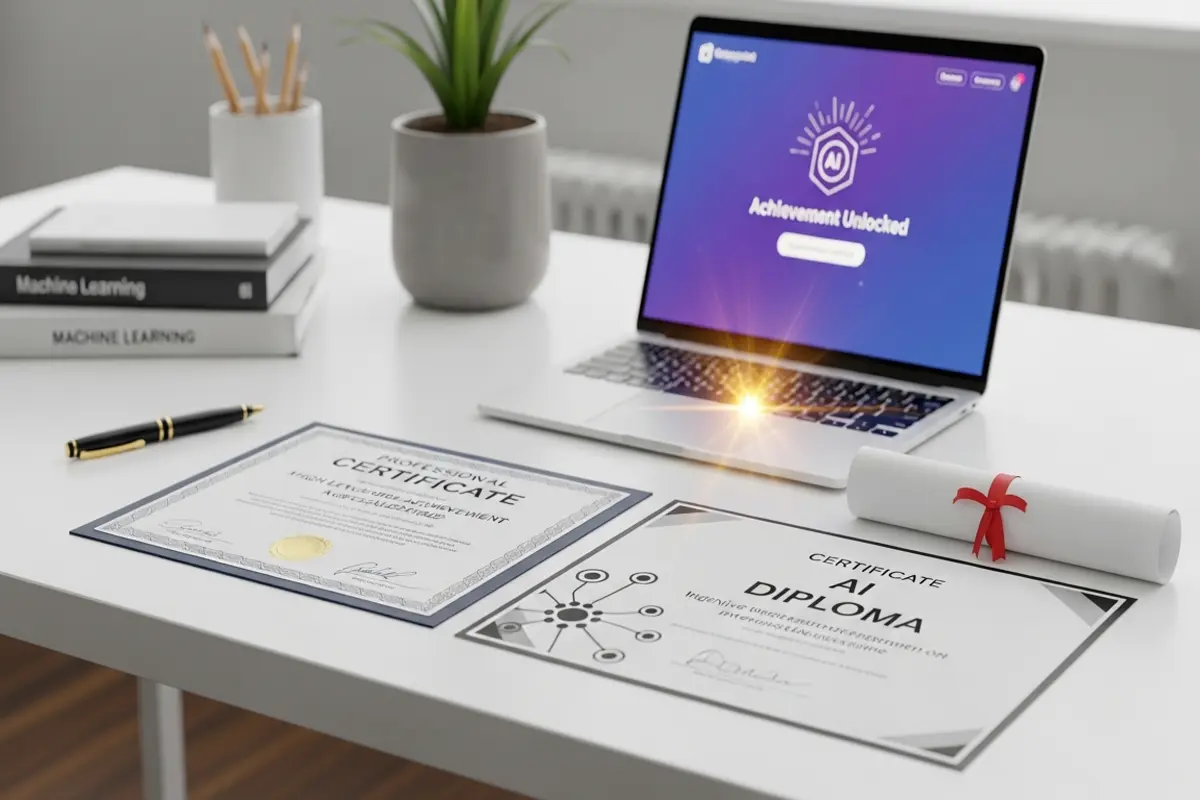
Free certifications add credibility to your resume and LinkedIn profile. Look for certificates from platforms that employers recognize. Our guide on free AI certifications employers value breaks down which ones carry the most weight in hiring decisions.
Stack two to three certifications that align with your specialization to create a compelling credential set.
Prepare for AI Job Interviews
The final step is interview preparation. Study common AI interview questions, practice explaining your projects clearly, and be ready to discuss both technical concepts and real-world applications. If you are also interested in development roles, our guide on how to land a developer job in 2026 offers practical advice that applies to AI positions as well.
Tips for Staying on Track
Following a learning path requires discipline, especially when every ai for students free course is self-paced. Here are some practical tips:
- Set weekly goals. Break each phase into specific, measurable tasks.
- Join a study group. Find classmates or online communities studying the same material.
- Track your progress. Use a simple spreadsheet or app to log completed courses and projects.
- Apply what you learn immediately. After each lesson, try to use the concept in a small project or exercise.
- Do not skip the fundamentals. Rushing ahead without solid basics leads to frustration later.
Key Takeaways
The path from AI beginner to job-ready professional is shorter than most students think. With the right ai for students free course resources and a structured approach, you can build competitive AI skills in under six months. Start with foundations, develop core skills, specialize through real projects, and earn certifications that employers respect.
The AI job market is growing fast, and free learning resources have never been better. The only thing standing between you and a career in AI is the decision to start.
Ready to take the first step? Browse the FreeAcademy AI course catalog and begin your learning path today.
Enjoyed this article?
Join The FreeAcademy Weekly
One practical AI email every Tuesday. New free courses, AI tips, and a short note from the founder.
Free forever. Unsubscribe anytime.
Related articles
Best Free AI Certifications in 2026
Compare the 11 best free AI certifications in 2026 — from Google, Microsoft, IBM, and FreeAcademy.ai. Includes a comparison table with time, issuer, and recognition level to help you choose.
Best Free Alternatives to Coursera Certificates in 2026
Coursera certificates cost $49-99+. Discover the best free alternatives for online course certificates in 2026, including FreeAcademy.ai, freeCodeCamp, MIT OpenCourseWare, Khan Academy, and The Odin Project.
Best Free AI Certifications That Actually Matter to Employers (2026)
The best free AI certifications employers actually value in 2026. Compare top options, learn which credentials stand out on a CV, and where to get started.