

Why SQL Databases Dominate
Introduction
In the previous lesson, we explored different types of databases. But if you look at what developers actually use, one pattern becomes crystal clear: SQL databases dominate. According to Stack Overflow's 2025 Developer Survey, the top databases are:
- PostgreSQL - 55.6%
- MySQL - 40.5%
- SQLite - 37.5%
- Microsoft SQL Server - 30.1%
Notice a pattern? The top 4 are all SQL databases. In fact, Redis (28%)—a NoSQL database—is the first non-SQL entry, and MongoDB (24%) comes in 6th.
Why do SQL databases continue to dominate despite decades of "NoSQL will replace SQL" predictions? Let's explore the reasons.
The Numbers Don't Lie
Stack Overflow Developer Survey 2025
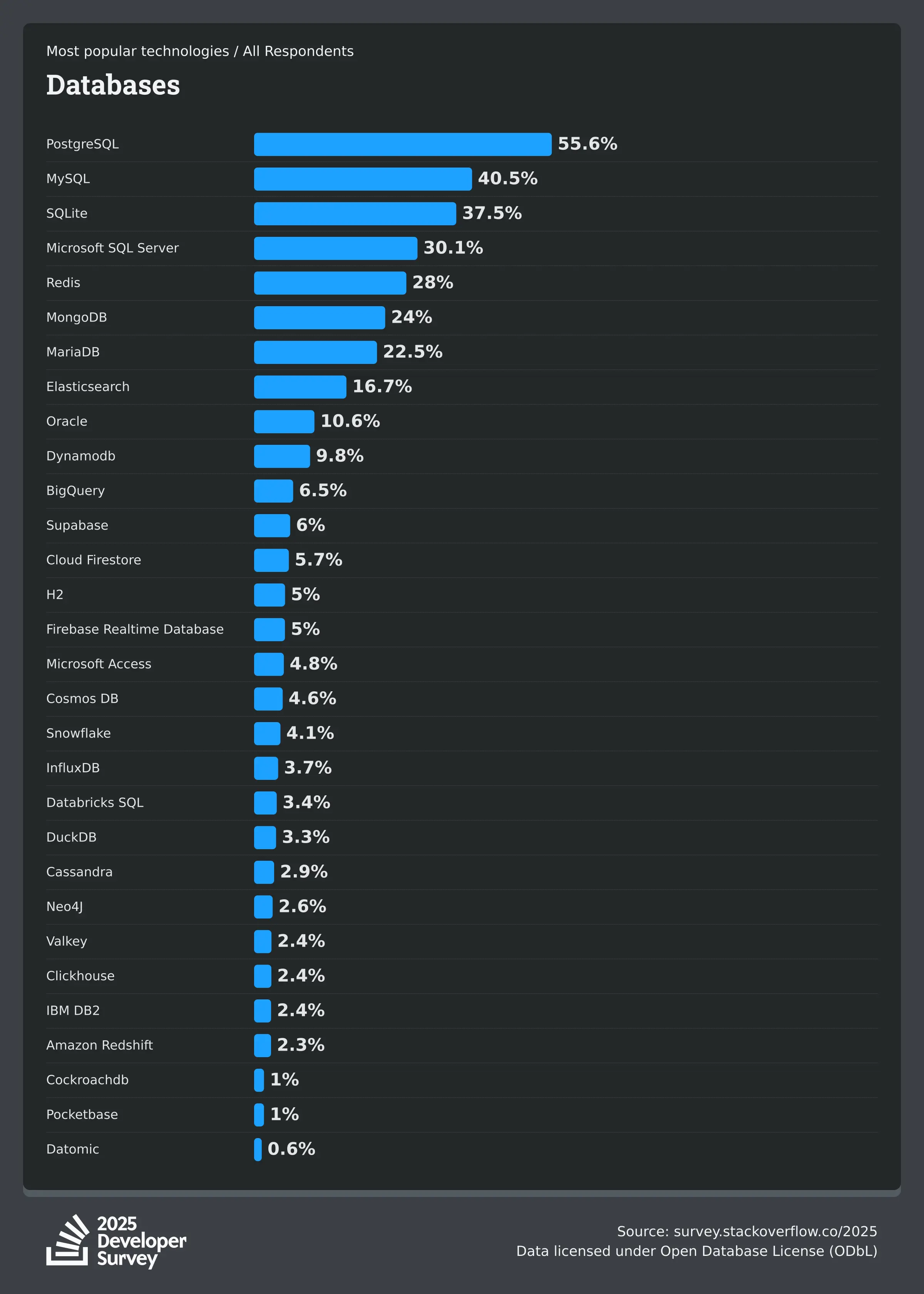
Key insights:
- PostgreSQL leads at 55.6%—more than half of all developers use it
- Combined SQL databases (PostgreSQL, MySQL, SQLite, SQL Server) far exceed NoSQL adoption
- Growth in Redis (+8%) shows the complementary role of NoSQL, not replacement
- SQLite at 37.5% shows SQL's reach from mobile apps to embedded systems
Industry Trends
- Enterprise: SQL databases (Oracle, SQL Server, MySQL) dominate large organizations—major corporations like Wells Fargo, GE, and Yahoo rely on SQL Server
- Startups: Most begin with PostgreSQL or MySQL, add NoSQL later if needed
- Data jobs: SQL is the #1 requested skill, appearing in 50-60% of data analyst/scientist job postings
- Cloud platforms: AWS RDS, Google Cloud SQL, Azure SQL—all SQL-focused
Why SQL Databases Dominate
1. ACID Guarantees
ACID (Atomicity, Consistency, Isolation, Durability) ensures reliable transactions:
Atomicity
Transactions succeed completely or fail completely—no partial updates.
-- Transfer money between accounts
BEGIN TRANSACTION;

UPDATE accounts SET balance = balance - 100 WHERE id = 1;  -- Deduct from Alice
UPDATE accounts SET balance = balance + 100 WHERE id = 2;  -- Add to Bob

COMMIT;  -- Both happen, or neither happens
If the database crashes between the two UPDATEs, the transaction rolls back. No money gets lost!
Consistency
Data always follows defined rules (constraints, foreign keys).
CREATE TABLE orders (
    id SERIAL PRIMARY KEY,
    customer_id INTEGER NOT NULL REFERENCES customers(id),
    amount DECIMAL(10,2) CHECK (amount > 0)
);

-- This fails: can't reference non-existent customer
INSERT INTO orders (customer_id, amount) VALUES (99999, 100);

-- This fails: amount must be positive
INSERT INTO orders (customer_id, amount) VALUES (1, -50);
Isolation
Concurrent transactions don't interfere with each other.
-- Transaction 1
BEGIN;
SELECT balance FROM accounts WHERE id = 1;  -- Sees $500
-- (Transaction 2 runs here)
UPDATE accounts SET balance = balance - 100 WHERE id = 1;
COMMIT;

-- Transaction 2 (concurrent)
BEGIN;
SELECT balance FROM accounts WHERE id = 1;  -- Also sees $500 (isolated)
UPDATE accounts SET balance = balance - 50 WHERE id = 1;
COMMIT;

-- Final balance: $350 (both updates applied correctly)
Durability
Committed data survives crashes, power failures, etc.
Why This Matters:
NoSQL databases often trade ACID for performance/scalability. But for:
- Banking: Can't lose money in a crash
- E-commerce: Can't oversell inventory
- Healthcare: Can't corrupt patient records
ACID is non-negotiable.
2. Powerful Query Language
SQL lets you answer complex questions in a single query:
Example: Business Question
"What are the top 5 customers by total purchase amount in 2024, and what categories do they buy most?"
SQL Solution:
WITH customer_totals AS (
    SELECT
        c.id,
        c.name,
        SUM(o.amount) as total_spent
    FROM customers c
    JOIN orders o ON c.id = o.customer_id
    WHERE EXTRACT(YEAR FROM o.order_date) = 2024
    GROUP BY c.id, c.name
    ORDER BY total_spent DESC
    LIMIT 5
),
top_categories AS (
    SELECT
        ct.name as customer_name,
        p.category,
        COUNT(*) as purchases
    FROM customer_totals ct
    JOIN orders o ON ct.id = o.customer_id
    JOIN order_items oi ON o.id = oi.order_id
    JOIN products p ON oi.product_id = p.id
    GROUP BY ct.name, p.category
)
SELECT
    customer_name,
    category,
    purchases
FROM (
    SELECT
        *,
        ROW_NUMBER() OVER (PARTITION BY customer_name ORDER BY purchases DESC) as rn
    FROM top_categories
) ranked
WHERE rn = 1;
Try doing this in a NoSQL database! You'd need:
- Multiple separate queries
- Application code to join and aggregate
- More complexity and room for errors
3. Data Integrity and Relationships
SQL databases enforce relationships between data:
CREATE TABLE customers (
    id SERIAL PRIMARY KEY,
    name VARCHAR(100) NOT NULL,
    email VARCHAR(100) UNIQUE NOT NULL
);

CREATE TABLE orders (
    id SERIAL PRIMARY KEY,
    customer_id INTEGER NOT NULL REFERENCES customers(id) ON DELETE CASCADE,
    order_date DATE NOT NULL,
    amount DECIMAL(10,2) NOT NULL
);

-- This fails: customer 999 doesn't exist
INSERT INTO orders (customer_id, order_date, amount)
VALUES (999, '2024-01-15', 100.00);

-- This works: customer 1 exists
INSERT INTO orders (customer_id, order_date, amount)
VALUES (1, '2024-01-15', 100.00);

-- Delete customer → orders automatically deleted (CASCADE)
DELETE FROM customers WHERE id = 1;
NoSQL approach: You'd need to:
- Manually check if customer exists (application code)
- Manually delete related orders (more code, more bugs)
- Hope your code never misses an edge case
4. Proven Scalability
"But NoSQL scales better!" Not so fast.
SQL databases have scaled to massive sizes:
- Facebook: Stores petabytes of data in MySQL
- Instagram: Runs on PostgreSQL with billions of users
- Uber: PostgreSQL for core transactional data
- Netflix: Uses PostgreSQL for critical data
Scaling techniques:
- Vertical scaling: More powerful servers
- Read replicas: Distribute read traffic
- Sharding: Partition data across servers
- Connection pooling: Handle thousands of connections
Modern SQL databases scale horizontally too:
- PostgreSQL: Citus extension for distributed queries
- CockroachDB: Distributed SQL (PostgreSQL compatible)
- Google Spanner: Global SQL database
5. Mature Ecosystem
SQL has 50+ years of development:
Tools
- ORMs: SQLAlchemy (Python), Hibernate (Java), Sequelize (JavaScript)
- GUI clients: pgAdmin, DBeaver, TablePlus, DataGrip
- Migration tools: Flyway, Liquibase, Alembic
- Monitoring: pganalyze, Datadog, New Relic
- Cloud services: AWS RDS, Google Cloud SQL, Azure Database
Knowledge
- Thousands of books, courses, tutorials
- Millions of Stack Overflow answers
- Decades of best practices
- Large community of experts
Career Value
- Most jobs require SQL
- Transferable across industries
- Core skill for data work
6. Standardization
SQL is standardized (ANSI SQL), so skills transfer across databases:
Learn PostgreSQL queries:
SELECT name, email FROM users WHERE age > 18;
Works in MySQL:
SELECT name, email FROM users WHERE age > 18;
Works in SQL Server:
SELECT name, email FROM users WHERE age > 18;
Works in SQLite:
SELECT name, email FROM users WHERE age > 18;
Compare this to NoSQL, where each database has its own API:
MongoDB:
db.users.find({ age: { $gt: 18 } }, { name: 1, email: 1 });
Cassandra:
SELECT name, email FROM users WHERE age > 18 ALLOW FILTERING;
DynamoDB:
response = table.scan(
    FilterExpression=Attr('age').gt(18),
    ProjectionExpression='name, email'
)
7. Flexibility with Extensions
Modern SQL databases aren't stuck in the past—they've adapted:
PostgreSQL Extensions
JSONB (document storage):
CREATE TABLE products (
    id SERIAL PRIMARY KEY,
    name VARCHAR(100),
    attributes JSONB  -- Flexible schema!
);

INSERT INTO products (name, attributes)
VALUES ('Laptop', '{"brand": "Dell", "ram": "16GB", "color": "silver"}');

-- Query JSON data
SELECT name FROM products
WHERE attributes->>'brand' = 'Dell';
pgvector (AI embeddings):
CREATE TABLE documents (
    id SERIAL PRIMARY KEY,
    content TEXT,
    embedding vector(1536)  -- OpenAI embedding
);

-- Find similar documents
SELECT content FROM documents
ORDER BY embedding <-> '[0.1, 0.2, ..., 0.9]'::vector
LIMIT 5;
Full-text search:
SELECT * FROM articles
WHERE to_tsvector('english', content) @@ to_tsquery('database & performance');
SQL databases give you both structure and flexibility!
Real-World Examples
Instagram (PostgreSQL)
- Billions of users, trillions of photos
- PostgreSQL for user accounts, relationships, posts
- Sharded across thousands of servers
- Chose SQL for ACID guarantees and complex queries
Uber (PostgreSQL)
- Millions of trips per day
- PostgreSQL for trip data, driver locations, payments
- Chose SQL for transactional integrity (can't lose a payment!)
- Scaled horizontally with custom sharding
Shopify (MySQL)
- Millions of online stores
- MySQL for products, orders, inventory
- Scaled to handle Black Friday traffic spikes
- Chose SQL for e-commerce reliability
Airbnb (PostgreSQL)
- Millions of listings and bookings
- PostgreSQL for reservations, availability, pricing
- Complex queries for search and recommendations
- SQL's JOINs perfect for relational data
When SQL Might Not Be the Best Choice
SQL doesn't win every time. Consider alternatives when:
1. Caching / Session Storage
Use Redis (NoSQL) for:
- User sessions (fast key-value lookups)
- Real-time leaderboards
- Rate limiting
2. Unstructured Data at Scale
Use MongoDB (NoSQL) for:
- Rapidly evolving schemas
- Storing varied document types
- When you don't need JOINs
3. Time-Series Data
Use InfluxDB or TimescaleDB for:
- IoT sensor data
- Application metrics
- Log aggregation
4. Graph Relationships
Use Neo4j (Graph) for:
- Social networks
- Fraud detection
- Knowledge graphs
5. AI/ML Applications
Use Pinecone or pgvector (Vector) for:
- Semantic search
- Recommendation engines
- RAG chatbots
But note: For most applications, SQL is the foundation, and these databases complement it.
The Verdict: Why PostgreSQL is Perfect for Learning
PostgreSQL combines:
- ✅ Core SQL skills that transfer to any database
- ✅ Modern features (JSONB, full-text search, vector embeddings)
- ✅ Open source (free to use, learn, deploy)
- ✅ Industry standard (used by top companies)
- ✅ Excellent documentation and community support
- ✅ Career value (55.6% of developers use it!)
Learning PostgreSQL gives you:
- Solid SQL fundamentals
- Exposure to modern use cases
- Skills that apply to MySQL, SQL Server, Oracle, etc.
- A database powerful enough for production systems
Key Takeaways
- SQL databases dominate: PostgreSQL, MySQL, SQLite, SQL Server lead adoption
- ACID guarantees: Critical for financial, e-commerce, healthcare apps
- Powerful queries: Complex analysis in a single SQL statement
- Proven scalability: Powers Facebook, Instagram, Uber, Netflix
- Mature ecosystem: 50+ years of tools, documentation, best practices
- Modern features: PostgreSQL supports JSON, vectors, full-text search
- Career value: SQL is the #1 skill for data professionals
Next Steps
You now understand why SQL databases dominate and why learning SQL is one of the best investments in your tech career. In the next module, we'll get hands-on: setting up PostgreSQL and writing your first SQL queries!
Get ready to code!