Learning How to Learn with AI: A Complete Guide

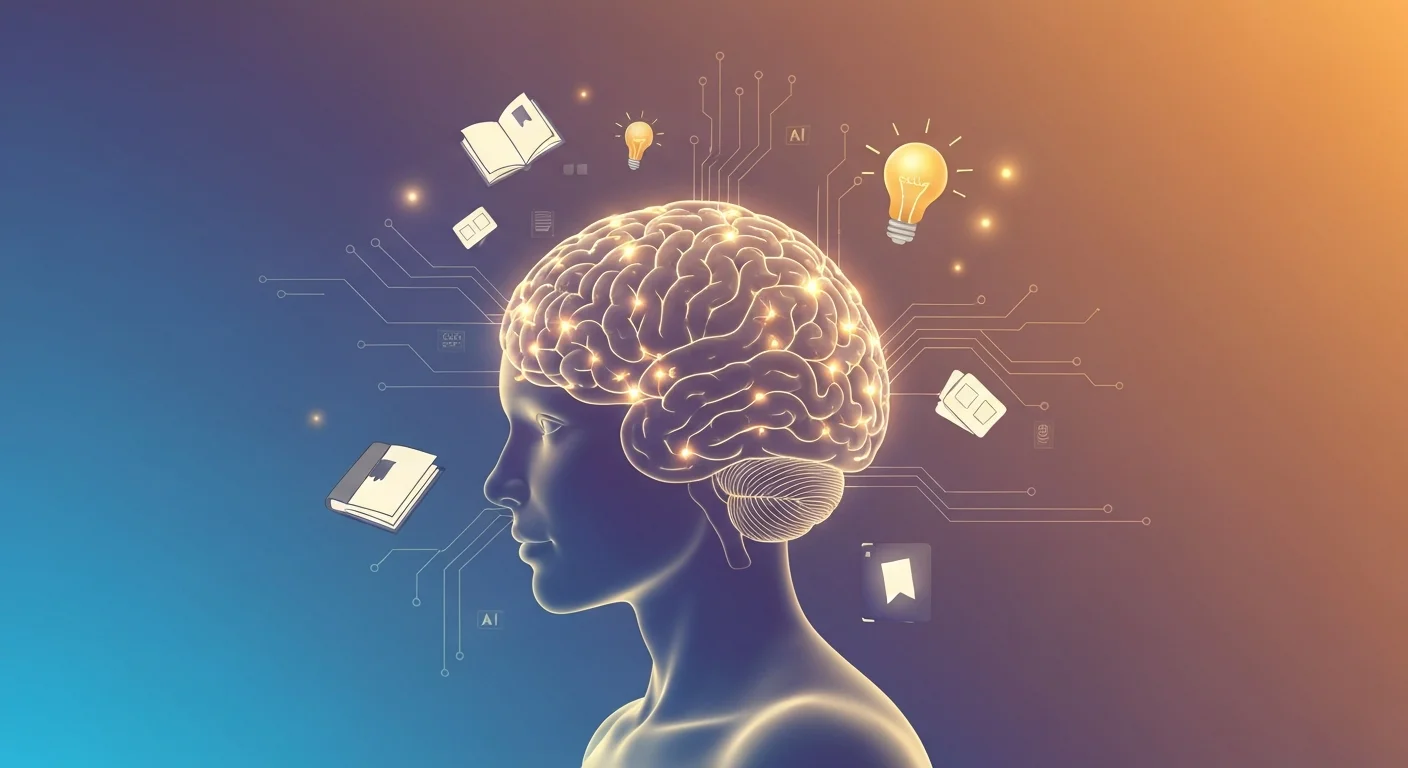
What if the biggest obstacle to learning something new isn't the subject itself — it's how you're trying to learn it?
For decades, cognitive scientists have understood the mechanisms behind effective learning: spaced repetition, active recall, deliberate practice, interleaving, and elaboration. The problem was never knowledge about how to learn. The problem was that applying these techniques consistently required enormous effort, planning, and discipline.
AI has changed that equation entirely.
Today, you can have a personal tutor that never gets tired, a study partner that adapts to your exact knowledge gaps, and a curriculum designer that builds custom learning paths — all available instantly and, in many cases, for free. The combination of proven learning science and AI tools creates something genuinely new: the ability for anyone, anywhere, to learn anything at an accelerated pace.
This guide will show you exactly how to do it. Whether you're a student preparing for exams, a professional switching careers, or simply someone who wants to learn more effectively, the strategies in this guide will transform how you acquire and retain knowledge.
How Your Brain Actually Learns
Before we bring AI into the picture, you need to understand the machinery you're working with. Your brain doesn't learn the way most people think it does.
The Memory Formation Process
Learning happens in three stages:
- Encoding — Your brain takes in new information through your senses and working memory
- Consolidation — During rest and sleep, your brain strengthens neural pathways and moves information from short-term to long-term memory
- Retrieval — You access stored information, and each successful retrieval strengthens the memory further
Most people focus obsessively on stage one. They re-read textbooks, highlight passages, and watch lecture after lecture. But research consistently shows that retrieval practice — actively pulling information out of your brain — is far more effective than passively putting information in.
The Forgetting Curve
In the 1880s, Hermann Ebbinghaus discovered something that still surprises people today: without deliberate review, you forget approximately 70% of new information within 24 hours. After a week, you've lost nearly 90%.
But here's the crucial insight — each time you successfully retrieve a memory at the moment you're about to forget it, the memory becomes significantly stronger and lasts longer. This is the principle behind spaced repetition, and it's one of the most robust findings in all of cognitive science.
Why Most Study Methods Fail
Re-reading notes creates a dangerous illusion of competence. The material feels familiar, so you believe you know it. But recognition is not the same as recall. When the exam comes — or when you need to apply the knowledge in the real world — you discover the gap between "this looks familiar" and "I can actually use this."
The most effective study methods are also the ones that feel the hardest:
- Active recall — Testing yourself instead of re-reading
- Spaced repetition — Reviewing at optimal intervals
- Interleaving — Mixing different topics instead of studying one thing in long blocks
- Elaboration — Explaining concepts in your own words and connecting them to what you already know
- Deliberate practice — Focusing specifically on what you find difficult
These techniques work because they force your brain to work harder during the learning process, which creates stronger, more durable memories. This is sometimes called "desirable difficulty."
Why AI Changes Everything About Learning
Here's what used to be true: even if you knew about these evidence-based learning techniques, implementing them was a significant challenge. Creating good flashcards takes time. Designing practice tests requires expertise. Finding someone who can explain a concept in exactly the way you need to hear it is largely a matter of luck.
AI removes these bottlenecks.
Personalized Tutoring at Scale
The educational researcher Benjamin Bloom found in 1984 that students who received one-on-one tutoring performed two standard deviations better than students in traditional classrooms. This became known as "Bloom's 2 Sigma Problem" — the challenge of providing the massive benefits of personal tutoring to every student.
AI doesn't perfectly solve Bloom's 2 Sigma Problem, but it gets remarkably close. An AI tutor can:
- Adjust explanations based on your current understanding
- Identify knowledge gaps you didn't know you had
- Generate unlimited practice problems at exactly the right difficulty level
- Provide immediate, detailed feedback on your work
- Be available 24/7 without fatigue or frustration
The Feedback Loop Revolution
Learning speed is largely determined by the quality and speed of your feedback loops. In a traditional classroom, you might wait days or weeks for feedback on an assignment. With AI, the feedback loop is measured in seconds.
This doesn't just save time — it fundamentally changes how learning works. When feedback is immediate, you can correct misunderstandings before they become ingrained. You can try multiple approaches and instantly see which ones work. You can iterate rapidly instead of waiting.
What AI Can't Do
It's important to be honest about limitations. AI cannot:
- Replace the motivation and accountability that comes from human relationships
- Guarantee the accuracy of every explanation (AI can be confidently wrong)
- Substitute for hands-on experience in fields that require it
- Provide the social learning that comes from studying with peers
- Give you a recognized credential on its own
The most effective approach combines AI tools with human connection, real-world practice, and structured courses. Think of AI as a powerful amplifier for your learning — not a replacement for the learning itself.
The AI Study Partner
The most immediate way to use AI for learning is as an interactive study partner. This goes far beyond asking AI to "explain X to me."
The Explanation Ladder
When you encounter a concept you don't understand, use what we call the Explanation Ladder technique. Start by asking AI to explain the concept. Then, based on your understanding, ask for adjustments:
- "Explain this like I'm 12 years old"
- "Now explain it more technically — I understood the basic idea"
- "Can you give me a concrete example from everyday life?"
- "How does this connect to [something I already know]?"
- "What's a common misconception about this?"
This iterative approach lets you build understanding layer by layer, at exactly the pace and level that works for you.
Socratic Dialogue
Instead of asking AI to give you answers, ask it to guide you to answers through questions. This is far more effective for deep learning.
Try this prompt: "I want to understand [topic]. Instead of explaining it directly, ask me a series of questions that will guide me to understand it myself. Start with what I already know and build from there. If I get something wrong, don't tell me the right answer — ask me another question that helps me see the error."
This Socratic approach activates retrieval practice and elaboration simultaneously. You're not passively reading an explanation — you're actively constructing understanding.
The Devil's Advocate
Once you think you understand something, ask AI to challenge your understanding:
- "I think I understand X. Try to poke holes in my explanation."
- "What are the strongest counterarguments to this idea?"
- "What would someone who disagrees say, and would they be right?"
This forces you to engage with the material at a deeper level and exposes weaknesses in your understanding that you might not have noticed.
Active Recall with AI
Active recall is the single most powerful study technique supported by research. AI makes it dramatically easier to implement.
AI-Generated Flashcards
After studying a topic, ask AI to generate flashcards that test the key concepts. But don't settle for simple fact-based cards. Ask for:
- Conceptual cards — "Why does X happen?" rather than "What is X?"
- Application cards — "Given this scenario, what would you do and why?"
- Connection cards — "How does X relate to Y?"
- Error-detection cards — "What's wrong with this statement: [intentionally flawed explanation]?"
You can use a prompt like: "I just studied [topic]. Create 20 flashcards that test deep understanding, not just memorization. Include a mix of why questions, application scenarios, and cards that require me to connect different concepts. Format each as Question/Answer."
Practice Problems and Mock Exams
AI excels at generating practice problems at any difficulty level. The key is to be specific about what you need:
- "Give me 10 practice problems on [topic], starting easy and getting progressively harder"
- "Create a mock exam on [subject] that covers [chapters/topics], with the same format as [exam type]"
- "I keep getting confused about [specific concept]. Give me 5 problems that specifically target this weakness"
After you attempt each problem, share your work with AI for detailed feedback. Don't just check if you got the right answer — ask AI to evaluate your reasoning process and identify where your thinking could be stronger.
The Elaborative Interrogation Technique
After learning a new fact or concept, ask yourself "Why?" and "How?" — then verify your answers with AI. For example:
- You learn: "Spaced repetition improves long-term retention"
- You ask yourself: "Why does spacing out reviews help more than massing them together?"
- You formulate your best answer
- You ask AI: "Here's my explanation of why spaced repetition works: [your explanation]. How accurate is this? What am I missing?"
This technique forces you to generate explanations (which strengthens memory) and then provides expert-level feedback on those explanations.
Spaced Repetition Meets AI
Spaced repetition is the practice of reviewing information at gradually increasing intervals. It's mathematically optimized to review material right at the point where you're about to forget it.
How Traditional Spaced Repetition Works
Tools like Anki have used algorithms to schedule reviews for years. The basic idea:
- Review a new card after 1 day
- If you remember it, review again after 3 days
- Then 7 days, then 14 days, then 30 days, and so on
- If you forget, reset to shorter intervals
This is effective, but it has a significant limitation: you have to create all the cards yourself, and the system can only test what's on the cards.
AI-Enhanced Spaced Repetition
AI transforms spaced repetition in several ways:
Dynamic card generation — Instead of static flashcards, ask AI to test you on a topic using different questions each time. This prevents the common problem of memorizing specific card wording rather than truly understanding the concept.
Adaptive difficulty — Tell AI how confident you feel about different subtopics, and ask it to focus your review sessions accordingly. "I'm reviewing [subject]. I feel solid on [topics A and B] but shaky on [topics C and D]. Design a 20-minute review session that spends more time on my weak areas."
Contextual review — AI can test you on material within realistic scenarios rather than in isolation. "Quiz me on organic chemistry reactions, but frame each question as a real-world problem a chemist might encounter."
Building Your AI Review System
Here's a practical framework for combining AI with spaced repetition:
- After each study session — Ask AI to generate a set of review questions based on what you learned
- Save these questions — Use a notes app, document, or flashcard tool
- Day 1 review — Attempt the questions from memory before checking answers with AI
- Day 3 review — Ask AI to generate new questions on the same material (this prevents memorizing specific questions)
- Day 7 review — Ask AI to create questions that integrate this material with previously learned topics
- Day 14+ reviews — Continue with increasingly complex, integrative questions
The key innovation here is that each review uses fresh questions, testing your understanding rather than your ability to memorize specific question-answer pairs.
Learning Technical Skills with AI
Technical skills like programming, mathematics, and science have always been challenging to learn independently because they require hands-on practice with immediate, accurate feedback. AI provides exactly that.
Programming with AI Assistance
When learning to code, AI serves multiple roles:
Code explainer — Paste code you don't understand and ask AI to explain it line by line. Ask follow-up questions until every part makes sense.
Debugging partner — When your code doesn't work, describe the expected vs. actual behavior and share the code. Ask AI to help you find the bug rather than fix it for you. "Don't give me the solution — give me a hint about where to look."
Challenge generator — "I just learned about [loops/recursion/APIs/etc.]. Give me a coding challenge that requires me to use this concept. Start with an easier one, and I'll ask for harder ones as I progress."
Code reviewer — Share your working code and ask AI to review it. "This code works, but I want to improve. What could be better about my approach? Are there more elegant or efficient ways to solve this?"
The crucial rule when learning to code with AI: always try to solve the problem yourself first. Use AI for hints and feedback, not for answers. If you let AI write your code for you, you'll feel productive but you won't actually learn.
Mathematics and Science
For math and science, use AI as a step-by-step guide:
- Attempt the problem yourself and write out your work
- Share your work with AI: "Here's my attempt at solving this problem. Don't tell me the answer, but tell me where my reasoning goes wrong."
- If you're completely stuck: "Give me just the first step of solving this, then let me try the rest."
- After solving it: "Are there other methods I could have used? Which approach is most elegant?"
This progressive hint system keeps you in the productive zone of struggle — challenged enough to learn but not so stuck that you give up.
Learning Languages with AI
Language learning is one of the areas where AI provides the most dramatic improvement over traditional methods.
Conversation Practice
AI can serve as an always-available conversation partner in your target language. But to make this truly effective, set clear parameters:
"Let's have a conversation in [language]. My level is [beginner/intermediate/advanced]. Rules: (1) Use vocabulary appropriate for my level, (2) If I make a grammar mistake, gently correct me and explain why, (3) If I don't know a word, I'll ask in English and you'll teach me, (4) Every few exchanges, introduce one new vocabulary word naturally."
Grammar Through Context
Instead of studying grammar rules in isolation, ask AI to explain grammar as it comes up in conversation. "I noticed you used [grammatical structure]. When do I use this vs. [alternative]? Give me 5 example sentences showing the difference."
Immersive Scenarios
Ask AI to create role-play scenarios that simulate real-life situations:
- Ordering at a restaurant
- Asking for directions
- Having a job interview
- Making small talk at a party
- Negotiating a price at a market
Each scenario forces you to use vocabulary and grammar structures in context, which is far more effective than memorizing word lists.
Pronunciation and Listening
While text-based AI has limitations for pronunciation practice, you can:
- Ask AI to write out phonetic pronunciations of words you're struggling with
- Request tongue twisters and pronunciation exercises for specific sounds
- Use AI voice features (available in ChatGPT, Claude, and Gemini mobile apps) for actual conversation practice with audio
Reading Faster and Deeper with AI
AI can transform how you read and process information, whether you're studying textbooks, research papers, or non-fiction books.
Pre-Reading Strategy
Before diving into a text, give AI the topic and ask:
- "What are the key concepts I should look for when reading about [topic]?"
- "What background knowledge will help me understand [this book/paper]?"
- "Create a list of questions I should be able to answer after reading this."
This activates your brain's filtering mechanisms. When you read with specific questions in mind, you process information more deeply and retain more.
Active Reading with AI
As you read, use AI to deepen your understanding:
- "The author argues [X]. What are the strongest criticisms of this position?"
- "How does [concept from chapter 3] connect to [concept from chapter 1]?"
- "The author uses the term [X]. How does this differ from how other experts use it?"
Post-Reading Synthesis
After finishing a book or article, use AI to consolidate your learning:
- Write a summary from memory (don't look at the text)
- Share it with AI: "I just read [book]. Here's my summary. What important ideas did I miss or misunderstand?"
- Ask AI to help you connect the ideas to other things you've read or experienced
- Generate a set of questions that test your understanding of the key concepts
This approach transforms passive reading into active learning, dramatically improving retention.
The Feynman Technique + AI
The Feynman Technique — named after physicist Richard Feynman — is one of the most effective learning strategies ever developed. The principle is simple: if you can't explain something in plain language, you don't truly understand it.
AI makes this technique significantly more powerful.
How It Works
- Choose a concept you want to understand deeply
- Explain it to AI as if AI knows nothing about the topic. Use simple language. No jargon.
- Ask AI to evaluate your explanation: "Pretend you're a curious 10-year-old. What parts of my explanation don't make sense? Where would you have questions?"
- Identify the gaps in your understanding based on AI's feedback
- Go back to the source material to fill those gaps
- Explain again, incorporating what you learned
- Repeat until your explanation is clear, complete, and accurate
Why AI Makes This Better
Traditionally, the Feynman Technique required a willing listener or an imaginary one. AI provides something better — a listener that can:
- Identify specific inaccuracies in your explanation
- Ask probing follow-up questions that expose hidden gaps
- Suggest analogies you might use to explain tricky parts
- Tell you when your explanation is genuinely good enough
Try this prompt: "I'm going to explain [concept] to you. Your job is to act as a smart but non-expert listener. Ask clarifying questions, point out anything confusing, and tell me if I'm wrong about anything. Be honest — if my explanation is unclear, say so."
Building a Personal Curriculum
One of AI's most underused capabilities is curriculum design. Instead of following generic courses, you can create a personalized learning path optimized for your goals, timeline, and existing knowledge.
The Curriculum Design Process
Start with a detailed prompt:
"I want to learn [subject/skill]. Here's my context:
- Current knowledge: [what you already know]
- Goal: [what you want to be able to do]
- Timeline: [how long you have]
- Available time: [hours per week]
- Learning style: [prefer reading/watching/doing]
- Resources I have access to: [books, courses, tools]
Create a week-by-week learning plan with specific topics, resources, and milestones. Include practice activities for each week."
Weekly Check-Ins
At the end of each week, report back to AI:
"This week I studied [topics]. Here's what I learned: [summary]. I found [X] easy and [Y] challenging. I spent [N] hours. Based on this, should we adjust next week's plan?"
This creates an adaptive curriculum that responds to your actual progress rather than following a rigid schedule.
Finding Free Resources
Ask AI to recommend free, high-quality resources for each topic in your curriculum. Platforms like FreeAcademy.ai offer free courses across technology, programming, and AI that can form the backbone of your learning path. Combine these structured courses with AI-powered study techniques for maximum effectiveness.
Avoiding AI Learning Traps
AI is a powerful learning tool, but it can also make you worse at learning if you use it incorrectly. Here are the most dangerous traps and how to avoid them.
The Illusion of Understanding
Reading an AI-generated explanation and nodding along is not the same as learning. This is the single biggest trap. The explanation feels clear. The concepts seem obvious. But if you close the chat and try to explain it yourself, you'll often find you can't.
The fix: After every AI explanation, close the chat and write a summary from memory. If you can't, you haven't learned it yet.
The Outsourcing Trap
When AI can solve any problem for you instantly, it's tempting to skip the struggle and just ask for the answer. But the struggle is the learning. Every time you skip the productive struggle, you miss the neural pathway strengthening that comes from effortful processing.
The fix: Set a rule — attempt every problem for at least 15 minutes before asking AI for help. When you do ask, request hints rather than solutions.
The Passive Consumption Trap
Generating an endless stream of AI explanations, summaries, and study guides feels productive. You're surrounded by high-quality learning materials! But generating materials is not the same as engaging with them.
The fix: For every hour you spend generating content with AI, spend at least two hours actively engaging with it — testing yourself, solving problems, explaining concepts, and applying knowledge.
The Accuracy Trap
AI can present incorrect information with complete confidence. If you're learning a subject and you can't yet evaluate the accuracy of what AI tells you, you might learn things that are wrong.
The fix: Cross-reference AI explanations with established textbooks, academic sources, or official documentation, especially when learning foundational concepts. Use AI to explain authoritative sources rather than as the sole source of truth.
The Breadth Without Depth Trap
AI makes it easy to learn a little about many things without going deep on anything. You can have fascinating conversations about quantum physics, medieval history, and machine learning all in one afternoon. But shallow knowledge across many domains is less valuable than deep competence in a few.
The fix: Choose your learning priorities deliberately. Use AI to go deeper on fewer topics rather than skimming the surface of many.
Your 30-Day AI Learning Accelerator
Here's a concrete, day-by-day plan to transform how you learn using the techniques in this guide. Choose any subject you want to learn and follow this plan.
Week 1: Foundation (Days 1-7)
Day 1 — Define your learning goal. Use AI to create a personalized curriculum. Identify the 3-5 core concepts you need to master first.
Day 2 — Study the first core concept using traditional resources (textbook, course, video). Take notes.
Day 3 — Use the Feynman Technique: explain what you learned to AI. Identify gaps. Review.
Day 4 — Generate flashcards and practice questions with AI. Test yourself.
Day 5 — Study the second core concept. Use the Explanation Ladder technique with AI to build understanding.
Day 6 — Review Day 2-3 material (spaced repetition). Study the third core concept.
Day 7 — Weekly review: Explain all concepts learned this week to AI. Have AI quiz you. Adjust next week's plan based on progress.
Week 2: Depth (Days 8-14)
Day 8 — Dive deeper into concepts from Week 1. Use Socratic dialogue with AI.
Day 9 — Practice applying concepts. Use AI to generate progressively harder problems.
Day 10 — Review Week 1 concepts (spaced repetition with new questions). Learn connecting concepts.
Day 11 — Use the Devil's Advocate technique. Have AI challenge your understanding.
Day 12 — Apply knowledge to a real project or realistic scenario.
Day 13 — Review and practice. Focus on your weakest areas identified by AI quizzing.
Day 14 — Weekly review and curriculum adjustment. Write a comprehensive summary from memory.
Week 3: Integration (Days 15-21)
Day 15 — Begin connecting different concepts together. Use AI to create integrative practice problems.
Day 16 — Teach what you've learned to someone else (a friend, colleague, or online community). Use AI to prepare your explanation.
Day 17 — Review all previous material with spaced repetition. AI-generated questions only.
Day 18 — Tackle an advanced topic. Use the progressive hint system with AI.
Day 19 — Apply knowledge to a more complex project. Get AI feedback on your work.
Day 20 — Identify remaining knowledge gaps. Use AI to create targeted practice.
Day 21 — Weekly review. Have AI conduct a comprehensive mock assessment.
Week 4: Mastery (Days 22-30)
Day 22 — Focus on your weakest areas. Use AI to generate intensive practice.
Day 23 — Connect your knowledge to adjacent topics. Explore how what you've learned relates to broader themes.
Day 24 — Create something — a project, essay, presentation, or solution — that demonstrates your learning.
Day 25 — Review everything. Use AI to conduct a thorough assessment of your understanding.
Day 26 — Fill in final gaps. Focus on nuance and edge cases.
Day 27 — Practice explaining complex ideas simply. Use the Feynman Technique on the hardest concepts.
Day 28 — Full comprehensive review with AI-generated exam.
Day 29 — Reflect on your learning journey. What worked? What didn't? Document your personalized learning system.
Day 30 — Plan your next learning goal. Use AI to design your next curriculum based on what you've learned about how you learn best.
Making This a Lifelong Practice
The techniques in this guide aren't just for a single 30-day sprint. They're a system for learning anything, for the rest of your life. The combination of evidence-based learning science and AI tools gives you an unprecedented advantage.
Here are the core principles to carry forward:
- Always test yourself — Active recall beats passive review every time
- Space your practice — Review at increasing intervals, not in marathon sessions
- Embrace productive struggle — Use AI for feedback and hints, not answers
- Explain to learn — The Feynman Technique works for every subject
- Stay honest about what you know — AI can help you identify gaps you're hiding from yourself
- Adapt constantly — Use AI to adjust your learning approach based on results
The best time to start learning how to learn was years ago. The second best time is today. Pick a subject you've been wanting to learn, open your favorite AI tool, and begin.
Your brain is capable of far more than you think. With the right techniques and AI as your learning partner, there's genuinely no limit to what you can master.
Ready to put these techniques into practice? Explore free courses on FreeAcademy.ai and start learning with AI-enhanced strategies today. Two great starting points: AI Essentials: Understanding AI in 2026 for a strong foundation, and the Interactive Prompt Engineering Practice course to sharpen the prompting skills that make AI a better learning partner.
Love reading? Apply these learning techniques to books with our free books library — hundreds of books to choose from. Our guide on How to Read More Effectively pairs well with the strategies in this article.
Enjoyed this article?
Join The FreeAcademy Weekly
One practical AI email every Tuesday. New free courses, AI tips, and a short note from the founder.
Free forever. Unsubscribe anytime.
Related articles
50 ChatGPT Prompts for Students: Homework, Essays, Studying & Research
Copy-paste these 50 ChatGPT prompts designed for students. Get help with homework, essay writing, studying for exams, and research projects. Organized by category for easy use.

Coursera Alternatives: 12 Free Platforms Better in 2026
Explore 12 free Coursera alternatives that deliver better courses, real projects, and recognized certificates without the paywall in 2026.

10 Best Coursera Alternatives in 2026: Free & Open Platforms
Discover the 10 best Coursera alternatives in 2026. Compare free and open online learning platforms for AI, programming, and tech skills with real certificates.
