How to Use AI to Prepare for a Job Interview

Most job seekers spend hours Googling "common interview questions" and rehearsing generic answers in front of a mirror. It works, sort of. But there's a better way.
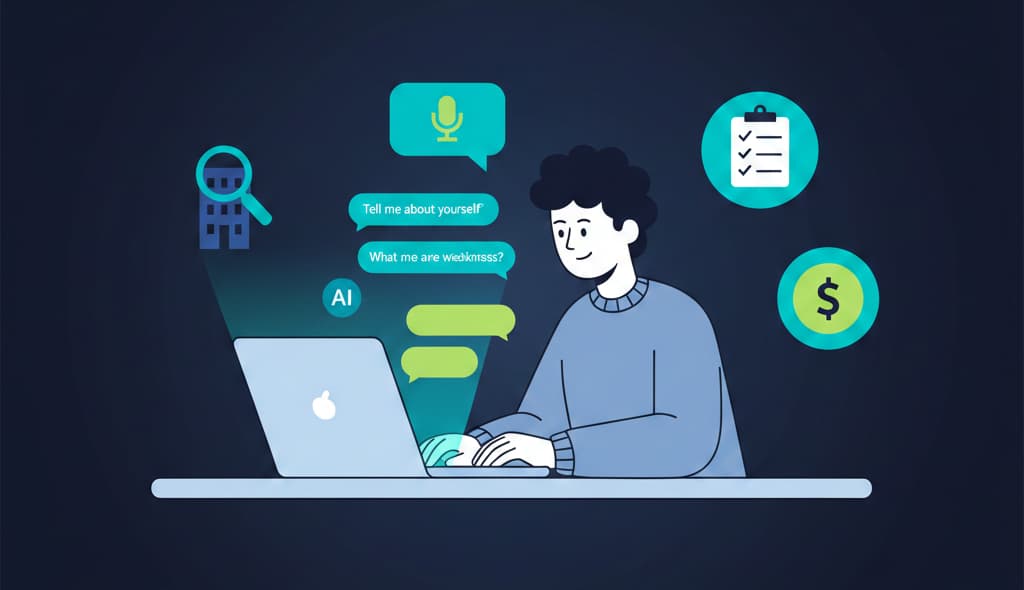
AI tools like ChatGPT, Claude, and Gemini can act as your personal interview coach—researching companies, generating role-specific questions, helping you craft compelling answers, and even running full mock interviews. The candidates who use AI to prepare aren't just more confident. They're measurably better prepared.
This guide walks you through exactly how to use AI at every stage of interview preparation, complete with prompts you can copy and customize.
Step 1: Research the Company Like an Insider
Walking into an interview without deep company knowledge is like taking an exam without reading the textbook. AI can compress hours of research into minutes.
What to research
Before your interview, you need to understand the company's mission, recent news, products, competitors, culture, and challenges. Interviewers notice when candidates have done their homework—and when they haven't.
Example prompts
Company overview:
I have an interview at [Company Name] for a [Job Title] position. Give me a
comprehensive briefing that covers:
- What the company does and their main products/services
- Their mission and core values
- Recent news or announcements from the past 6 months
- Their main competitors and market position
- Company culture based on publicly available information
- Any recent challenges or opportunities they're facing
Industry context:
What are the biggest trends and challenges in the [industry] sector right now?
I want to sound informed when discussing where [Company Name] fits in the
market during my interview.
Role-specific research:
Based on this job description, what are the top priorities for someone in this
role at [Company Name]? What problems is this hire likely expected to solve?

[Paste the job description]
Pro tip
Paste the actual job description into AI. It will extract specific skills, technologies, and priorities that generic research would miss. This gives you a roadmap of exactly what the interviewer cares about.
Step 2: Generate Likely Interview Questions
Generic interview prep covers generic questions. AI can generate questions specific to your role, industry, and experience level—the questions you'll actually face.
Types of questions to prepare for
- Behavioral questions ("Tell me about a time when...")
- Technical questions (role-specific knowledge)
- Situational questions ("What would you do if...")
- Culture-fit questions (values alignment)
- Curveball questions (creative thinking)
Example prompts
Role-specific questions:
I'm interviewing for a [Job Title] position at [Company Name]. Based on this
job description, generate 15 likely interview questions. Include a mix of
behavioral, technical, and situational questions. Prioritize the questions
most likely to be asked based on the key requirements listed.

[Paste the job description]
Experience-level calibration:
I have [X years] of experience in [field]. I'm interviewing for a
[junior/mid/senior] [Job Title] role. What questions should I expect that
are specific to my experience level? What might the interviewer be testing
for at this career stage?
The hard questions:
What are the toughest interview questions for a [Job Title] position?
Include questions that candidates typically struggle with and explain why
interviewers ask each one.
Once you have a list of likely questions, you're ready for the most important step: crafting strong answers.
Step 3: Practice STAR Method Answers
The STAR method (Situation, Task, Action, Result) is the gold standard for answering behavioral interview questions. AI is remarkably good at helping you structure your real experiences into compelling STAR stories.
How to use AI for STAR answers
Don't ask AI to make up answers for you. Instead, give it your real experience and let it help you structure and refine your response.
Example prompts
Building a STAR answer:
Help me create a STAR method answer for this interview question:
"Tell me about a time you had to deal with a difficult team member."

Here's what actually happened:
- I was working on [project] with a colleague who kept missing deadlines
- It was affecting the whole team's delivery
- I [describe what you did]
- The outcome was [describe the result]

Structure this into a clear, concise STAR answer that takes about 90 seconds
to deliver. Make it sound natural, not rehearsed.
Refining weak answers:
Here's my current answer to the interview question "[question]":

[Paste your draft answer]

Improve this answer by:
1. Making the Situation more concise (2-3 sentences max)
2. Clarifying my specific Actions (not what the team did, what I did)
3. Quantifying the Results wherever possible
4. Keeping the total response under 2 minutes when spoken aloud
Building a STAR story bank:
I'm preparing for a [Job Title] interview. Here are 5 key experiences from
my career:

1. [Brief description of achievement/challenge]
2. [Brief description of achievement/challenge]
3. [Brief description of achievement/challenge]
4. [Brief description of achievement/challenge]
5. [Brief description of achievement/challenge]

For each experience, tell me which common interview questions it could
answer. Then help me structure each one as a STAR response.
Pro tip
Prepare 5-7 STAR stories that cover different competencies: leadership, conflict resolution, problem-solving, failure/learning, teamwork, and going above and beyond. A well-prepared story bank lets you adapt to unexpected questions by pulling from experiences you've already practiced.
Step 4: Run Mock Interviews with AI
Reading answers off a screen and saying them out loud are completely different experiences. AI can simulate a realistic interview so you can practice delivery, handle follow-up questions, and build confidence.
Example prompts
Full mock interview:
Act as a hiring manager interviewing me for a [Job Title] position at
[Company Name]. Here's the job description:

[Paste the job description]

Conduct a realistic 30-minute interview. Ask one question at a time, wait
for my response, then give brief feedback before moving to the next question.
Start with an icebreaker, move through behavioral and technical questions,
and end by asking if I have questions.

After the interview, give me an overall assessment with specific areas
to improve.
Pressure testing:
I just gave you this answer to an interview question:

[Paste your answer]

Now act as a tough interviewer. Ask 3 follow-up questions that probe for
more detail, challenge my assumptions, or dig deeper into the results.
This will help me prepare for rigorous interviewers.
Body language and delivery coaching:
Review this interview answer for delivery issues:

[Paste your answer]

Flag any sections that:
- Are too long (over 2 minutes spoken)
- Use jargon the interviewer might not understand
- Sound rehearsed or robotic
- Lack specific details or metrics
- Could be misinterpreted

Suggest improvements for each issue.
Making mock interviews more effective
- Speak your answers out loud rather than typing them. Then transcribe or summarize what you said and paste it into AI for feedback.
- Record yourself answering and listen back. AI can't see your body language, but you can.
- Do multiple rounds. Your first mock interview will be rough. Your third will be significantly better.
Step 5: Prepare Smart Questions to Ask
"Do you have any questions for us?" is not the end of the interview—it's your last chance to make an impression. Weak questions signal disinterest. Strong questions signal strategic thinking.
Example prompts
Generate thoughtful questions:
I'm interviewing for a [Job Title] at [Company Name]. Based on the job
description and what I know about the company, suggest 10 thoughtful
questions I could ask the interviewer. Avoid generic questions like
"What's the culture like?" Focus on questions that:

- Show I've researched the company
- Demonstrate strategic thinking about the role
- Help me evaluate if this is the right fit for me
- Would impress a hiring manager

[Paste the job description]
Stage-appropriate questions:
I'm in the [first/second/final] round of interviews at [Company Name].
The interviewer is [their role, e.g., "the VP of Engineering"].
What questions are appropriate for this stage and this person's level?
I don't want to ask HR-level questions to a senior executive or
strategic questions to a peer interviewer.
Questions to always have ready
AI can help you prepare these essential categories:
- About the role: "What does success look like in the first 90 days?"
- About the team: "How does this team collaborate with [related department]?"
- About growth: "What career paths have people in this role typically followed?"
- About challenges: "What's the biggest challenge facing this team right now?"
Step 6: Prepare for Salary Negotiation
Most candidates leave money on the table because they don't prepare for the salary conversation. AI can help you research market rates, practice negotiation scripts, and anticipate counterarguments.
Example prompts
Market research:
What is the typical salary range for a [Job Title] with [X years] of
experience in [City/Region]? Consider:
- Base salary range (25th, 50th, 75th percentile)
- Common benefits and perks
- Equity/stock options if applicable
- How company size affects compensation
- Any recent trends in compensation for this role
Negotiation script:
Help me prepare a salary negotiation script. Here's my situation:
- Position: [Job Title] at [Company Name]
- They offered: [amount]
- My target: [amount]
- My leverage: [relevant experience, competing offers, unique skills]

Write a professional, confident response that:
1. Expresses enthusiasm for the role
2. Presents my counteroffer with clear justification
3. Remains collaborative, not adversarial
4. Includes a fallback position if they can't meet the number
Handling tough negotiation scenarios:
How should I respond if the interviewer asks these salary-related questions:
1. "What are your salary expectations?"
2. "What's your current salary?"
3. "This is our final offer—take it or leave it."
4. "We can't go higher on base, but we can offer [alternative]."

Give me professional responses for each that protect my negotiating position.
Bonus: AI Interview Prep Checklist
Use this prompt the night before your interview to make sure you haven't missed anything:
I have an interview tomorrow for [Job Title] at [Company Name]. Run through
a final preparation checklist:

1. Key company facts I should mention naturally in conversation
2. The 3 most important qualities they're looking for (based on job description)
3. My top 3 STAR stories that match those qualities
4. 3 questions I should ask
5. Salary range I should target
6. Potential red flags or tough questions to watch for
7. A 60-second "tell me about yourself" summary

[Paste the job description]
What AI Can't Do for You
AI is a powerful preparation tool, but it has limits. Keep these in mind:
- Don't memorize AI-generated scripts word for word. Interviewers can tell when someone is reciting. Use AI to structure your thinking, then deliver answers in your own voice.
- Don't fabricate experiences. AI should help you present your real achievements more effectively, not invent fake ones. Follow-up questions will expose any fiction.
- Don't skip the human element. Practice with a real person at least once before your interview. AI can simulate questions, but it can't replicate the pressure of eye contact and real-time judgment.
- Don't rely on outdated information. AI training data has cutoff dates. Cross-check any company facts against the company's current website and recent news.
From Preparation to Confidence
The difference between a nervous candidate and a confident one usually isn't talent or experience—it's preparation. AI doesn't make you a better candidate. It makes you a better-prepared one.
Start with company research, generate role-specific questions, build your STAR story bank, run mock interviews, and prepare your questions and salary position. Each step builds on the last, and AI makes every step faster and more thorough than doing it manually.
The candidates who use AI to prepare aren't cheating. They're using every available tool to present their best selves. That's exactly the kind of resourcefulness employers want to see.
Frequently Asked Questions
Is it ethical to use AI to prepare for a job interview?
Absolutely. Using AI for interview preparation is no different from reading a book about interviewing, working with a career coach, or Googling common interview questions. You're preparing your own authentic answers—AI just helps you do it more efficiently. The answers and experiences are still genuinely yours.
Which AI tool is best for interview preparation?
ChatGPT, Claude, and Gemini all work well for interview prep. Claude tends to give more nuanced, thoughtful responses for behavioral questions. ChatGPT is great for quick question generation and mock interviews. Gemini can pull in recent web information about companies. Try a couple and use whichever feels most helpful for your preparation style.
How far in advance should I start preparing with AI?
Start at least 3-5 days before your interview. Day one: company research and question generation. Day two: build your STAR story bank. Day three: first mock interview. Days four and five: refine weak areas and do additional mock rounds. Last-minute cramming is less effective than spaced practice over several days.
Can AI help me prepare for technical interviews?
Yes. AI can generate coding problems, system design questions, and technical scenarios specific to your role. For programming interviews, AI can also review your solutions and suggest optimizations. However, for coding challenges, make sure you can solve problems independently—AI should train you, not answer for you during the actual interview.
Should I mention that I used AI to prepare?
There's no need to volunteer it, but don't lie if asked. Many interviewers now expect candidates to leverage AI tools. If it comes up naturally, you can frame it positively: "I used AI to research your company and practice my responses, which helped me prepare more thoroughly." This actually demonstrates the kind of AI fluency many employers value.
How do I avoid sounding scripted in the actual interview?
Use AI to structure your answers, then practice delivering them in your own words—not by reading them. Record yourself speaking the answers aloud and refine until they sound natural. The goal is to internalize the structure (STAR format, key talking points) while keeping the delivery conversational. If you can explain your answer differently each time while hitting the same key points, you're ready.
Ready to Build Your AI Skills?
Interview preparation is just one way AI can accelerate your career. To develop the prompt engineering skills that make every AI interaction more effective, explore our Prompt Engineering Practice course. For a broader understanding of AI tools and capabilities, start with AI Essentials.
The professionals who master AI don't just ace interviews—they outperform in the roles they land.
Explore all our AI courses and start building skills that compound throughout your career.
Enjoyed this article?
Join The FreeAcademy Weekly
One practical AI email every Tuesday. New free courses, AI tips, and a short note from the founder.
Free forever. Unsubscribe anytime.
Related articles
50 ChatGPT Prompts for Job Seekers: Resume, Cover Letter & Interview Prep
Land your dream job with these 50 ChatGPT prompts for job seekers. Get help writing resumes, crafting cover letters, preparing for interviews, and optimizing your LinkedIn profile.
AI Automation Jobs in 2026: Are They Real, and What Do They Pay?
A clear look at AI automation jobs in 2026: which roles hire, what automation specialists actually do, honest salary ranges, and the fastest way in.
How to Use AI to Write a Cover Letter That Gets Interviews
Learn how to use AI to write a personalized cover letter that stands out. Step-by-step prompts, before/after examples, and tips to avoid common mistakes.