

Economics & Finance Trends Shaping 2025–2026: From Trade Wars to AI Automation (Updated for 2026)

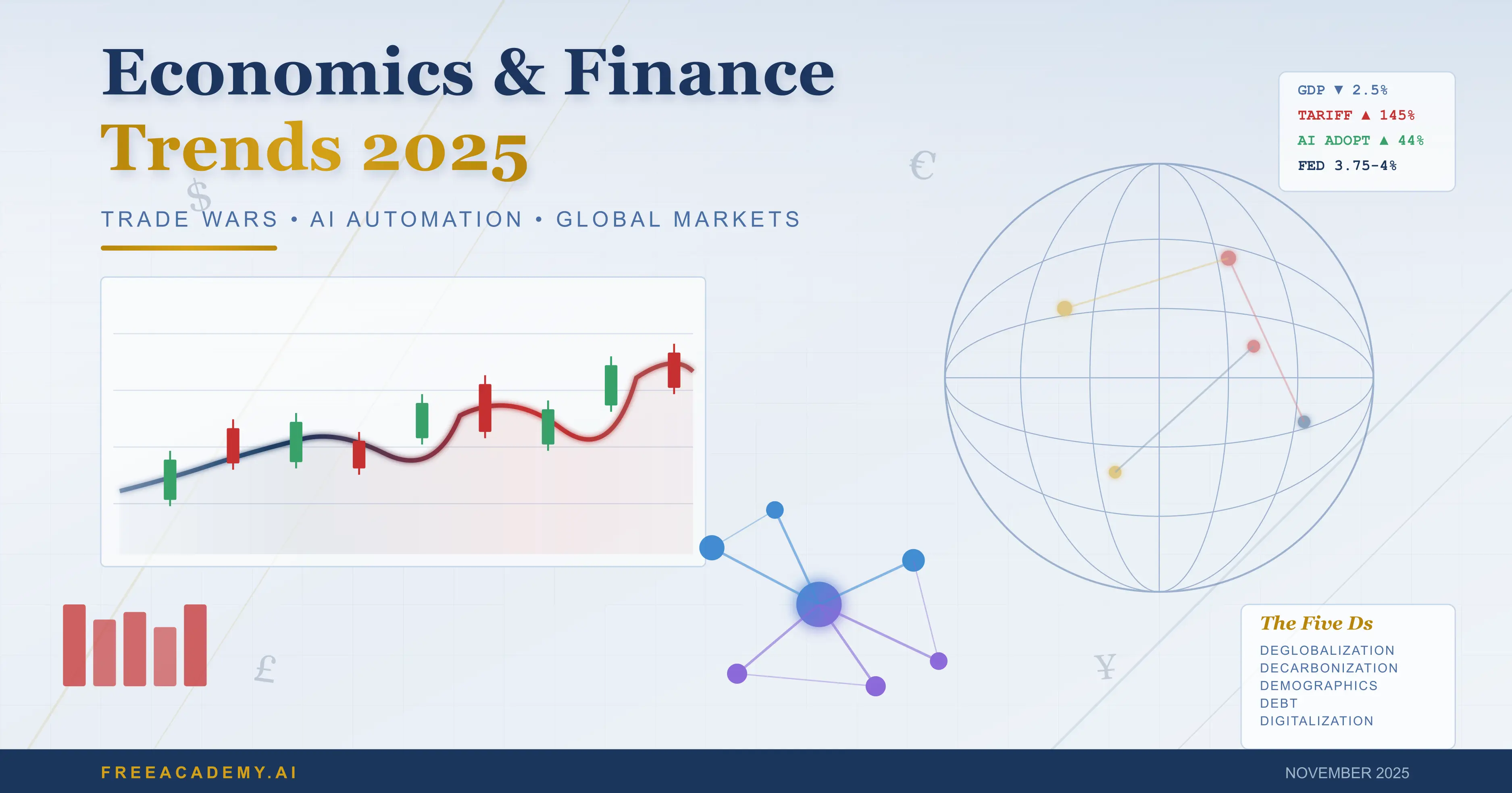
Economics & Finance Trends Shaping 2025
The global economy in 2025 stands at a critical juncture. After years of pandemic recovery, supply chain restructuring, and monetary policy adjustments, we're now witnessing a fundamental reshaping of international trade, technological adoption, and financial operations. This article examines the five most significant trends defining economics and finance today—and what they mean for your financial decisions.
The 2025 Trade War: A Century-High Tariff Environment
Perhaps no single factor is reshaping the global economy more dramatically than the escalating trade tensions that began in early 2025. The United States has implemented sweeping tariff increases targeting major trading partners including Canada, China, and Mexico, driving average effective US tariff rates to levels not seen since the early 20th century.
Key Economic Impacts
According to research from the Federal Reserve Bank of San Francisco and NBER, the trade war is projected to reduce US real income by approximately 1% by 2028. The effects are unevenly distributed across states—those with higher trade exposure, such as South Carolina, Texas, and California, face steeper declines of more than 3%, while states with domestically-oriented economies perform relatively better.
The World Bank's Global Economic Prospects report paints a sobering picture: global growth in 2025 is expected to be the weakest in 17 years outside of outright recessions. By decade's end, global GDP growth is projected to average just 2.5%—the slowest pace since the 1960s.
Key takeaways:
- US inflation increased by approximately 2-3% in the short run due to tariff pass-through
- Manufacturing employment may see temporary gains, offset by losses in services and agriculture
- Close US trading partners—Canada (-2%), Mexico (-2.7%), Ireland (-3%)—face steeper losses than China (-0.5%)
- Global value chains are being fundamentally restructured, creating a less efficient but more geographically diverse trade system
Federal Reserve Policy: Navigating Inflation and Employment
The Federal Reserve continues its delicate balancing act between its dual mandate of price stability and maximum employment. After cutting rates twice in 2025—most recently in October to a target range of 3.75%-4%—the central bank now faces uncertainty about its December meeting.
Fed Chair Jerome Powell has explicitly stated that a December rate cut is "far from" certain, noting "strongly differing views" among FOMC members. Core PCE inflation remains at 2.9%, above the Fed's 2% target, while the labor market shows mixed signals—September saw solid job gains of 119,000, but the unemployment rate ticked up to 4.4%.
Market expectations have shifted dramatically: the probability of a December rate cut has fallen from 97% in mid-October to approximately 22-32% as of late November. The Fed has also concluded its quantitative tightening program as of December 1, ending the reduction of its $6.6 trillion balance sheet.
The "Five Ds" Transforming Global Finance
The World Economic Forum has identified five fundamental forces—the "Five Ds"—establishing a multi-dimensional decision space for policymakers and investors:
1. Deglobalization
Trade fragmentation is accelerating as geopolitical rivalries and supply chain vulnerabilities fuel economic nationalism. The number of trade restrictions imposed annually worldwide has increased from approximately 1,000 in 2019 to over 3,000 in 2023, with 2025 seeing even more dramatic escalation. Research from the IMF and BIS demonstrates that open economies experience lower inflation rates, suggesting deglobalization will meaningfully increase inflationary pressures.
2. Decarbonization
The transition to sustainable energy continues to reshape capital allocation and corporate strategy, with climate risk models becoming standard practice in financial analysis.
3. Demographics
The IMF's World Economic Outlook highlights the rise of the "silver economy." While population aging poses challenges such as slower growth and increased fiscal pressures, healthier aging trends offer opportunities by boosting labor force participation among older individuals and extending working lives.
4. Debt
Global debt has reached a record $307 trillion, largely driven by developed countries. In the US, debt servicing costs now exceed the defense budget—a trend likely to worsen as higher interest rates persist. Elevated debt limits governments' capacity to invest in infrastructure, education, and research.
5. Digitalization
AI and automation are fundamentally changing how financial operations are conducted, creating both displacement risks and new opportunities—which brings us to our next major trend.
AI Automation: The Finance Function's Transformation
Artificial intelligence has moved from experimental technology to core operational driver in finance. According to a McKinsey survey of 102 CFOs, 44% now use generative AI for more than five use cases in 2025, up from just 7% in the previous year. Investment continues to accelerate, with 65% of respondents planning to increase AI spending.
Productivity Gains
An MIT/Stanford study from August 2025 found that AI cuts monthly financial close time by 7.5 days for accounting firms using the technology. AI-using accountants support 55% more clients per week compared to non-users. Some companies report reducing invoice processing time from hours to minutes, with error rates dropping by up to 90%.
Key Applications
- Payment Automation: 63% of CFOs say AI has made payment automation significantly easier—a 23% increase from 2024
- Fraud Detection: Advanced ML algorithms analyze vast datasets in real time, reducing false positives and enabling faster investigations
- Compliance Automation: AI streamlines KYC, AML processes, and regulatory reporting while reducing penalties
- Predictive Analytics: AI-driven models analyze historical data, real-time metrics, and external trends for customized, actionable forecasts
- Agentic AI: Emerging systems that independently pursue goals and orchestrate complex workflows like accounting close processes — Cynked covers this shift in detail in How Agentic AI Is Replacing Enterprise Automation in 2026
Despite the enthusiasm—85% of CFOs express optimism about AI's efficiency potential—an implementation gap remains. According to CFO Connect's State of AI in Finance 2025 report, 61% of finance teams have yet to implement AI into their workflows, presenting both a challenge and an opportunity for early adopters. If you want to get ahead of this curve, our AI for Finance & Accounting course covers the practical skills finance professionals need to start using AI effectively.
The AI-Labor Market Intersection
The impact of AI on employment is becoming more visible. According to Challenger & Grey's September 2025 survey, 7,000 US jobs were cut due to AI implementation in that month alone—out of 54,064 total job eliminations. For the first nine months of 2025, 17,375 jobs were cut due to AI, representing a sharp acceleration from previous periods.
However, perspectives vary. A Yale Budget Lab study found that "the broader labor market has not experienced a discernible disruption since ChatGPT's release 33 months ago," though it acknowledges AI will likely have a significant impact over time. The Deloitte Global Weekly Economic Update notes that finance professionals are evolving into more strategic roles, with 87% reporting an expanded scope of work including data analytics, fintech integration, and strategic advisory responsibilities.
Regional Economic Outlook
Asia-Pacific
China faces notable challenges: fixed-asset investment in the first 10 months of 2025 declined 1.7% year-over-year, with property investment down 14.7%. The government is expected to provide additional rate cuts and adopt expansionary fiscal policy to generate short-term demand. South Asia remains the fastest-growing EMDE region, though growth is expected to moderate to 5.8% in 2025.
Europe
European economies are expected to see positive growth in the 0.5%-2% range, with increased fiscal stimulus and ECB rate cuts helping offset tariff disruption. Germany's historic decision to loosen its constitutional debt brake represents a once-in-a-generation shift in fiscal policy that could boost the wider European economy.
Latin America
Growth is projected to remain steady at 2.3% in 2025 and firm to 2.5% by 2026-27. Mexico faces the most direct impact from US trade barriers given its tight integration with the US economy, though the entire region will be indirectly affected through trade, investment, and financial links.
Key Takeaways for Investors and Business Leaders
-
Prepare for prolonged uncertainty: Trade policy volatility is the new normal. Diversify supply chains and consider geographic risk in investment decisions.
-
Monitor Fed policy carefully: With inflation sticky at 3% and the labor market sending mixed signals, monetary policy remains data-dependent. Don't assume a preset course for rate cuts.
-
Embrace AI strategically: The productivity gains are real, but implementation requires thoughtful planning. Focus on high-value applications like predictive analytics and workflow automation.
-
Consider demographic tailwinds: The silver economy presents opportunities in healthcare, financial services, and consumer goods targeted at older populations.
-
Watch regional divergence: Europe's fiscal expansion, Asia's structural challenges, and Latin America's trade exposure create distinct investment environments.
As the World Bank's Chief Economist Indermit Gill noted, the time has come for a reset—one involving renewed global cooperation, restored fiscal responsibility, and a relentless focus on creating jobs. For investors and business leaders, navigating this environment requires both adaptability and a clear-eyed assessment of the forces reshaping our economic landscape.
Want to dive deeper into these topics? Explore FreeAcademy's courses on Corporate Finance, AI for Finance & Accounting, Sustainable Economics, and Personal Finance to build the skills you need to navigate today's complex economic landscape.
Enjoyed this article?
Join The FreeAcademy Weekly
One practical AI email every Tuesday. New free courses, AI tips, and a short note from the founder.
Free forever. Unsubscribe anytime.
Related articles
Sustainable Economics: Why It Matters for Our Future
Explore how sustainable economics is reshaping business, policy, and society. Learn why economic sustainability is crucial for long-term prosperity and environmental health.

30 AI Prompts for Stock Market and Investment Research
30 AI prompts for stock market and investment research: analyze earnings, filings, and news faster. Research prompts only, not financial advice.

AI Regulation and Compliance for Finance and Accounting: A Practical Playbook
A step-by-step compliance playbook for finance and accounting pros using AI: SOX, GLBA, GDPR, MiFID II, the EU AI Act, plus what you can safely paste.